Outstanding tech performers in Vietnam's digital ecosystem honoured

After four editions of the Top Industry 4.0, this year, the programme was officially renamed “Vietnam I4 Impact Awards”, which is not just a change in name but a shift in development thinking and core values.

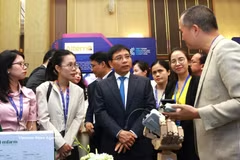
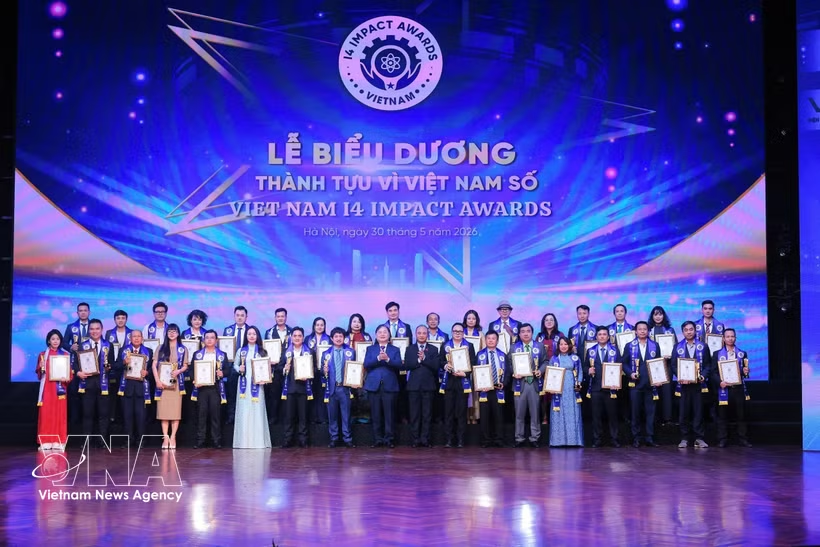
Winners of the Vietnam I4 Impact Awards 2026 at the ceremony in Hanoi on May 30 (Photo: VNA)

Hanoi (VNA) – A ceremony was held in Hanoi on May 30 to present the Vietnam I4 Impact Awards 2026, commending achievements in contributing to Vietnam's digital transformation.

The event was held by the Vietnam Union of Science and Technology Associations (VUSTA) in coordination with the Vietnam Institute of Digital Transformation and Innovation, the National Authority of Digital Transformation under the Ministry of Science and Technology, the Vietnam Automation Association, and the Bao Sang Development JSC.

VUSTA President Dr. Phan Xuan Dung said that the Vietnam I4 Impact Awards aim to seek, honour, and popularise models, initiatives, solutions, and individuals who are creating practical impacts on the economy, society, and future development of the country.

He described the programme as a practical move in response the Politburo’s Resolution No. 57-NQ/TW, dated December 22, 2024, on breakthroughs in science – technology development, innovation, and national digital transformation.

After four editions of the Top Industry 4.0, this year, the programme was officially renamed “Vietnam I4 Impact Awards”, Dung said, noting that this is not just a change in name but a shift in development thinking and core values.

Today’s "I4" is not just "Technology 4.0" but also "Technology – Innovation – Intelligence – Impact", which are also the central critera throughout the Vietnam I4 Impact Awards, he elaborated, adding that through this programme, VUSTA hopes to build a platform connecting the State, businesses, research institutes, universities, scientists, and investors to promote innovation, technology transfer, and the formation of new value chains for Vietnam in the future.

In 2026, the programme attracted nearly 300 entries from more than 200 organisations, businesses, and localities. After two rounds of selection, the jury selected 140 applications from 97 outstanding entrants for commendation.

Many of the solutions have supported smart healthcare management, green economy development, AI and big data application, as well as digital transformation in management, production, business, and cultural value preservation, according to the organising committee.

Specifically, 66 collectives were honoured in the category of digital industry and infrastructure; 40 collectives in human impact and sustainability; five collectives in culture, heritage and global collaboration; 24 collectives and individuals in governance and leadership; and seven collectives and individuals in the Rong Xanh (Blue Dragon) Awards.

Organisers affirmed that the honourees not only possess outstanding technological capabilities but also demonstrate strategic vision and the ability to connect with the innovation ecosystem and promote green growth. They form a crucial part of the core force in realising the Party and State’s major policies on science and technology development./.

VNA

See more

Tra Vinh University attracts a growing number of students and interns from Vietnam and abroad for study and research programmes. (Photo: VNA)

Fostering skilled workforce for innovation era: experts

Experts said close coordination among State management agencies, research institutes, universities, and businesses will improve training quality and serve the dual goals of quality education and practical research application.

Manufacturing cameras at the Sunny Opotech Vietnam Co., Ltd. in the Yen Binh Industrial Park, Thai Nguyen province. (Illustrative photo: VNA)

OV intellectuals pin hopes on stronger Vietnam – Singapore technology ties

OVs hope the two countries can establish an interconnected cooperation mechanism in the technology supply chain, from sharing research, testing, and development infrastructure to training human resources, thereby forming a technology alliance able to compete with others in the ASEAN region and the world.

Deputy Prime Minister Nguyen Van Thang talks with technology enterprises on the sidelines of the event. (Photo: VNA)

Vietnam launches first national AI-native hackathon

Part of the Vietnam Innovation Challenge 2026, the programme goes beyond conventional coding competitions by requiring participants to develop AI-driven solutions to business challenges in real time.

Ho Chi Minh City: Rising hub for science, technology, innovation

Ho Chi Minh City: Rising hub for science, technology, innovation

Ho Chi Minh City currently hosts 143 science and technology enterprises, accounting for around 20% of the national total. Total factor productivity (TFP) contributes 59% to the city’s GRDP growth, with science and technology responsible for 74% of TFP growth.

A view of the talks in Bangkok on May 28. (Photo: VNA)

Vietnam, Thailand step up cooperation in science, technology, innovation

Over recent years, NSTDA has built strong partnerships with Vietnamese research institutes and organisations in agriculture, biotechnology, energy and sustainable development. Notable examples include joint projects on cassava value chains, salt-tolerant rice, biotechnology products and an initiative on green energy cooperation and development in the Mekong basin.

Targeting full integration of all individual and organisational documents on VNeID by 2028 in accordance with regulations on electronic identification and authentication. (Photo: VNA)

VNeID set to become Vietnam’s all-in-one digital super app

The project aims to transform VNeID into a modern, secure and highly scalable national digital platform capable of effectively serving citizens, businesses, agencies and organisations in handling administrative procedures, accessing online public services, conducting electronic transactions and using digital utilities.

Thai Binh Seed Group Joint Stock Company has applied science and technology in research and production to develop numerous high-yield, high-quality crop varieties. (Photo: VNA)

Localities aim for higher growth through science, technology

Experiences from localities nationwide show that Resolution 57 is fostering a marked transformation in development mindset. Science and technology, innovation and digital transformation are increasingly becoming foundational drivers of economic growth and opening new development space for localities in the years ahead.

Lieutenant Colonel Nguyen Dinh Do Thi of the Department of Cybersecurity and High-Tech Crime Prevention under the Ministry of Public Security speaks at a discussion session. (Photo: VNA)

Experts recommend ‘five don’ts’ to protect personal data

Vietnamese authorities handled more than 30 cases involving the illegal sale and theft of personal data between 2023 and 2025, affecting over 160 million data records across sectors including health, education, finance, banking and telecommunications.

Major General Nguyen Tung Hung, deputy commander of the Cyber Warfare Command under the Ministry of National Defence, addresses the event (Photo: VNA)

Protecting digital future in post-quantum, AI era

Participants highlighted the importance of building a proactive, synchronised and sustainable national cybersecurity ecosystem through closer cooperation among regulators, technology firms, research institutions and cybersecurity experts.

An engineer from the Digital Transformation Centre under the Khanh Hoa provincial Department of Science and Technology carry out equipment maintenance work. (Photo: VNA)

Vietnam pushes ahead with AI-powered legal infrastructure

Research by the Ministry of Justice (MoJ) shows that AI adoption in the legal sector remains constrained by fragmented, unstandardised and weakly connected legal databases. A unified national legal data ecosystem has yet to be established, while big data and AI applications are still largely confined to pilot programmes and have not been integrated across the full legislative process, including drafting, appraisal, review and inspection of legal documents.