Hanoi (VNA) – To date, 82 credit institutions have recorded outstanding green credit loans totalling 828 trillion VND (approximately 31.8 billion USD), with an average annual growth rate of more than 20% during the 2017–2025 period. The result reflects the banking sector’s coordinated efforts to promote green growth, circular economy and sustainable development.
The information was provided by Deputy Governor of the State Bank of Vietnam (SBV) Nguyen Ngoc Canh at a workshop on credit solutions to promote green economy, circular economy and Environmental, Social and Governance (ESG) standards.
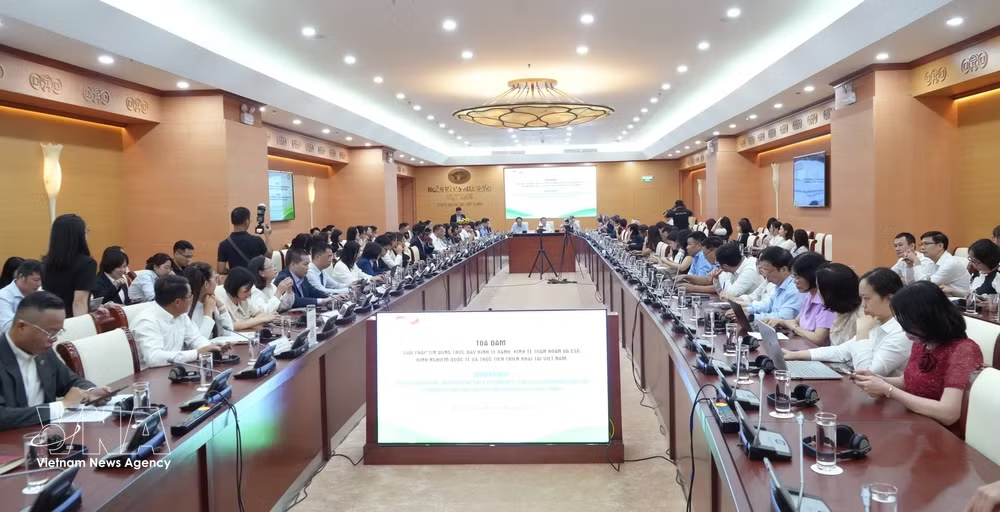
Jointly organised by the SBV, the German Agency for International Cooperation (GIZ), and the Ministry of Agriculture and Environment in Hanoi on June 9, the event was held within the framework of the macroeconomic reform/green growth programme supported by Germany’s Federal Ministry for Economic Cooperation and Development.
At the workshop, representatives of the Ministry of Agriculture and Environment shared guidance on identifying green and circular projects and applying ESG standards. International experts from Germany’s DZ Bank and KfW Development Bank also presented international experiences regarding ESG frameworks, ESG implementation within banks, and financing for circular economy projects.
Speaking at the event, Canh said that promoting green economy, circular economy and sustainable development remains a priority for the Vietnamese Government, reflected through measures such as the improvement of the Law on Environmental Protection and the national policy framework on green growth.
He noted that developing a circular economy and applying ESG standards are not only environmental solutions and means of using resources more efficiently, but also represent a new development model that can enhance productivity, resilience and deeper participation in global value chains. In particular, the Politburo's Resolution No. 68-NQ/TW on the private sector's development has provided additional momentum for this transition by emphasising the need to diversify capital sources for the private sector and to study and develop mechanisms for interest-rate support, encouraging investment in green projects, circular economy projects and those adopting ESG standards.
The Deputy Governor said the SBV is currently submitting to the Government a draft decree on a 2% interest-rate subsidy funded by the State budget for private enterprises, household businesses and individual business owners borrowing from banks to implement green and circular projects and projects applying ESG standards.
Regarding credit institutions, Canh noted that banks have improved awareness and increasingly prioritised capital allocation to green sectors and circular economy models, while gradually integrating ESG factors into their development strategies and business operations. Results showed strong growth in both the number of institutions providing green credit and the scale and growth rate of outstanding green loans in recent years.
To date, loans subject to environmental and social risk assessments have exceeded 5.1 quadrillion VND (some 193.6 billion USD), representing an almost 25-fold increase compared with the end of 2017 and accounting for 27.7% of total outstanding credit in the economy.
Dr Michaela Baur, Country Director of GIZ in Vietnam, said that green finance cooperation between Germany and Vietnam represents a strategic investment in green growth and enhanced competitiveness for both sides. GIZ remains committed to accompanying the Southeast Asian country and its banking sector throughout the green transition process.
Within the framework of the macroeconomic reform/green growth programme, GIZ is working with the Ministry of Agriculture and Environment and relevant agencies, including the SBV, to finalise classifications for green and circular projects as well as ESG implementation frameworks accompanied by incentive mechanisms. The programme also seeks to improve banks’ capacity in governance, data management, project appraisal and sustainable financial products.
The participation of Germany’s KfW Development Bank and DZ Bank alongside GIZ demonstrates an integrated approach to Vietnam–Germany cooperation, whereby technical assistance in policy development and capacity building is implemented in parallel with financial cooperation and the private sector's engagement. This coordinated approach is expected to facilitate the mobilisation of resources for green and circular projects and support the implementation of ESG standards in Vietnam, from policy building through to specific investment portfolios./.