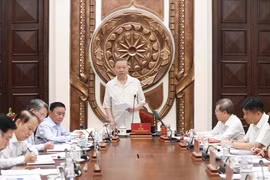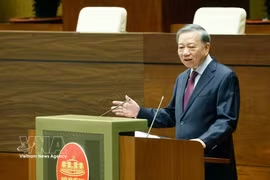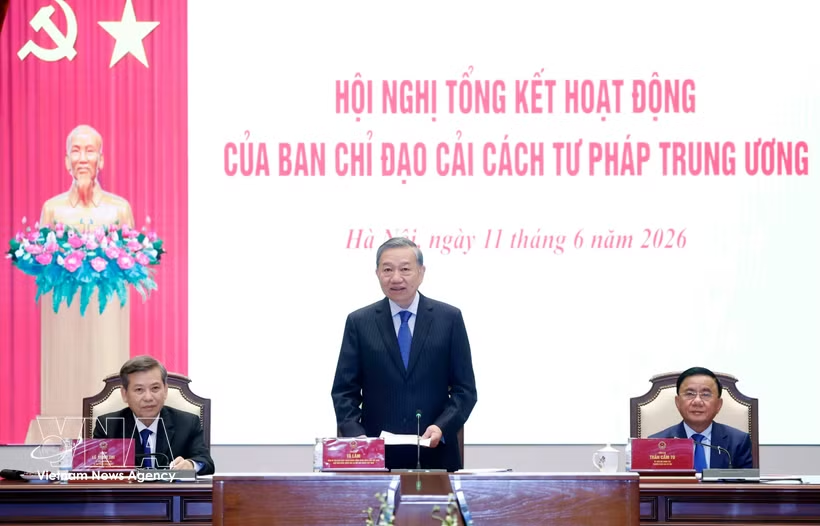
Hanoi (VNA) - Party General Secretary and State President To Lam chaired a conference in Hanoi on June 11 to review the operations of the Central Steering Committee for Judicial Reform, stressing the need to further improve the quality of institutional development, law enforcement and operation of judicial agencies.
The leader said that looking back on the committee’s operations over successive terms, there are sufficient grounds to affirm that it has successfully fulfilled the responsibilities entrusted by the Party.
The committee has advised and assisted the Party Central Committee, the Politburo and the Secretariat in leading, directing, inspecting and supervising the implementation of judicial reform policies and tasks, he noted.
Its work has contributed to maintaining and strengthening the Party’s leadership over judicial organisations and activities, while establishing an inter-agency coordination mechanism in a highly important, complex and sensitive field directly related to justice, human rights, citizens’ rights, the interests of the State, and the lawful rights and interests of organisations and individuals. These efforts have played an important role in safeguarding political security and social order and safety, thereby creating a stable environment for the country’s socio-economic development and international integration.
However, the General Secretary and President said that judicial reform had yet to fully meet practical requirements and public expectations in some respects.
Drawing from the committee’s operations and the implementation of judicial reform in recent years, he said that the current requirement is not merely to continue judicial reforms, but to fundamentally renew leadership and direction mechanisms so that judicial reforms could enter a new phase, closely linked with institutional improvement, law enforcement, power control and national development.
The top leader said that under a recent decision of the Politburo, the Central Steering Committee for Judicial Reform will be reorganised and integrated into the new Central Steering Committee for Institutional Improvement and Law Enforcement.
The conclusion of the committee’s operations under the previous model does not mean the end of judicial reform. Rather, it marks a transition to a new leadership and direction model with a broader vision, higher requirements, more synchronised approaches and clearer accountability, he stresses.
Party General Secretary and State President Lam underscored the need for a new mindset that places judicial reforms within a unified rule-of-law framework: good law-making, strict law enforcement, an honest judiciary, safeguarded justice, controlled power, protected human and citizens’ rights, and national development supported by a transparent, effective and coherent institutional system.
Judicial reform in the new phase is not only about reforming judicial agencies, but also about enhancing the operational capacity of a law-governed State. It is not merely about handling cases, but about safeguarding justice and building public trust; not simply about meeting professional targets, but about serving the people, supporting development and protecting the nation’s future through law and justice, he said.
Regarding priorities in the coming period, the leader called for continued thorough implementation of the Party’s viewpoints on judicial reforms and the building of a socialist rule-of-law State. Changes to the steering committee’s organisational model must not slow down, weaken or disrupt judicial reform efforts.
He stressed the need to ensure a smooth transfer of responsibilities to the Central Steering Committee for Institutional Improvement and Law Enforcement.
The General Secretary and President also highlighted the need to further improve the quality of institutional development, law enforcement and the operation of judicial agencies, along with a tighter control of judicial power, stronger efforts to prevent and combat misconduct in judicial activities, the development of a judiciary that is honest, capable and professional, and the acceleration of digital transformation and data-based governance in judicial reforms.
He requested the Party Central Committee's Commission for Internal Affairs, in coordination with the Ministry of Justice and relevant agencies, to organise the transfer of tasks, projects and work programmes in a comprehensive, rigorous and scientific manner, ensuring continuity and further development.
He expressed his confidence that, drawing on the traditions, experience, capabilities and sense of responsibility accumulated over many terms, agencies across the political system will continue to uphold the spirit of innovation, solidarity, dedication, determination and effectiveness, thereby building a professional, modern, fair, strict and incorruptible Vietnamese judiciary devoted to the Fatherland and serving the people.
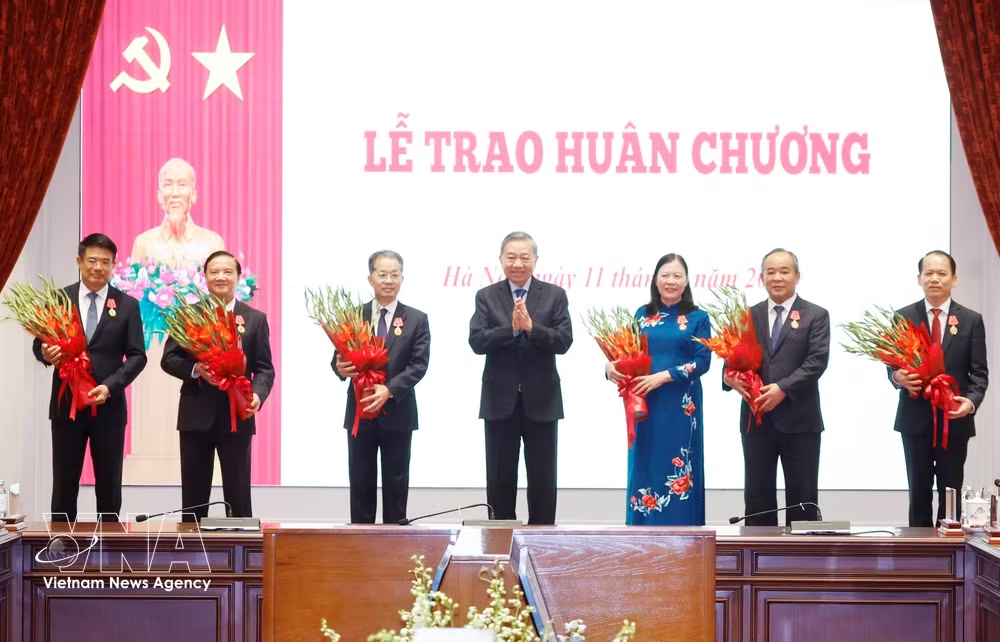
On the occasion, Party General Secretary and State President Lam presented First-Class Labour Orders to Chief Justice of the Supreme People’s Court Nguyen Van Quang, National Assembly Vice Chairman Nguyen Khac Dinh and Procurator General of the Supreme People’s Procuracy Nguyen Huy Tien for their outstanding contributions to judicial reforms. He also awarded Second-Class Labour Orders to Chairman of the State Presidential Office Le Khanh Hai, Minister of Justice Hoang Thanh Tung and Chairwoman of the National Assembly's Committee for People's Aspirations and Supervision Le Thi Nga.
At the conference, Politburo member and Permanent member of the Party Central Committee’s Secretariat Tran Cam Tu also presented Third-Class Labour Orders to seven individuals in recognition of their outstanding contributions to judicial reforms./.