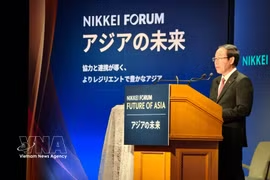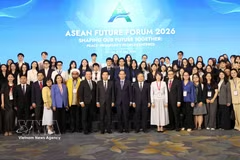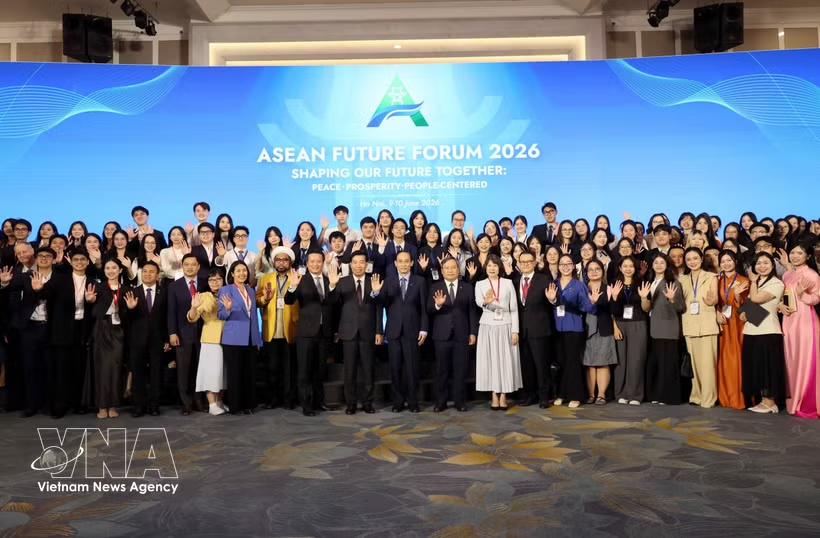
Kuala Lumpur (VNA) - The ASEAN Future Forum 2026 (AFF 2026), recently held in Hanoi, served as a strategic platform enabling the grouping to move beyond crisis management towards long-term regional planning, while further enhancing Vietnam’s diplomatic standing, according to Collins Chong Yew Keat, a foreign affairs, security and strategy analyst at the University of Malaya (Malaysia).
Speaking to the Vietnam News Agency's resident correspondent in Kuala Lumpur, Collins said AFF 2026 reflected ASEAN’s need to act with greater unity, strategic thinking and practical ambition amid mounting geopolitical uncertainty, economic fragmentation, technological disruption and climate-energy challenges.
The forum’s agenda focused on five key themes: resilience and unity, major power dynamics, conflict prevention, inclusive artificial intelligence, energy security, and new development models for ASEAN economies.
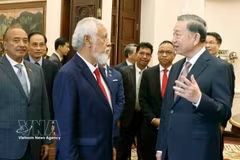
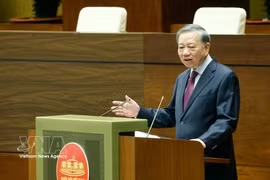
He noted that Vietnamese Prime Minister Le Minh Hung’s message underscored the need for ASEAN to evolve from a passive participant in global trends into an active force shaping international norms and standards. AFF 2026 therefore repositioned ASEAN as an agenda-setting actor, a hub for dialogue, cooperation and trust in an increasingly divided world.
The Malaysian expert said the forum institutionalised Vietnam’s role as a constructive and forward-looking contributor within ASEAN.
Bringing together leaders, policymakers, academics, businesses, youth representatives, social organisations, political parties and local authorities, AFF 2026 strengthened ASEAN Community-building in three key areas.
First, it reinforced ASEAN’s intellectual and policy infrastructure by narrowing the gap between vision documents and implementation through fresh ideas and cross-sector engagement.
Second, it advanced the bloc’s people-centred agenda by involving youth, businesses, academia and civil society, helping transform ASEAN from a diplomatic project into a vibrant regional community.
Third, it enhanced ASEAN’s strategic resilience in the face of external shocks, including conflicts, trade restrictions, technological controls, energy disruptions, food insecurity, and financial volatility.
Overall, Collins described AFF 2026 as a valuable platform for fostering long-term strategic thinking, regional trust-building and policy innovation. While it cannot immediately resolve ASEAN’s structural challenges, including consensus-based decision-making and uneven development, the forum provides important space for future-oriented dialogue.
For Vietnam, it strengthens diplomatic influence; for Malaysia, it complements priorities set during its 2025 ASEAN Chairmanship; and for ASEAN as a whole, it reinforces the idea that community-building must be driven not only by summits and declarations, but also by sustained, inclusive and forward-looking regional dialogue, the scholar concluded./.