AFF 2026 potential to become an incubator of ideas for ASEAN’s future agenda: expert

Collins Chong Yew Keat, a strategic, security and foreign affairs analyst at the Universiti Malaya, said that Vietnam’s decision to organise the forum was highly timely, as the bloc is currently facing a range of interconnected challenges, from major-power competition, maritime tensions and supply chain disruptions to non-traditional issues such as climate change and technological transformation.

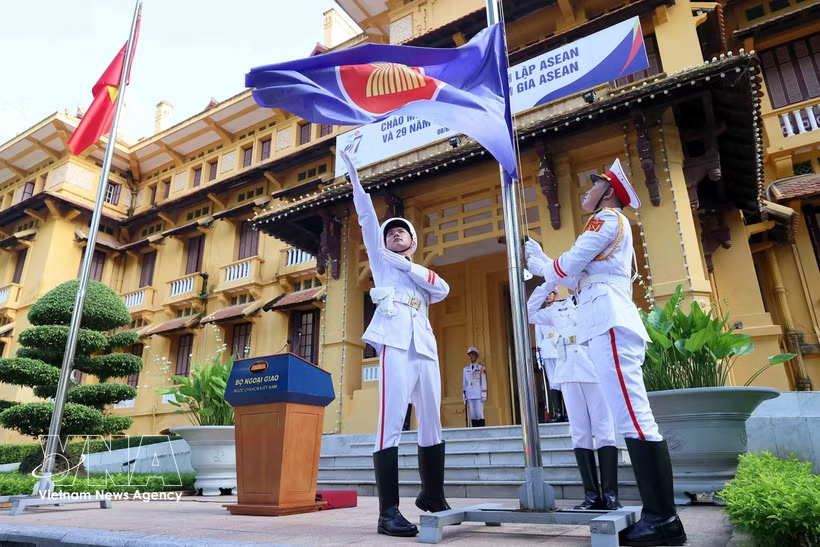
Flag-raising ceremony marking the 57th anniversary of the founding of the Association of Southeast Asian Nations (ASEAN), organised by the Vietnamese Ministry of Foreign Affairs in Hanoi on August 8, 2024. (Photo: VNA)

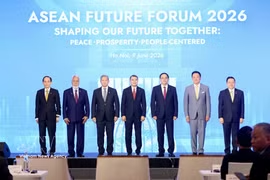
Kuala Lumpur (VNA) – The ASEAN Future Forum (AFF) 2026 has the potential to become an 'incubator of ideas' for ASEAN’s future agenda, contributing to the identification of emerging challenges, the formulation of policy recommendations, and the implementation of the ASEAN Community Vision 2045, according to Collins Chong Yew Keat, a strategic, security and foreign affairs analyst at the Universiti Malaya.

Speaking to Vietnam News Agency correspondents in Malaysia, the expert said Vietnam’s decision to organise the forum was highly timely, as the bloc is currently facing a range of interconnected challenges, from major-power competition, maritime tensions and supply chain disruptions to non-traditional issues such as climate change and technological transformation. In such an uncertain environment, the theme chosen by Vietnam serves as a strategic affirmation of the values ASEAN most urgently needs today: regional solidarity, stability and growth founded on the well-being of its people.

Collins noted that the emphasis on peace directly reflects one of the region’s foremost strategic concerns. Southeast Asia is currently one of the world’s most geopolitically complex regions, particularly in relation to developments in the East Sea and the spillover effects of other global flashpoints. In his view, Vietnam understands clearly that without a peaceful, stable and predictable environment, ASEAN’s economic development objectives will be difficult to achieve.

At the same time, the goal of prosperity is being pursued as the bloc seeks to reinforce its role as a dynamic growth centre amid the restructuring of global trade and investment flows. However, the Malaysian expert argued that such prosperity cannot be achieved through isolated national strategies. Rather, it requires stronger regional integration, ranging from resilient supply chains and digital integration to enhanced energy security.

Importantly, the principle of people-centred development adds political and social depth to the forum. It underscores that ASEAN is not merely a project of intergovernmental cooperation but must remain closely connected to the practical interests of its citizens through employment, education, healthcare and resilience to climate-related shocks.

According to Collins, the organisation of the AFF 2026 also reflects Vietnam’s foreign policy of independence, self-reliance, multilateralisation and diversification in a regional context. Through the forum, the nation continues to affirm its role as a proactive, active and responsible member of ASEAN.

The event, he said, reaffirms Vietnam’s commitment to ASEAN as the prioritised pillar of the regional architecture, with Vietnam enhancing its own standing through contributions to the bloc’s collective capacity and strength.

The forum’s agenda demonstrates efforts to link traditional foreign policy issues with emerging challenges such as artificial intelligence (AI) governance, urban development and Mekong subregional cooperation. This reflects an increasingly mature approach to regional diplomacy, one that not only addresses immediate concerns but also seeks to anticipate long-term trends.

The AFF also contributes to supporting Vietnam’s development vision while reinforcing Hanoi’s image as a responsible stakeholder capable of connecting ASEAN with global partners.
vnanet-collins-chong-yew-keat.jpg
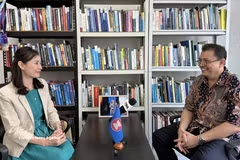
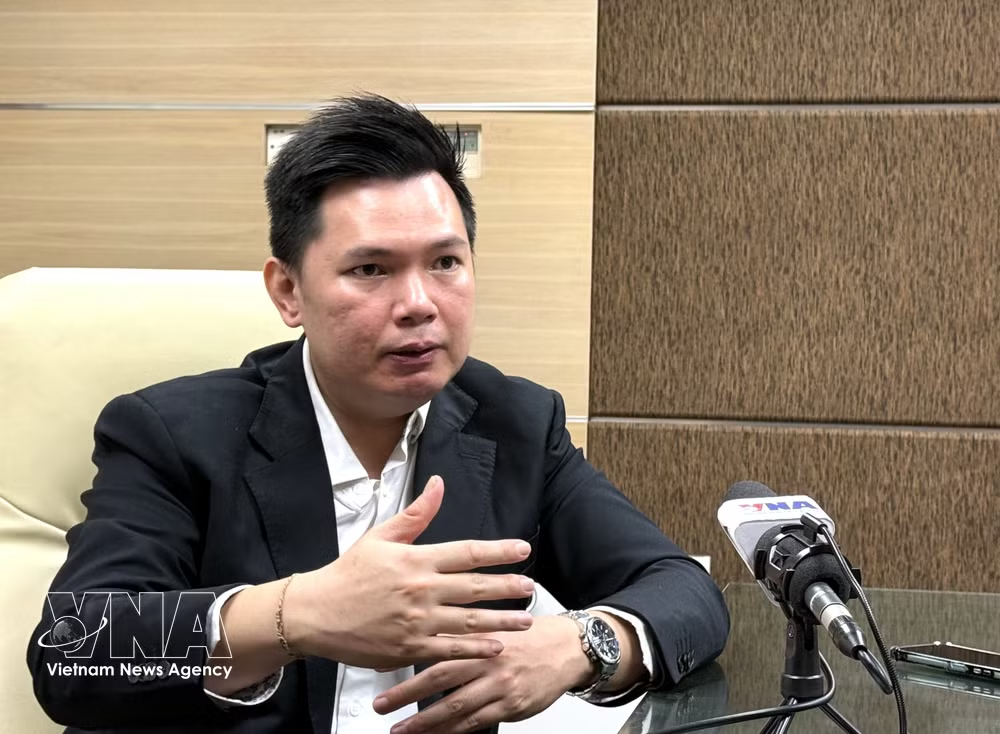
Collins Chong Yew Keat, a strategic, security and foreign affairs analyst at the Universiti Malaya (Photo: VNA)

One of the most significant features of the AFF, the analyst noted, is Vietnam’s continued commitment to developing the forum into a reputable regional track-two dialogue mechanism. This helps provide ASEAN with a more flexible policy discussion platform where officials, academics and the business community can exchange views and propose new initiatives before they are considered through formal channels.

He stressed that the forum not only enhances Vietnam’s international standing but also strengthens ASEAN centrality in its relations with external partners. By proactively defining priorities in areas such as energy, digital transformation and sustainable growth, the bloc can bolster its strategic autonomy and improve its ability to adapt to changes in the international environment.

According to Collins, what Vietnam has done and continues to do reflects a long-term foreign policy vision that helps ASEAN not only adapt to the challenges of the times but also take a more active role in shaping its future position in the world./.
VNA

See more

Congratulations sent to PAICV leadership on Cabo Verde election win

Congratulations sent to PAICV leadership on Cabo Verde election win

General Secretary of the Communist Party of Vietnam Central Committee and State President To Lam has sent a message of congratulations to the African Party for the Independence of Cabo Verde (PAICV)’s leadership on the occasion of its victory in the recent parliamentary election in Cabo Verde.

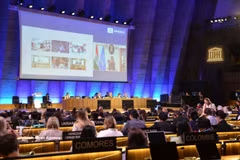
A view of the 11th Session of the General Assembly of the States Parties to the Convention for the Safeguarding of the Intangible Cultural Heritage. (Photo: VNA)

Vietnam continues to promote role as active, responsible member of UNESCO

As one of the earliest countries to join the 2003 convention and currently having 17 intangible cultural heritage elements inscribed by UNESCO, Vietnam consistently regards culture as the spiritual foundation of society, both a goal and a driving force for sustainable development, Van said, adding that the country has been working to improve its legal framework, place communities at the centre, and integrate heritage conservation with education, sustainable tourism and digital transformation.

Minister of Foreign Affairs Le Hoai Trung (Photo: the Ministry of Foreign Affairs)

FM highlights Vietnam's role in advancing ASEAN-Russia strategic partnership

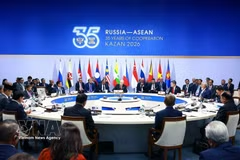
Foreign Minister Trung told the press following the PM’s participation in the summit, held in Kazan, Russia, on June 17-18, that the event has yielded "highly positive and comprehensive" results, laying a strategic foundation for cooperation between ASEAN and Russia – Vietnam’s comprehensive strategic partner.

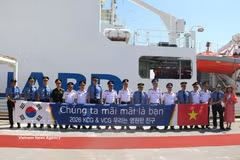
Delegates from the Vietnam Coast Guard and the Korea Coast Guard pose for a commemorative photo. (Photo: VNA)

Vietnam Coast Guard vessel visits RoK

Vietnam Coast Guard vessel CSB 8001 paid a visit to the Republic of Korea (RoK) from June 15–19, reinforcing cooperation between the two countries' maritime law enforcement agencies and contributing to their Comprehensive Strategic Partnership.

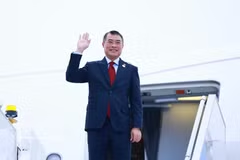
Prime Minister Le Minh Hung returns to Hanoi on June 19 morning, concluding a successful working trip to Russia. Photo: VNA

Prime Minister returns to Hanoi, concluding successful working trip to Russia

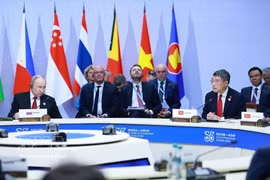
Prime Minister Le Minh Hung’s first working trip to Russia in his new position was highly successful, continuing to implement the foreign policy of the Party and the State. It reaffirmed Vietnam’s position and responsibilities within ASEAN and contributed to the overall success of the ASEAN–Russia Commemorative Summit.

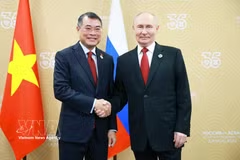
Prime Minister Le Minh Hung (L) and Russian President Vladimir Putin (Photo: VNA)

Prime Minister meets with Russian President

Prime Minister Le Minh Hung affirmed that Vietnam’s new Government wishes to work closely with the Russian Government to push forward agreements reached between General Secretary and President Lam and President Putin, thereby elevating bilateral ties comprehensively.

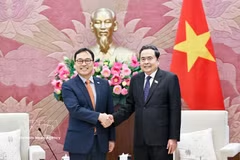
NA Chairman Tran Thanh Man (R) and outgoing RoK Ambassador to Vietnam Choi Young Sam (Photo: VNA)

NA Chairman congratulates outgoing RoK ambassador’s successful tenure

NA Chairman Tran Thanh Man credited outgoing Ambassador of the Republic of Korea to Vietnam Choi Young Sam with driving bilateral ties forward, pointing to expanded parliamentary and people-to-people exchanges that have added depth to the Vietnam-RoK Comprehensive Strategic Partnership.

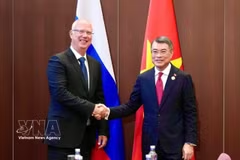
Prime Minister Le Minh Hung (R) and Kirill Dmitriev, CEO of the Russian Direct Investment Fund (RDIF). (Photo: VNA)

PM receives head of Russian Direct Investment Fund in Kazan

The PM welcomed Russian businesses and investors operating in Vietnam, saying their presence contributes to implementing agreements reached by the two countries’ top leaders and elevating mutually beneficial cooperation to a new level.

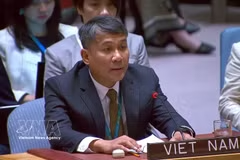
Standing Deputy Minister of Foreign Affairs Nguyen Minh Vu speaks at the open debate (Photo: VNA)

Vietnam affirms women’s indispensable role in lasting peace

Despite being hit by natural disasters and climate change, Vietnam continues to join the UN Central Emergency Response Fund (CERF), UN peacekeeping operations, ASEAN disaster management cooperation, and deploy search-and-rescue and humanitarian assistance teams to countries affected by disasters and crises, thus translating solidarity into concrete action and ensuring that humanitarian considerations remain at the centre of all response efforts.