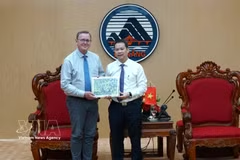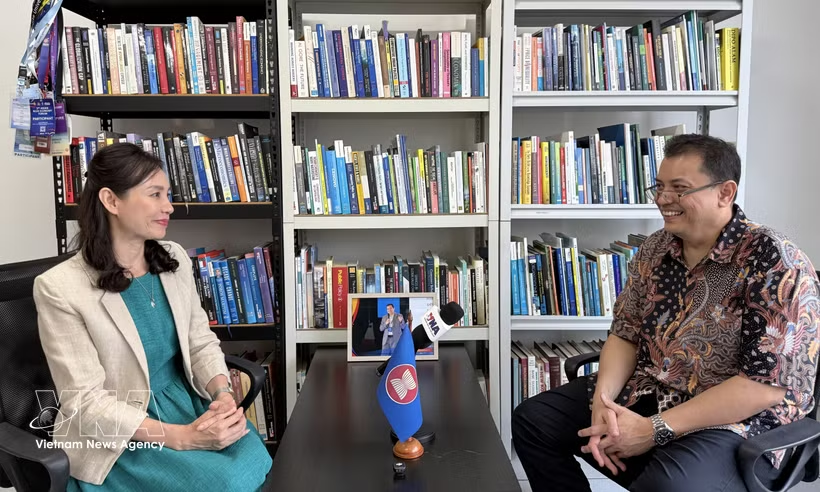
Jakarta (VNA) - Vietnam and Indonesia are well positioned to become strategic gateways connecting ASEAN with Russia, according to Dr. Arisman, Executive Director of Indonesia’s Centre for Southeast Asian Studies (CSEAS).
In an interview granted to the Vietnam News Agency’s correspondents in Jakarta, Arisman said Vietnam's free trade agreement with the Eurasian Economic Union (EAEU) enables the country to serve as a bridge between ASEAN and Eurasia, while strengthening its appeal as a destination for investment, particularly in logistics, infrastructure and production.
Vietnam could expand cooperation with Russia in LNG, hydrogen, and green transition technologies, in line with its goals of ensuring energy security and promoting sustainable development.
Meanwhile, Indonesia, as ASEAN’s largest economy with substantial energy and industrialisation needs, also has significant opportunities to cooperate with Russia in mining, fertilisers, gas, industrial processing, and infrastructure development.
In addition, both Vietnam and Indonesia are expected to benefit from growing digital cooperation, with promising areas including artificial intelligence (AI), cybersecurity, fintech, and digital infrastructure, supported by their young populations and dynamic startup ecosystems.
Arisman noted that the combination of market scale, strategic location, and strong digital growth potential would enable Vietnam and Indonesia to effectively capitalise on opportunities arising from ASEAN–Russia cooperation initiatives in the 2026–2030 period, generating substantial benefits for both countries.
According to the expert, ASEAN-Russia relations have evolved over the past 35 years from a largely political dialogue into a comprehensive partnership covering trade, investment, energy, digital transformation, food security and supply chain connectivity.
The shift reflects broader geopolitical changes, with Russia pursuing its "pivot to the East" strategy to deepen engagement in Asia, while ASEAN continues to diversify partnerships and maintain strategic autonomy and balance to reduce risks arising from geopolitical competition.
Economic cooperation between ASEAN and Russia has gained momentum in recent years, particularly in energy, agriculture and logistics, demonstrating that practical economic interests are increasingly driving the partnership. However, challenges remain, including relatively modest trade volumes, limited transport and logistics connectivity, and strong competition from ASEAN's economic partners such as China, the US, Japan and the European Union.
Despite these constraints, Arisman said the outlook for ASEAN-Russia relations through 2030 remains positive, underpinned by converging strategic interests.
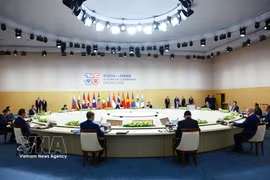
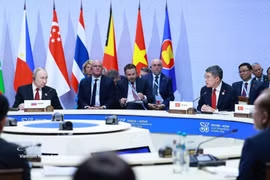
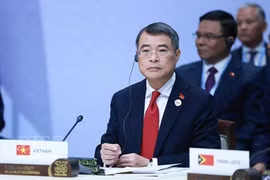
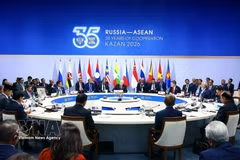
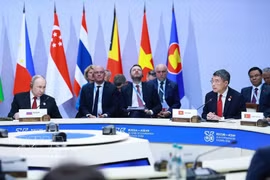
He described the ASEAN-Russia Commemorative Summit marking the partnership's 35th anniversary in Kazan as a turning point toward more institutionalised and practical cooperation. Discussions focused on issues directly affecting economic resilience and people's livelihoods, including energy security, food security, logistics connectivity and digital transformation.
This, he noted, clearly reflects the convergence of interests between ASEAN and Russia amid rapidly changing global conditions.
Leaders also adopted the ASEAN-Russia Plan of Action 2026-2030, alongside the Kazan Declaration 2026, declarations on energy and cultural cooperation, and a new work plan to guide collaboration over the next five years.
According to Arisman, both sides are likely to focus on priority areas including energy, food security, trade and investment, digital transformation, logistics infrastructure development, and enhanced connectivity between ASEAN and EAEU.
He identified energy and food security as important pillars of the partnership. Russia could help ASEAN diversify energy supplies through cooperation in liquefied natural gas (LNG), hydrogen and civilian nuclear energy, while its expertise in large-scale infrastructure could support regional energy connectivity.
In food security, Russia's role as a major exporter of wheat and fertilisers offers opportunities to stabilise supply chains. Cooperation is also expanding to agricultural logistics, post-harvest storage, agricultural research and smart farming to strengthen the resilience of regional food systems./.