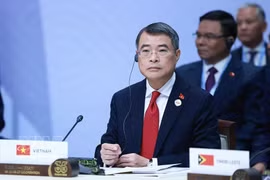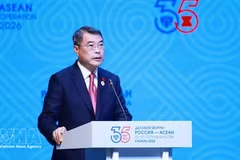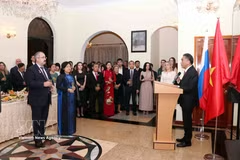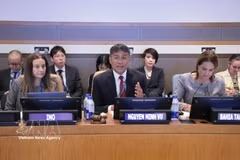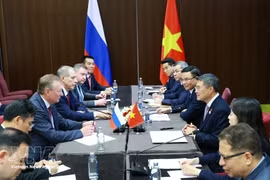
Kazan (VNA) — Prime Minister Le Minh Hung on June 18 proposed three major orientations to enhance ASEAN–Russia cooperation, calling for a more substantive partnership that contributes to peace, stability and sustainable development.
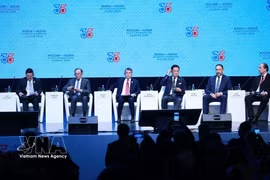
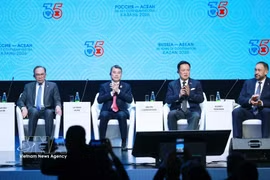
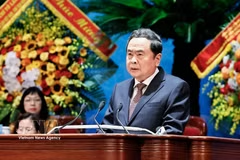
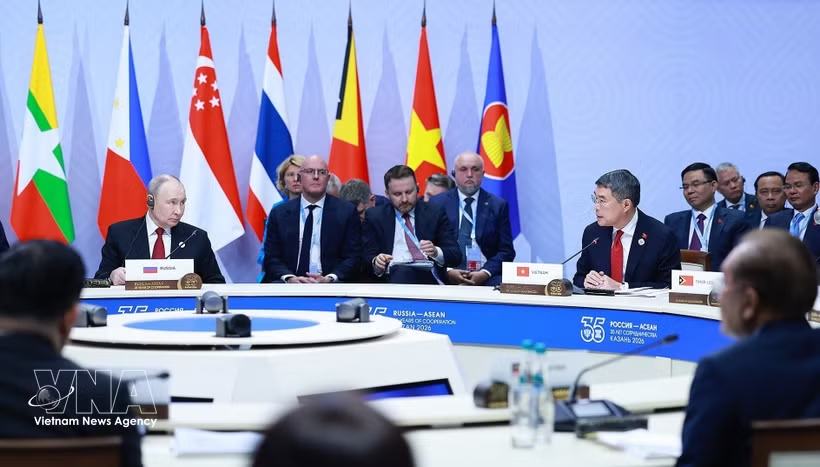
Addressing the plenary session of the ASEAN–Russia Commemorative Summit marking 35 years of dialogue relations in Kazan, Russia, the Vietnamese PM stressed that amid unpredictable global developments, ASEAN and Russia need to work together to build a more balanced and sustainable environment.
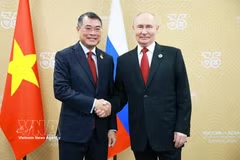
PM Hung reaffirmed that Vietnam attaches great importance to its traditional friendship and Comprehensive Strategic Partnership with Russia, and supports the country’s continued contributions to peace, stability, cooperation and development in the Asia-Pacific region and the world.
He underscored that Vietnam supports the peaceful settlement of disputes and conflicts in accordance with international law, the United Nations Charter and the 1982 United Nations Convention on the Law of the Sea (UNCLOS). He also welcomed the recent agreement reached between the US and Iran on the Middle East situation, expressing his hope that the parties would effectively implement the agreement and work toward lasting peace for the benefit of the region and the international community.
To advance ASEAN–Russia relations in a more practical and effective manner, the PM outlined three key orientations.
First, he called for elevating the partnership to a higher strategic level through the regular organisation of ASEAN–Russia summits, stronger ties between the ASEAN Inter-Parliamentary Assembly (AIPA) and the Russian Parliament, and continued promotion of the principles and values shared by both sides.
Second, he urged more substantive economic cooperation by addressing bottlenecks in logistics, market access and payment mechanisms. He proposed raising two-way ASEAN–Russia trade to 45 billion USD by 2035 while expanding collaboration in education, training, youth exchanges, culture and tourism.
Third, he emphasised the need to enhance self-reliance and resilience, particularly by making energy a major pillar of cooperation. He also proposed establishing priority mechanisms for the supply of fertilisers, animal feed materials and agricultural technologies, while strengthening digital resilience and supporting the implementation of the United Nations Convention against Cybercrime, (also known as the Hanoi Convention).
The PM announced that Vietnam will host the ASEAN–Russia Young Diplomats Summit in 2027.
The commemorative summit brought together Russian President Vladimir Putin, ASEAN Secretary-General Kao Kim Hourn and leaders of ASEAN member states.
In his remarks, President Putin said the world is undergoing profound structural changes and noted that ASEAN–Russia relations have made important contributions to peace, stability and development over the past 35 years. He reaffirmed Russia’s commitment to ASEAN-led mechanisms, including the East Asia Summit (EAS), the ASEAN Regional Forum (ARF) and the ASEAN Defence Ministers’ Meeting Plus (ADMM+).
Putin emphasised that both sides need to double bilateral trade in the next 10 years and expand cooperation in areas such as counter-terrorism, transnational crime, artificial intelligence (AI), science and technology, biosecurity, civilian nuclear energy, connectivity, and logistics.
ASEAN leaders, for their part, highlighted Russia’s role and contributions in the Asia-Pacific region and agreed that the ASEAN–Russia Strategic Partnership should play a greater role in promoting regional peace, security and development.
Trade between ASEAN and Russia reached nearly 18 billion USD in 2025, while the number of Russian visitors to ASEAN climbed to 3.2 million, up 27% from 2024. Russia remains an important partner for ASEAN in energy, fertilisers and grain supplies, while ASEAN exports electronics, agricultural products, processed food, textiles and consumer goods to the Russian market.
Both sides committed to strengthening high-level dialogue and deepening substantive cooperation in trade, investment, science, technology, education, training, people-to-people exchanges, and emerging fields such as the digital economy, innovation, AI, cybersecurity, and maritime cooperation. Both sides agreed to prioritize energy, while strengthening cooperation on food security and agricultural supply chains. Cultural cooperation will also be promoted to further connect the two regions.
In addition, to expand the scope of cooperation, ASEAN and Russia agreed to strengthen ASEAN-Eurasian Economic Union (EAEU) linkages, utilise existing FTAs between the EAEU and Vietnam and Singapore, promote cooperation between ASEAN and the Shanghai Cooperation Organisation (SCO), and explore possibilities for cooperation with BRICS.
At the conclusion of the summit, ASEAN and Russian leaders adopted the Kazan Declaration 2026 “ASEAN-Russian Federation: Unity in Diversity – 35 Years Together”; the Joint Statement of ASEAN and the Russian Federation on Energy Cooperation; the Joint Statement of ASEAN and the Russian Federation on Cultural Cooperation; and the Plan of Action to Implement the ASEAN-Russian Federation Strategic Partnership (2026–2030)./.