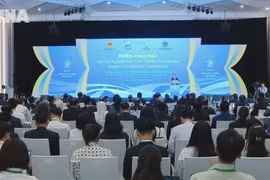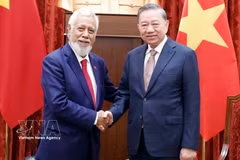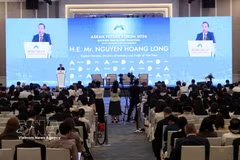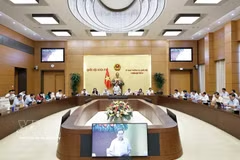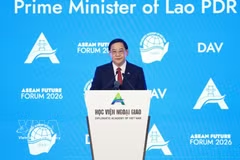
Hanoi (VNA) – Domestic and foreign policymakers, scholars and experts gathered for the third ASEAN Future Forum (AFF) 2026 in Hanoi on June 9, when three plenary sessions and one panel discussion put the bloc’s resilience and unity under debate.
Bolstering internal resilience while expanding connectivity
The first plenary session, titled “Resilience and Unity in a Changing World”, was moderated by former Vietnamese Deputy Minister of Foreign Affairs Dang Dinh Quy and examined the concepts of resilience and unity in the new global landscape.
Former Indonesian Foreign Minister Marty Natalegawa urged ASEAN to stop merely adapting and start actively shaping its strategic environment. Cautioning that big-power competition could split the bloc, he proposed a “dynamic equilibrium” approach to sustain stability, dialogue and inclusive cooperation. Diversity is ASEAN’s defining feature, he said, noting that unity doesn’t mean uniformity, and the real challenge is converting differences into strength.
Vietnamese Deputy Foreign Minister Nguyen Manh Cuong spotlighted “cooperative resilience”, flagging a paradox of an interconnected world that deeper integration leaves countries more exposed to external shocks. Nevertheless, such challenges do not diminish the value of integration, he said.
Resilience is not synonymous with isolation. Rather, it involves bolstering internal capacity while simultaneously expanding connectivity. ASEAN’s resilience rests on the three pillars of internal unity, an effective central role, and substantive cooperation mechanisms, he said. He pushed for priority investment in knowledge, technology, infrastructure connectivity, sustainable supply chains, and broader dialogue platforms.
Prof. Tetsuya Watanabe, President of the Economic Research Institute for ASEAN and East Asia (ERIA), proposed a new economic approach centred on regional industrial cooperation and the development of sub-regions such as the Mekong as emerging growth engines.
With global governance in crisis, Prof. Yves Tiberghien from Canada’s University of British Columbia called ASEAN a model for advancing peace, stability and respect for international law.
Meanwhile, Prof. Kuik Cheng-Chwee from the National University of Malaysia said resilience also captures a nation's and region’s ability to withstand and bounce back from disruptions. CEO of Asia Group Advisors Adam Schwarz demanded a shift from assessment to action, pressing for deeper intra-ASEAN economic integration, stronger institutional frameworks and greater private sector involvement.
Advancing conflict prevention, fostering strategic trust
The second plenary session, focusing on advancing ASEAN initiatives on conflict prevention, discussed proactive and flexible approaches to conflict prevention, aiming to sharpen ASEAN’s practical capabilities and define partner roles in an increasingly tangled regional security landscape.
Australian Ambassador to Vietnam Gillian Bird opened by stressing the need to spot potential conflicts early rather than responding only after crises emerge. She called for greater investment in early-warning systems and rules-based regional institutions.
United Nations Under-Secretary-General Izumi Nakamitsu said effective prevention hinges on creating flexible diplomatic options and narrowing the gap between early warning and early action through trust building and information sharing on maritime security and cybersecurity.
Isidro L. Purisima, Senior Undersecretary in the Philippines’ Office of the Presidential Adviser, tied conflict prevention directly to governance, inclusive development and early tackling of threats such as inequality and climate change.
Dr. Chem Widhya, Secretary-General of the ASEAN Inter-Parliamentary Assembly (AIPA), argued that ASEAN does not need new structures but should instead focus on effectively delivering on existing commitments, including the Treaty of Amity and Cooperation (TAC), the ASEAN Regional Forum (ARF), and the ASEAN Defence Ministers’ Meeting-Plus (ADMM-Plus), with legislatures playing a stronger role.
Representing ASEAN’s partners, Chinese Ambassador to ASEAN Wang Qing urged the bloc to move beyond Cold War thinking, champion common security and treat economic development cooperation as the bedrock of lasting peace.
The importance of diplomatic solutions and dialogue was also highlighted by Éléonore Caroit, French Minister Delegate for Francophonie, International Partnerships, and French Nationals Abroad, in a video message to the forum.
Speakers and participants concurred that ASEAN must urgently shift from a reactive posture to a preventive one, bolster strategic trust, uphold its centrality, and reinforce substantive cooperation mechanisms to navigate future strategic uncertainties.
Leaving no one behind in AI era
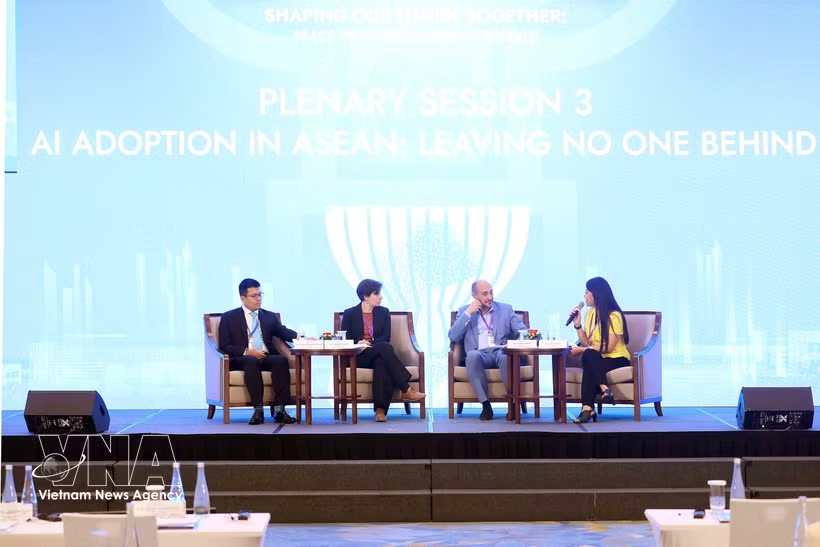
The third plenary session, “AI Adoption in ASEAN: Leaving No One Behind”, explored both the opportunities and challenges posed by AI, with a particular focus on narrowing digital divides and pushing regional cooperation.
Speaking virtually, Minister of Foreign Affairs of the Republic of Korea Cho Hyun affirmed that the greatest challenge of the AI era is to ensure that people from all walks of life can access and benefit from AI, rather than limiting its advantages to technological breakthroughs or economic gains. Praising ASEAN’s commitment to inclusivity in digital transformation, he expressed his hope that ASEAN will become a key partner in global AI cooperation.
He also mentioned practical initiatives to narrow digital disparities, including a computing infrastructure project in Indonesia and the Korea – ASEAN Digital Academy, which has just opened a campus in Vietnam.
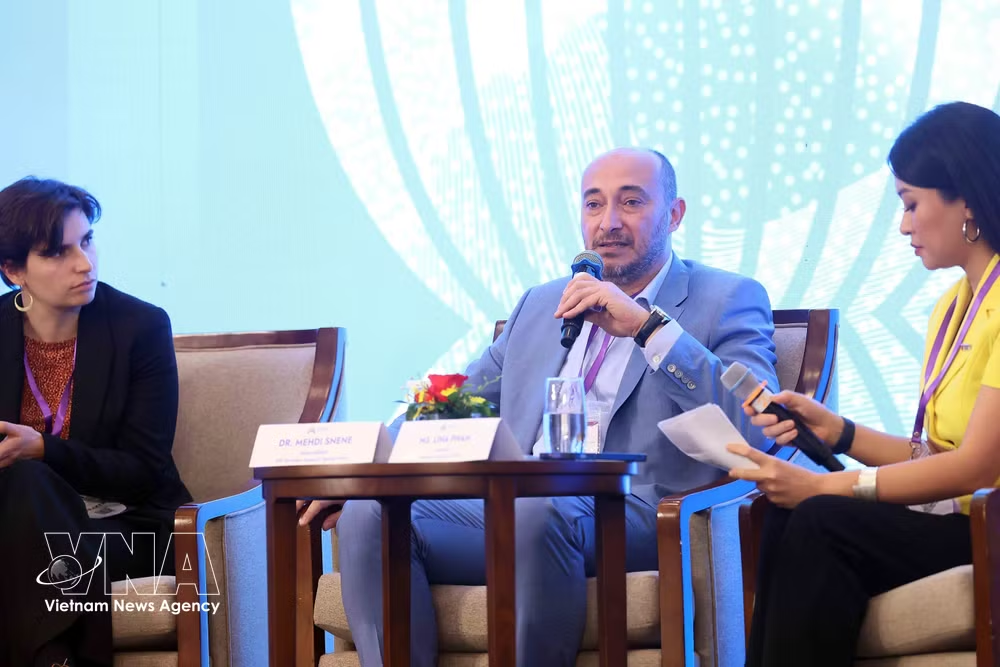
Dr. Mehdi Snene, Senior Adviser to the UN Secretary-General’s Tech Envoy at the UN Office for Digital and Emerging Technologies, suggested ASEAN establish a common governance framework and present a unified voice in global AI discussions. He also cited the Sea Lion project, designed to develop a shared AI model for all ASEAN member states, as a successful example of regional collaboration.
Drawing on European experience, Leonie Mader, an AI specialist with Germany’s Konrad Adenauer Foundation (KAS), recommended that ASEAN countries adopt a risk-based approach to AI governance similar to the core principles of the European Union’s AI Act. She cautioned against chasing technology trends indiscriminately, arguing that AI models must be built around national needs and comparative advantages.
The same day, the AFF 2026 hosted a panel discussion on the changing strategic landscape and its implications for ASEAN, featuring strategic exchanges between President of the Diplomatic Academy of Vietnam Dr. Nguyen Hung Son and Prof. Yan Xuetong from Tsinghua University of China.
Delegates observed that technology, particularly AI, is increasingly redefining national power. Competition among major powers is no longer primarily ideological but shifting toward cyberspace, where there is a growing risk of two separate technological ecosystems emerging./.