📝OP-ED: Strength of policies shaped by listening to public voices

Recent developments have demonstrated that policies shaped through listening to public opinion have become a powerful source of social consensus and public trust, enabling the Party, the State and the people to work together toward more ambitious goals and a longer-term vision for national development.

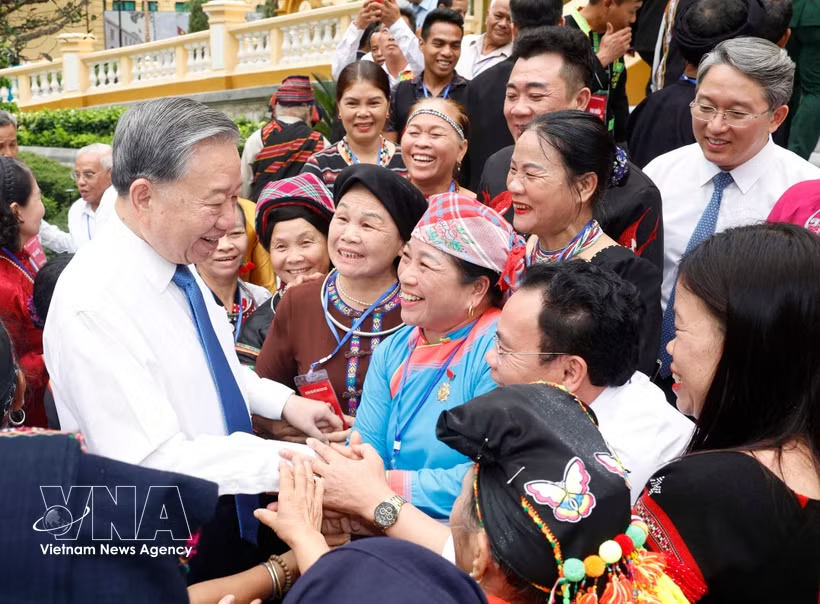
Party General Secretary and State President To Lam meets with outstanding village heads and elders, artisans and community leaders from across the country to listen to their opinions and aspirations on Apirl 18, 2026. (Photo: VNA)

Hanoi (VNA) – At a time when the world is evolving at an unprecedented pace and Vietnam stands at a pivotal moment in its development journey, with strategic socio-economic decisions made against the backdrop of intense global competition, any delays can mean missing opportunities for an entire development cycle. Yet, amid the urgency of reform and growth, the legitimate aspirations, concerns and expectations of the people have not been overlooked.

Recent developments have demonstrated that policies shaped through listening to public opinion have become a powerful source of social consensus and public trust, enabling the Party, the State and the people to work together toward more ambitious goals and a longer-term vision for national development.

That public consensus and trust also serve as compelling evidence refuting unfounded allegations and distortions that seek to deny the Party’s and the State’s commitment to listening to the people in recent years.

Vietnam’s revolutionary history has proved that the harmony between the Party’s vision and the people’s aspirations constitutes a vital source of national strength leading the country from one success to another. This unity transforms challenges into opportunities, difficulties into motivation and aspirations into tangible achievements. Listening to the people, embracing constructive feedback and adjusting policies in line with practical realities are therefore not only central to the principle of putting the people at the heart of governance, but also essential characteristics of a truly transparent, open and progressive rule-of-law state.

In the current period of profound transformation, this approach has become even more important than ever. Addressing the 11th National Congress of the Vietnam Fatherland Front for the 2026–2031 term, Party General Secretary and State President To Lam reaffirmed that the genuine voice of the people must guide policymaking, underscoring the principle that meaningful reform cannot succeed without understanding and responding to citizens’ concerns.

Recent policy adjustments provide concrete examples of this approach. One notable case is the Government’s decision to raise the annual revenue threshold exempt from taxation for business households and individuals to 1 billion VND (38,000 USD), doubling the level proposed in the initial draft and effective from January 1, 2026. The adjustment followed consultations with business households, economists and professional associations, reflecting both practical realities and public feedback. The measure not only provides direct support for millions of small businesses but also shows the Government’s commitment to fostering private-sector development as a key driver of economic growth.

Another example is Hanoi’s proposed Red River Landscape Boulevard project. Recognising public concerns surrounding this large-scale infrastructure initiative, city authorities have prioritised transparency, public consultation and expert engagement. Through public information sessions, thematic conferences and community-level dialogues, numerous recommendations have been incorporated into the project’s planning process. Adjustments to the project’s scope and investment scale, together with repeated commitments to protecting residents’ rights and legitimate interests in resettlement and urban redevelopment, have demonstrated an effort to place people at the centre, with social consensus considered as the foundation and practical effectiveness as the yardstick for all development decisions.

Similarly, the nationwide rollout of E10 biofuel has generated diverse opinions among the public. Rather than dismissing concerns, relevant authorities have actively provided information, clarified technical issues and refined implementation plans. Such efforts reflect a modern governance approach that values dialogue and seeks to build social consensus through transparency and evidence-based policymaking.

The concerns expressed by citizens – whether related to relocation, changes to familiar neighbourhoods, shifts in livelihoods, digital transformation, tax policies or emissions reduction commitments – are legitimate and deserve attention. Importantly, public sentiment is being acknowledged, and authorities have shown a willingness to address concerns through practical measures. Examples include digital platforms enabling citizens to provide feedback on fuel quality and environmental issues, as well as community surveys designed to gather residents’ views on urban planning and local development.

Listening to public opinion and incorporating feedback should not be interpreted as inconsistency or hesitation in governance. On the contrary, it is a hallmark of effective and responsive administration. Policies refined through public consultation are not concessions to pressure but improvements designed to better meet development needs and the legitimate aspirations of the people.

Vietnam’s history has consistently demonstrated that when the Party remains closely connected to the people, listens to their voices and draws strength from their support, even the most formidable challenges can be overcome. The social consensus needed to achieve the country’s long-term aspirations for prosperity and sustainable development is built on trust – trust that is nurtured through respect for the people, openness to their views and a continuous commitment to improving policies in the public interest.

This principle is not only rooted in President Ho Chi Minh’s thought but has remained a consistent guiding philosophy of the Party and State during the leadership, governance, and development of the country./.

VNA
See more

Party General Secretary and State President To Lam present greeting flowers to the People'sPolice force on the occasion of the 64th anniversary of the force's traditional day (Photo: VNA)

Top leader asks for building stronger, more modern people's police force

Party General Secretary and State President To Lam highlighted the country's recent socio-economic achievements, recognising the significant contributions by the People's Public Security force, particularly the People's Police, senior police leaders over different periods and the Association of Former People's Public Security Officers through grassroots movements safeguarding national security.

Prime Minister Le Minh Hung chairs a government meeting with the business community in Hanoi on July 18 (Photo: VNA)

PM urges stronger development foundations for sustainable growth

Opening the event, the PM underscored the significance of the meeting, saying that it is the first engagement between the new-term government’s members and the business community - the vanguard on the economic front, playing a key role in driving growth, generating employment, and enhancing national competitiveness.

Prime Minister Le Minh Hung (R) receives Greek Minister of Foreign Affairs George Gerapetritis in Hanoi on July 17. (Photo: VNA)

Vietnam–Greece ties still hold considerable untapped potential: PM

PM Le Minh Hung recommended that the two sides step up all-level exchanges and meetings, especially those at high level, make full use of the existing cooperation mechanisms, expand collaboration in the economy, trade and investment, and effectively implement the EU–Vietnam Free Trade Agreement (EVFTA).

Party General Secretary and State President To Lam offers incense at the memorial stele dedicated to heroic martyrs. (Photo: VNA)

Identifying fallen soldiers a sacred responsibility towards Fatherland: Top leader

Party General Secretary and State President To Lam stressed that every set of remains recovered represents far more than a technical achievement. It marks the return of a son or daughter to the Fatherland and to his/her family, the restoration of a missing chapter of history, and a reaffirmation of the country's enduring tradition of remembering those who served the nation.

Representatives of the liaison committee of veterans of Battalion 261 - Giron in Ho Chi Minh City present a commemorative photo to Mauricio Alejandro Martínez Duque, Consul General of Cuba in the city. (Photo: VNA)

Get-together marks 73rd anniversary of Cuba’s Moncada Barracks attack

Building on the long-standing friendship between Vietnam and Cuba, the Vietnam–Cuba Friendship Association in Ho Chi Minh City has worked closely with the Consulate General of Cuba in Ho Chi Minh City to organise a wide range of activities in recent years, including gatherings marking major national anniversaries, cultural and artistic exchanges, and programmes connecting organisations and localities from the two countries

National Assembly Vice Chairman Nguyen Khac Dinh addresses the fourth session of the National Assembly (NA) Standing Committee on July 17, 2026. (Photo: VNA)

Modern criminal justice system proposed under revised Criminal Procedure Code

The revised code proposes more progressive procedural rules to enhance adversarial proceedings, tighten power oversight and better protect human and citizens' rights. It will retain effective existing provisions, amend or repeal outdated regulations, and introduce new procedures to expedite case handling, reduce procedural costs and improve efficiency while ensuring fairness, objectivity and greater protection of the lawful rights and interests of organisations and individuals. It also aims to modernise criminal proceedings through the wider application of digital technologies and closer alignment with international practices.

Deputy Minister of Foreign Affairs Le Thi Thu Hang has a working session with Vietnamese associations in Udon Thani province, northeastern Thailand, on July 16. (Photo: VNA)

Vietnamese community in Thailand urged to strengthen friendship bridge

Deputy Minister of Foreign Affairs Le Thi Thu Hang commended the unity and sense of responsibility shown by the Vietnamese community in Udon Thani and across Thailand, urging them to continue preserving the Vietnamese language and cultural identity while helping build a positive image of Vietnamese people and contributing to bilateral relations.

Deputy Prime Minister and Minister of National Defence Gen. Phan Van Giang (R) and Minister in charge of the General Secretariat of the Mauritanian Government Moctar Al Housseynou Lam. (Photo: baochinhphu.vn)

Vietnam seeks Mauritania’s role as bridge to African Union for deeper ties

Vietnam expects Mauritania to act as a bridge for substantive cooperation between Vietnam and the African Union (AU), said Deputy Prime Minister and Minister of National Defence Gen. Phan Van Giang during a reception in Hanoi on July 16 for Minister in charge of the General Secretariat of the Mauritanian Government Moctar Al Housseynou Lam.

Minister of Foreign Affairs Le Hoai Trung (R) and Minister in charge of the General Secretariat of the Mauritanian Government, Moctar Al Housseynou Lam. (Photo: VNA)

Vietnam treasures traditional friendship with Mauritania: FM

The two officials agreed to continue their long-standing coordination at multilateral forums, including the Francophonie, while reinforcing practical collaboration with regional organisations such as ASEAN and the AU, for the benefit of their people and for peace, stability and development in their respective regions and globally.

Deputy Minister of Foreign Affairs Le Thi Thu Hang (L) pays a courtesy call on Lao Deputy Prime Minister and Minister of Foreign Affairs Thongsavanh Phomvihane. (Photo: VNA)

Vietnam, Laos strengthen cooperation on overseas community affairs

The two sides signed a Memorandum of Understanding on cooperation in overseas Vietnamese and overseas Lao affairs for the 2026–2030 period, providing a framework for future collaboration. Laos will send a delegation to Vietnam to study preparations for the World Conference of Overseas Vietnamese, scheduled for December 2026.