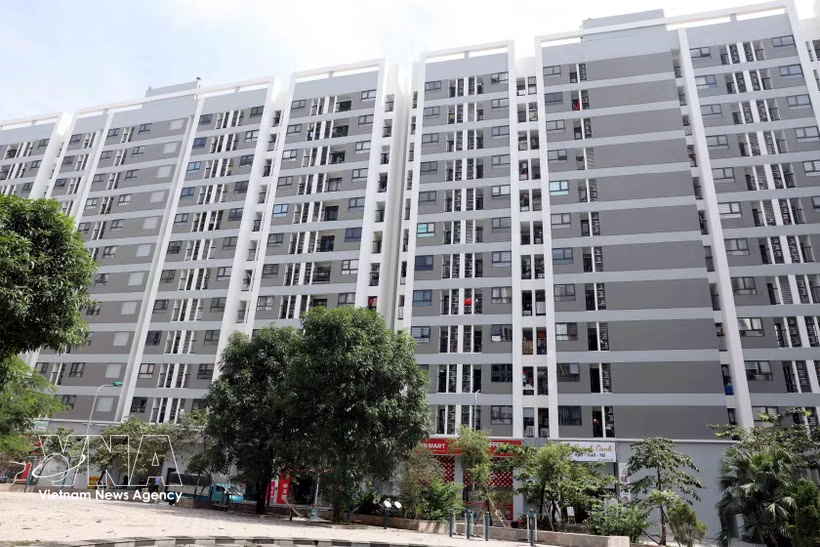
Vietnam advances long-term rental housing to meet growing housing demand

The accelerated development of social housing, along with the gradual formation of a long-term rental housing market, is expected to create a more diversified housing ecosystem that meets the needs of various groups, contributing to developing a more sustainable social welfare policy in the time to come

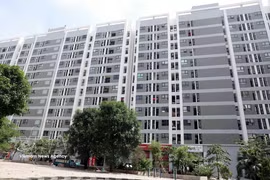
Vietnam is set to make long-term rental housing a key pillar of its social welfare strategy through 2030 - Illustrative image (Photo: VNA)

Hanoi (VNA) - Vietnam is set to make long-term rental housing a key pillar of its social welfare strategy through 2030, as soaring home prices, an imbalanced housing supply and declining affordability prompt a policy shift from homeownership towards expanding rental options for workers and low-income households.

This information was announced by Ha Quang Hung, Deputy Director of the Department of Housing Management and Real Estate Market under the Ministry of Construction, at a press briefing held on the afternoon of June 18.

He said beside the goal of developing 1 million social housing units, the formation of a long-term rental housing market with the participation of both the State and the private sector is expected to be an important direction to meet real demand.

Although Vietnam's housing market has shown positive signs, particularly in social housing, Hung said supply remains heavily skewed towards high-end properties, while affordable homes continue to fall short of demand. The market also remains dominated by homes built for sale, with long-term rental housing still underdeveloped.

He said that rapidly rising property prices in major cities have made homeownership increasingly unattainable for workers, civil servants, and young people. Meanwhile, existing incentives have also proved insufficient to attract businesses and long-term investors to the rental housing segment.

Against this backdrop, the Party and State have adopted a new housing strategy that places commercial, social and rental housing on equal footing. Long-term rental housing is now identified as a strategic priority to serve workers, civil servants, public employees and members of the armed forces, he noted.

Future housing development will be integrated into urban planning, land-use strategies, industrial park development and public transport infrastructure. Transit-oriented development (TOD) areas, industrial zones, economic zones and major economic corridors have been identified as priority locations for rental housing projects.

Under the new approach, the State will play a facilitating role through planning, financial and credit policies while leveraging public resources to encourage greater private-sector participation.

The Ministry of Construction is working with relevant ministries to revise the Housing Law, the Real Estate Business Law and related regulations, with the amendments expected to be submitted to the National Assembly in October 2026.

The proposed policy framework will classify housing into four categories - commercial housing, rental housing, official residences and policy housing. Rental housing will receive priority support through incentives on land access, finance, taxation and credit to attract private capital and long-term investment funds.

Hung said that alongside the orientation of developing rental housing, the programme to build 1 million social housing units continues to gather pace.

In recent years, the policy framework for social housing and worker accommodation in industrial zones has been gradually improved in a more coherent and flexible direction, with various incentives related to land, taxation, credit, and infrastructure investment.

In 2025, the country completed more than 103,000 social housing units, exceeding the set target. In the first five months of this year, an additional 40 projects were launched, with 34,383 units. Cumulatively, around 720,000 social housing units are currently under development nationwide, equivalent to 72% of the goal of building 1 million units by 2030. More than 180,000 units have already been completed, improving living conditions for hundreds of thousands of households.

The accelerated development of social housing, along with the gradual formation of a long-term rental housing market, is expected to create a more diversified housing ecosystem that meets the needs of various groups, contributing to developing a more sustainable social welfare policy in the time to come./.
VNA

See more

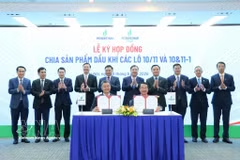
Participants at the signing ceremony (Photo: VNA)

Petrovietnam signs two major oil, gas agreements

The agreements underscore the commitment of Petrovietnam, the Petrovietnam Exploration Production Corporation (PVEP) and their partners to advancing oil and gas exploration, development and production activities, contributing to national energy security, optimising existing resources and creating new growth drivers for Vietnam’s energy industry.

At the investment promotion conference in Belgium on June 19 (Photo: VNA)

Tay Ninh seeks Belgian investment across sectors

Tay Ninh wishes to become a trusted partner of the Belgium business community, particularly in areas such as circular economy, clean energy, environmental technology, biotechnology and advanced agriculture.

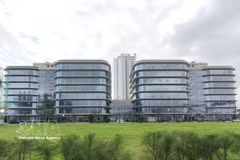
The operation centre of the Vietnam International Financial Centre in Da Nang (Photo: VNA)

Da Nang seeks opportunities in emerging fintech, Web3 wave

With special policy mechanisms approved by the National Assembly, plans for a free trade zone, an international financial centre and regional semiconductor and AI hubs, Da Nang has significant opportunities to pilot new technology and financial models while maintaining effective risk controls.

The factory area of ​​Intel, a major investor in the Ho Chi Minh City High-Tech Park (Photo: VNA)

Ho Chi Minh City targets AI, semiconductor investment in new-generation FDI drive

To prepare for a new generation of FDI attraction in line with Resolution No. 10-NQ/TW on the development of the foreign-invested sector, the city is expanding its high-tech development space. A newly approved 194.84ha expansion area in Long Phuoc ward is being planned under a “Green–Clean–Digital” model, with the goal of achieving carbon neutrality before 2050.

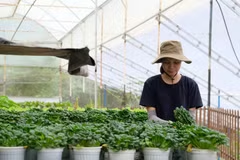
A worker harvest VietGAP-certified vegetables at a greenhouse farm in Da Lat, Lam Dong province, supplying both domestic and international markets. (Photo: VNA)

Lam Dong eyes opportunities in multi-trillion-dollar Halal market

Lam Dong boasts a diverse range of high-quality agricultural products, including vegetables, flowers, coffee, tea, fruit and processed food products, providing a strong foundation for developing Halal-certified goods and services for markets in the Middle East, South Asia, Southeast Asia and Africa.

Vietnam has a total of 374,816 electric vehicles (EVs) in circulation nationwide as of the end of May 2026 (Photo: VNA)

Electric vehicle adoption accelerates in Vietnam

In the period leading up to 2030, the construction sector will prioritise areas with strong potential for reducing urban air pollution, particularly rail and road transport. Relevant agencies are developing criteria for green rest stops, green railway stations, green seaports, and green airports. These standards are expected to be finalised in 2026 and widely applied from 2027.

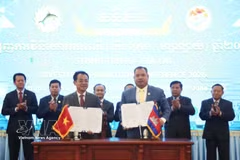
Within the framework of the conference, representatives from Cambodia's Stung Treng province and Phu Tai JSC of Vietnam's Gia Lai province sign a MoU on large-timber plantation investment research project (Photo: VNA)

Vietnamese, Cambodian localities boost investment cooperation

Permanent Vice Chairman of the Gia Lai People’s Committee Nguyen Tuan Thanh said the conference not only showcased Stung Treng’s investment potential and business environment, but also served as a practical platform for local authorities and enterprises of the two countries to exchange information, strengthen connections and explore new cooperation opportunities in investment, trade, agriculture, tourism, logistics and other sectors of mutual interest.

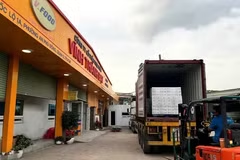
Container of ready-to-eat eggs exported to Japan by Vinh Thanh Dat (Photo: Thanhnien.vn)

Vietnamese poultry eggs enter Japanese market

The first shipment to Japan not only reflects Vinh Thanh Dat’s efforts to enhance the value of Vietnamese eggs but also opens new opportunities for processed egg products to access demanding international markets.

A car is refuelled at a Petrolimex station. (Photo: VNA)

Fuel prices cut for fourth straight adjustment

The publication of the E10RON95-III base price began from this pricing period under Government Resolution No. 29/2026/NQ-CP, as part of efforts to align domestic fuel prices with global market developments and improve price management.

Visitors explore smart electronic devices on display at the exhibition. (Photo: VNA)

Hundreds of companies join Automechanika Ho Chi Minh City 2026

This year’s three-day exhibition showcases leading international and regional brands, including VinFast of Vietnam, BYD Oway of China, Brembo of Italy, Daeheung of the Republic of Korea, Empire Motor of Japan, and TriAlliance GmbH of Germany.