Electric vehicle adoption accelerates in Vietnam

In the period leading up to 2030, the construction sector will prioritise areas with strong potential for reducing urban air pollution, particularly rail and road transport. Relevant agencies are developing criteria for green rest stops, green railway stations, green seaports, and green airports. These standards are expected to be finalised in 2026 and widely applied from 2027.

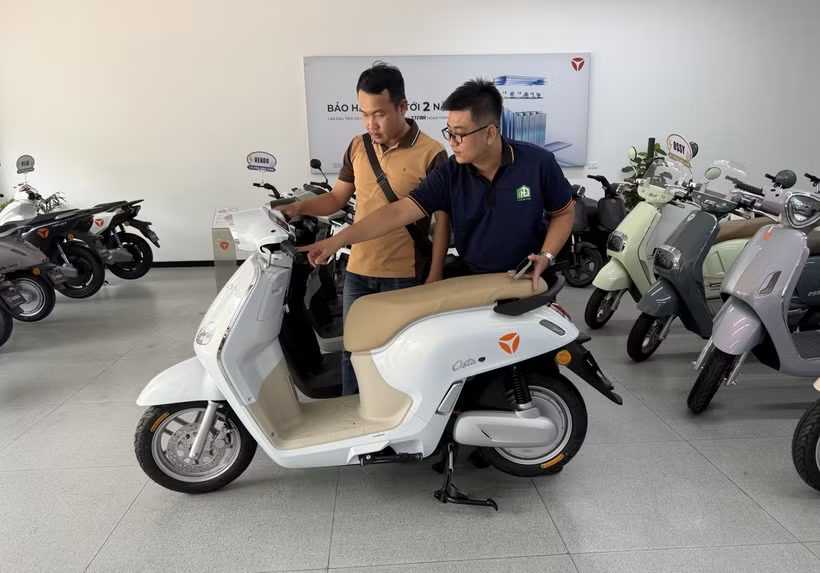
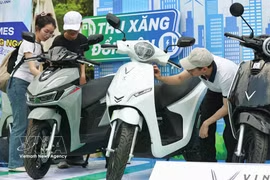
Vietnam has a total of 374,816 electric vehicles (EVs) in circulation nationwide as of the end of May 2026 (Photo: VNA)

Hanoi (VNA) – Vietnam had a total of 374,816 electric vehicles (EVs) in circulation nationwide as of the end of May 2026, reflecting a growing shift toward green transport, particularly in the private vehicle and public passenger transport segments.

The information was released by Tran Huu Minh, Deputy Director of the Department of Transport and Traffic Safety under the Ministry of Construction (MoC), at the ministry’s second-quarter press conference held in Hanoi on June 18.

According to official statistics, the total included 369,849 electric passenger cars, 3,396 electric trucks, and 1,571 electric buses. The rising number of EVs is helping to reshape public transport systems in major urban centres, while contributing to reductions in greenhouse gas emissions and improvements in urban air quality.

The progress has been attributed to the implementation of a range of policies and mechanisms introduced by the Government and relevant ministries. Key among them are Decision No. 876/QD-TTg issued by the Prime Minister and the Ministry of Construction’s Plan No. 1679 on green energy transition and the reduction of carbon and methane emissions in the transport sector.

Despite these achievements, Minh noted that the transition from conventional vehicles to electric cars and motorcycles continues to face significant challenges. Common concerns raised by residents and businesses include the availability of charging infrastructure, charging times, as well as investment and operating costs.

To further promote green transport, the MoC is reviewing and revising its green energy transition action programme. It is also coordinating with local authorities to integrate green transport infrastructure into urban planning, including EV charging networks and facilities for non-motorised transport.

At the same time, the ministry is developing a smart city criteria framework, with the potential to expand it into a Green-Smart City framework, providing localities with clearer benchmarks for implementation.

In the period leading up to 2030, the construction sector will prioritise areas with strong potential for reducing urban air pollution, particularly rail and road transport. Relevant agencies are developing criteria for green rest stops, green railway stations, green seaports, and green airports. These standards are expected to be finalised in 2026 and widely applied from 2027.

The ministry is also working with localities to review urban railway development plans in line with the amended Railway Law and National Assembly Resolution No. 188/2025/QH15. Efforts will focus on transit-oriented development (TOD) models and accelerating metro projects in Hanoi and Ho Chi Minh City.

In parallel, the ministry is promoting multimodal transport and restructuring the transport sector to reduce reliance on road transport. Priority will be given to developing modern, integrated transport corridors and policies that increase the share of rail, inland waterway, and maritime transport.

Authorities are also studying incentives to modernise railway, shipping, and aviation fleets, strengthen connectivity between transport modes, and enhance the competitiveness of logistics and international transport services./.

VNA

See more

The operation centre of the Vietnam International Financial Centre in Da Nang (Photo: VNA)

Da Nang seeks opportunities in emerging fintech, Web3 wave

With special policy mechanisms approved by the National Assembly, plans for a free trade zone, an international financial centre and regional semiconductor and AI hubs, Da Nang has significant opportunities to pilot new technology and financial models while maintaining effective risk controls.

The factory area of ​​Intel, a major investor in the Ho Chi Minh City High-Tech Park (Photo: VNA)

Ho Chi Minh City targets AI, semiconductor investment in new-generation FDI drive

To prepare for a new generation of FDI attraction in line with Resolution No. 10-NQ/TW on the development of the foreign-invested sector, the city is expanding its high-tech development space. A newly approved 194.84ha expansion area in Long Phuoc ward is being planned under a “Green–Clean–Digital” model, with the goal of achieving carbon neutrality before 2050.

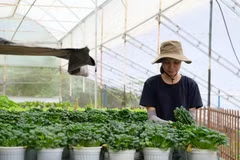
A worker harvest VietGAP-certified vegetables at a greenhouse farm in Da Lat, Lam Dong province, supplying both domestic and international markets. (Photo: VNA)

Lam Dong eyes opportunities in multi-trillion-dollar Halal market

Lam Dong boasts a diverse range of high-quality agricultural products, including vegetables, flowers, coffee, tea, fruit and processed food products, providing a strong foundation for developing Halal-certified goods and services for markets in the Middle East, South Asia, Southeast Asia and Africa.

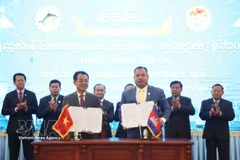
Within the framework of the conference, representatives from Cambodia's Stung Treng province and Phu Tai JSC of Vietnam's Gia Lai province sign a MoU on large-timber plantation investment research project (Photo: VNA)

Vietnamese, Cambodian localities boost investment cooperation

Permanent Vice Chairman of the Gia Lai People’s Committee Nguyen Tuan Thanh said the conference not only showcased Stung Treng’s investment potential and business environment, but also served as a practical platform for local authorities and enterprises of the two countries to exchange information, strengthen connections and explore new cooperation opportunities in investment, trade, agriculture, tourism, logistics and other sectors of mutual interest.

Container of ready-to-eat eggs exported to Japan by Vinh Thanh Dat (Photo: Thanhnien.vn)

Vietnamese poultry eggs enter Japanese market

The first shipment to Japan not only reflects Vinh Thanh Dat’s efforts to enhance the value of Vietnamese eggs but also opens new opportunities for processed egg products to access demanding international markets.

Vietnam is set to make long-term rental housing a key pillar of its social welfare strategy through 2030 - Illustrative image (Photo: VNA)

Vietnam advances long-term rental housing to meet growing housing demand

The accelerated development of social housing, along with the gradual formation of a long-term rental housing market, is expected to create a more diversified housing ecosystem that meets the needs of various groups, contributing to developing a more sustainable social welfare policy in the time to come

A car is refuelled at a Petrolimex station. (Photo: VNA)

Fuel prices cut for fourth straight adjustment

The publication of the E10RON95-III base price began from this pricing period under Government Resolution No. 29/2026/NQ-CP, as part of efforts to align domestic fuel prices with global market developments and improve price management.

Visitors explore smart electronic devices on display at the exhibition. (Photo: VNA)

Hundreds of companies join Automechanika Ho Chi Minh City 2026

This year’s three-day exhibition showcases leading international and regional brands, including VinFast of Vietnam, BYD Oway of China, Brembo of Italy, Daeheung of the Republic of Korea, Empire Motor of Japan, and TriAlliance GmbH of Germany.