ASEAN Future Forum: Vietnam at forefront of advancing ASEAN-centred regional architecture

Thayer observed that Vietnam is increasingly emerging as a regional hub not only for manufacturing but also for diplomacy, supported by an expanding network of international partnerships. In his view, AFF 2026 represents an open and forward-looking agenda in which Vietnam acts as a trailblazer, proposing and advancing new ideas for regional cooperation.

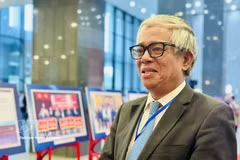
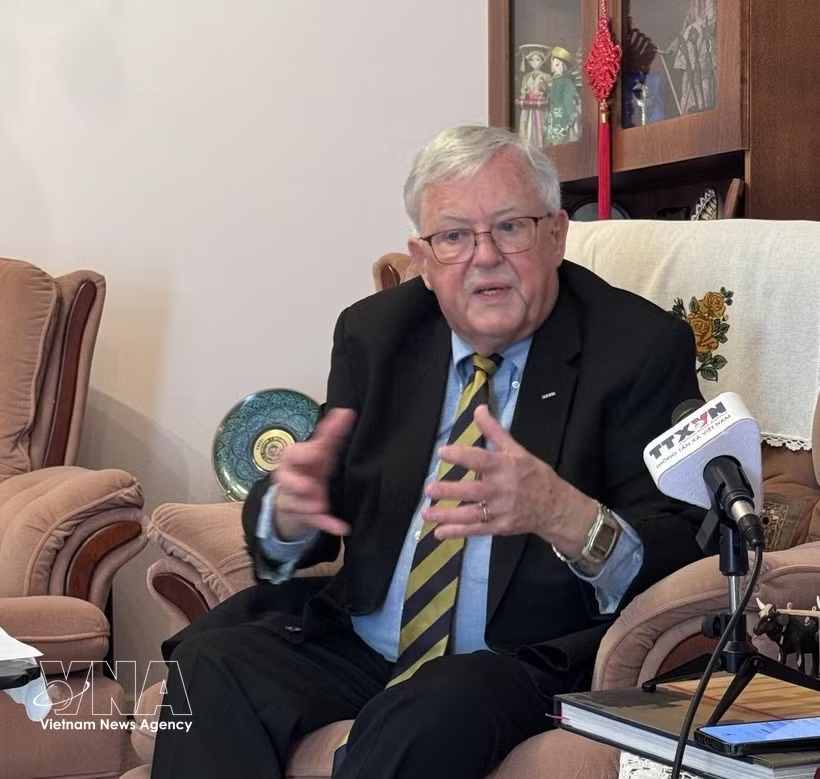
Professor Carl Thayer of the Australian Defence Force Academy at the University of New South Wales in an interview with the Vietnam News Agency. (Photo: VNA)

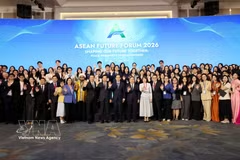
Sydney (VNA) – Vietnam has successfully sustained and elevated the ASEAN Future Forum (AFF) into a dynamic platform for dialogue and cooperation, contributing to regional exchanges while reinforcing ASEAN’s central role in shaping the region’s future, according to Professor Carl Thayer of the Australian Defence Force Academy at the University of New South Wales.

Thayer said that the forum extends beyond government participation to include business leaders, media representatives and academics; and features a broad range of activities, including discussions on the role of Southeast Asian political parties in ASEAN Community-building, youth aspirations toward 2030, and the Mekong subregion’s place in ASEAN’s cooperative architecture toward 2045.

According to the professor, one of the forum’s most notable achievements is Vietnam’s effort to translate ideas into practical action, including the integration of proposals into the ASEAN Community Vision 2045.

He stressed that ASEAN Community Vision 2045 should be viewed as an evolving process requiring continuous adaptation by member states to ensure the region remains stable, prosperous and people-centred. Security must also be understood in broader terms, encompassing not only military concerns but also human security, societal resilience, technology governance and preventive diplomacy.

This approach reflects Vietnam’s contribution to ASEAN’s agenda: prioritising practical solutions, fostering dialogue and incorporating the perspectives of citizens rather than relying solely on broad declarations, Thayer stated, highlighting the importance of research institutions and forums such as the AFF as spaces where new ideas can be tested, refined and developed before being translated into concrete policy measures.

Assessing the significance of Vietnam’s hosting of AFF 2026, the scholar said Vietnam is sending a clear message of political stability, modernisation and international integration. At the same time, it is demonstrating its readiness to contribute actively to shaping ASEAN’s agenda and institutional development.

Vietnam’s continued support for Mekong cooperation and developing countries, he added, forms an important backdrop to this year’s forum. Through the event, Vietnam has reaffirmed its commitment to working closely with ASEAN members and partners to build a peaceful, united, prosperous, resilient, innovative and people-centred ASEAN Community.

Thayer observed that Vietnam is increasingly emerging as a regional hub not only for manufacturing but also for diplomacy, supported by an expanding network of international partnerships. In his view, AFF 2026 represents an open and forward-looking agenda in which Vietnam acts as a trailblazer, proposing and advancing new ideas for regional cooperation.

He held that Vietnam could play a significant role in shaping an ASEAN-centred regional architecture. With Vietnam set to host APEC in 2027, opportunities may arise to enhance coordination between major regional gatherings, enabling leaders to participate in both APEC and East Asia meetings. Together with Singapore’s ASEAN Chairmanship in the same year, these factors could create favourable conditions for strengthening regional engagement and reinforcing ASEAN's centrality.

The expert also underscored that ASEAN's centrality must be built upon practical policy proposals capable of addressing emerging challenges. The immediate priority is to help manage major-power competition, and respond effectively to regional crises, thus contributing to strengthening strategic trust and shaping the regional architecture, he added./.

VNA
See more

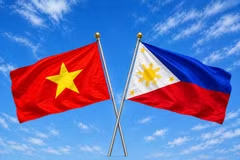
The national flags of Vietnam and the Philippines. Photo: VNA

Vietnam congratulates Philippines on Independence Day

General Secretary of the Communist Party of Vietnam and State President To Lam and Prime Minister Le Minh Hung on June 12 sent congratulatory messages to Philippine President Ferdinand Romualdez Marcos Jr on the occasion of the 128th anniversary of the Declaration of Independence of the Republic of the Philippines (June 12, 1898 – 2026).

Former Deputy Minister of Foreign Affairs Ambassador Pham Quang Vinh. (Photo: VNA)

AFF 2026 marks Vietnam’s transition from participant to regional agenda-setter

With sharp strategic mindset and a proven capacity for practical action at both bilateral and multilateral levels, Vietnam has demonstrated its role as a builder and agenda-setter, contributing to a robust platform for dialogue and cooperation in pursuit of a resilient, peaceful, and truly people-centred ASEAN Community by 2045

Party General Secretary and State President To Lam addresses the national conference disseminating and implementing Politburo Resolution No. 06-NQ/TW (Photo: VNA)

📝OP-ED: When foreign affairs pioneer in shaping nation's future

Resolution No. 06-NQ/TW represents both a continuation and a development of the Party’s comprehensive foreign policy and President Ho Chi Minh’s thought. If international integration helped create a favourable environment for development, diplomacy today is tasked with protecting and expanding that space.

An overview of the 4th session of the 17th Hanoi People’s Council for the 2026–2031 term. (Photo: VNA)

Capital Law 2026 paves way for Hanoi’s new development model

One of the key breakthroughs of the new resolutions is the shift from a traditional management-oriented approach to a development-enabling model. The proposed policies are designed not only to address current issues but also to establish the foundation for a more modern, proactive and flexible system of urban governance.

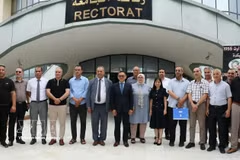
Vietnamese Ambassador to Algeria Tran Quoc Khanh (seventh from left) poses for a group photo with the leaders and staff of the University of Skikda. (Photo: VNA)

Vietnam, Algeria strengthen agricultural trade connectivity

Vietnam’s main exports to Algeria include coffee, cashew nuts, pepper, textiles and garments, steel and selected industrial products, while the North African country sells animal feed, chemicals, dates and other agricultural products to Vietnam.

Vietnamese Deputy Minister of Foreign Affairs Le Thi Thu Hang speaks at the forum. (Photo: VNA)

Vietnam, Switzerland eye stronger economic connectivity

Vietnamese Deputy Minister of Foreign Affairs Le Thi Thu Hang expressed Vietnam’s desire to see Swiss enterprises expand their long-term presence and investment in the country, particularly in high technology, innovation, renewable energy, pharmaceuticals, healthcare and digital transformation. She also emphasised cooperation in talent development, high-end tourism and international financial centre development.

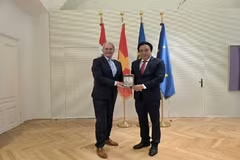
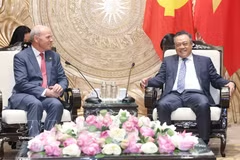
Chairman of the People’s Committee of Hue city Nguyen Khac Toan (right) presents a souvenir to Karl Wilfing, President of the State Parliament of Lower Austria. (Photo: People’s Committee of Hue city)

Hue city moves to deepen multifaceted cooperation with Austrian partners

Toan proposed Lower Austria consider establishing an official cooperation mechanism with Hue to facilitate investment collaboration in tourism, education and training, healthcare, information technology, green and smart urban development, heritage conservation, hi-tech agriculture and sustainable development.

Prime Minister Le Minh Hung chairs the working session with the Standing Board of the Hanoi Party Committee on June 11. (Photo: VNA)

Prime Minister urges Hanoi to target higher growth, become leading innovation hub

The PM emphasised that Hanoi must achieve its 11% growth target for 2026 through comprehensive solutions and regular reviews of growth scenarios. He called on the city to unlock growth potential in processing, manufacturing, trade, services, finance, banking, insurance, transport, logistics, construction and real estate, while controlling inflation and market stability.

Party General Secretary and State President To Lam addresses the conference. (Photo: VNA)

Top leader calls for better quality of institutional development

Party General Secretary and State President Lam underscored the need for a new mindset that places judicial reforms within a unified rule-of-law framework: good law-making, strict law enforcement, an honest judiciary, safeguarded justice, controlled power, protected human and citizens’ rights, and national development supported by a transparent, effective and coherent institutional system.

A damaged road is seen following the earthquake near General Santos City, the Philippines, on June 9, 2026. (Photo: Xinhua/VNA)

Messages of sympathy sent to Philippines over losses caused by earthquake

General Secretary of the Communist Party of Vietnam Central Committee and State President To Lam, and Prime Minister Le Minh Hung on June 11 sent messages of sympathy to Philippine President Ferdinand Romualdez Marcos over great losses of life and property caused by a recent earthquake in the southern Philippines.