Coffee Citizens model aims to lift Vietnamese value chain

As global consumers place greater emphasis on quality, traceability and sustainability, Vietnam is increasingly looking beyond export volumes and seeking ways to create more value from every bean it produces.

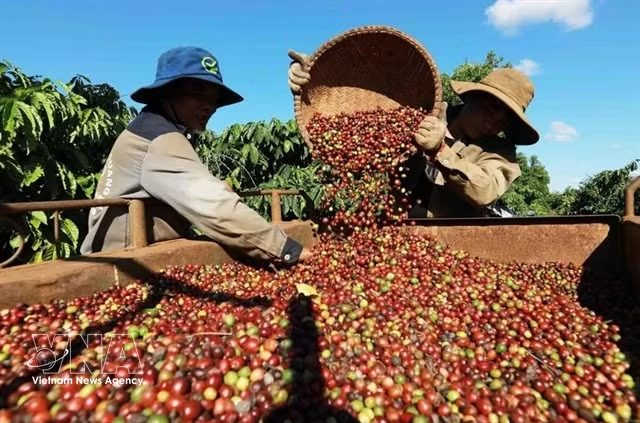
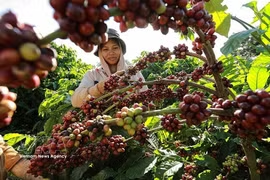
Farmers harvesting coffee.(Photo: VNA)

Hanoi (VNS/VNA) - Vietnam is one of the world’s leading coffee exporters and the largest producer of Robusta coffee, yet it captures only a limited share of industry value as most coffee is exported raw while the highest profits lie in processing, trading and branding.

This imbalance has become one of the defining challenges facing the industry. As global consumers place greater emphasis on quality, traceability and sustainability, Vietnam is increasingly looking beyond export volumes and seeking ways to create more value from every bean it produces.

Against this backdrop, the Global Coffee Alliance (GCA) sees an opportunity for Vietnam, particularly the Central Highlands, to become a global coffee hub that brings together every stage of the value chain from production and processing to technology, culture and tourism.

Behind this vision lies a fundamental challenge that has long limited the development of Vietnam’s coffee industry: information asymmetry.

A representative of Intimex Buon Ma Thuot told the Thoi bao Ngan hang (Banking Times) online newspaper that the industry's biggest weakness today is not technology or capital but a lack of transparency and equal access to information.

“Farmers have little access to market data. They sell based on prevailing purchasing prices but often lack visibility into long-term market trends and consumer demand. International buyers, meanwhile, typically have a much clearer understanding of such information,” the company noted.

As a result, coffee growers often find themselves in a reactive position when prices fluctuate. When prices rise, they rush to sell to secure profits. When prices fall, they often lack the information needed to determine whether they should hold inventory or adjust production strategies.

This dynamic has made the coffee value chain less resilient and more difficult to upgrade, he said.

It is against this backdrop that the GCA has introduced the concept of Coffee Citizens, a digitally connected network designed to bring together all stakeholders in the coffee ecosystem.

The model aims to connect farmers, cooperatives, processors, exporters, retailers and consumers through a shared digital infrastructure. Information related to cultivation, harvesting, processing and distribution would be digitised and made transparent across the entire supply chain.

Le Hoang Diep Thao, CEO of King Coffee, said the model's core value lies in closing the information gap that has long disadvantaged farmers. Greater transparency would allow farmers to play a more active role in the value chain rather than remaining its weakest link, she said.

Despite its potential, turning the Coffee Citizens vision into reality will not be easy.

One of the biggest challenges is technological infrastructure and digital adoption. Most coffee farms in Vietnam remain small-scale operations and many farmers have limited digital capabilities. Without strong support from businesses and government agencies, participation in a digital ecosystem may prove difficult.

Data standardisation and verification also present significant challenges. Any global platform requires common standards to ensure that information remains accurate, consistent and trustworthy.

Ultimately, technology is only a tool. The more important task is creating governance mechanisms and building trust among participants. Without trust and collaboration, even the most advanced digital systems will struggle to deliver meaningful results.

Despite these challenges, industry leaders believe initiatives such as the GCA and the Coffee Citizens model could help reposition Vietnam’s coffee sector.

Rather than competing primarily on volume and low costs, the industry has an opportunity to compete on quality, transparency and value creation in line with evolving global consumer expectations./.

VNA
See more

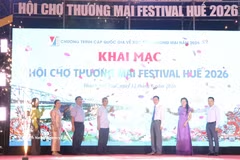
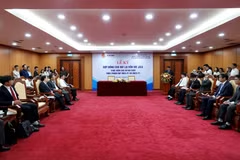
The opening ceremony of the Hue Festival Trade Fair 2026. (Photo: VNA)

Hue Festival Trade Fair 2026 opens with 240 booths

For Hue, the fair is also an opportunity to introduce the image of a dynamic and business-friendly locality while promoting local specialties, One Commune One Product (OCOP) items and outstanding rural industrial products, helping stimulate trade, services, tourism and investment attraction.

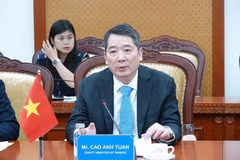
Deputy Minister of Finance Cao Anh Tuan at the meeting with the delegation of the RoK Embassy led by Ambassador Choi Young-sam on June 12 (Photo: mof.gov.vn)

Ambassador pledges more contributions to Vietnam – RoK economic links

Deputy Minister of Finance Cao Anh Tuan congratulated Ambassador Choi Young-sam on his successful tenure in Vietnam and praised his contributions to the substantive and productive development of the Vietnam – RoK Comprehensive Strategic Partnership across various fields, including economic and financial cooperation.

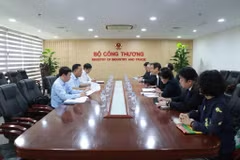
The working session between Deputy Minister of Industry and Trade Nguyen Hoang Long and IKC Representative Director and Executive Vice President Atsuhiko Hirano in Hanoi on June 12 (Photo: Vietnamese Ministry of Industry and Trade)

Vietnam, Japan cultivate energy collaboration

Deputy Minister of Industry and Trade Nguyen Hoang Long urged Idemitsu to leverage its role as a strategic shareholder and team up with other partners to respond swiftly to geopolitical shifts, ensuring a stable, sustainable crude oil flow to the refinery.

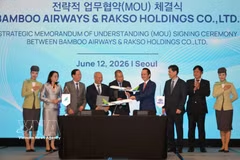
Leaders of Bamboo Airways and Rakso Holdings Co.Ltd sign an MoU to promote cooperation in the aviation, tourism and service sectors at the forum in Seoul on June 12. (Photo: VNA)

FLC Group seeks to expand investment cooperation in RoK

Ambassador Vu Ho suggested enhancing Vietnam – RoK ties in tourism, aviation and flexible investment models to develop flagship projects meeting high standards, helping herald a new cooperation phase between the two countries.

Delegates press the buttons to launch the Meiko Yen Quang semiconductor manufacturing plant project. (Photo: VNA)

Work starts on 500-million-USD Meiko semiconductor plant in Phu Tho province

The project has an initial investment of more than 500 million USD and will focus on artificial intelligence and space technology-related applications. Once fully operational, it is expected to generate annual revenue of around 530 million USD per year and create approximately 2,000 jobs for local workers.

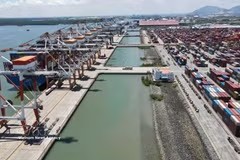
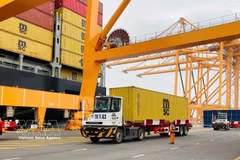
Cargo handling operations at Berths 3 and 4 of the Hai Phong International Gateway Port. (Photo: VNA)

AI reshapes logistics, raising bar for workforce skills

According to the Vietnam Logistics Business Association (VLA), the logistics sector will require around 2.2 million workers by 2030, including 1.6 million employees for logistics service providers and nearly 600,000 personnel supporting logistics operations in manufacturing and trading enterprises.

The site planned for the Ninh Thuan 1 nuclear power plant in Phuoc Dinh commune of Khanh Hoa province (Photo: VNA)

Nuclear power projects to transform Khanh Hoa coastal communities

Khanh Hoa province aims to hand over fully cleared sites to investors by June 30, 2026. For Ninh Thuan 1, both the plant site and the resettlement zone are scheduled for completion by June 30. For Ninh Thuan 2, the plant site is due on June 15, with the resettlement area following by June 30.

Professor Tao Yitao, Director of the China Centre for Special Economic Zone Research (Photo: VNA)

Stable beginnings, powerful breakthroughs for Vietnam’s private economic sector

Vietnam is now at a critical juncture in pursuing what its leadership has described as a new era of national rise. In the long term, the development of the private economic sector will depend not only on supportive policies but also on a stable, transparent institutional environment that guarantees fair competition, said Professor Tao Yitao, Director of the China Centre for Special Economic Zone Research.

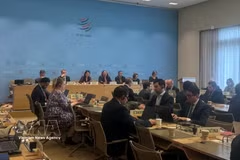
The trade policy review of Uruguay at the WTO headquarters. (Photo: VNA)

Vietnam participates in WTO review of Uruguay's trade policy

Vietnam also welcomed Uruguay's active engagement in the multilateral trading system as a founding member of the WTO. Uruguay has ratified the Agreement on Fisheries Subsidies, joined the Multi-Party Interim Appeal Arbitration Arrangement (MPIA), and contributed to Joint Statement Initiatives (JSIs) on e-commerce and micro, small and medium-sized enterprises (MSMEs).

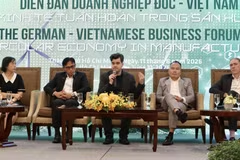
Experts discuss cooperation opportunities in Vietnam-Germany manufacturing value chains at the forum. (Photo: VNA)

Vietnam-Germany cooperation creates new opportunities for sustainable manufacturing

Germany is an important partner of Vietnam and a global leader in green technology, smart manufacturing, automation and circular economy solutions. The combination of German technological expertise and Vietnam's manufacturing capabilities and strong commitment to transformation would create significant opportunities in green production, supporting industries, digital transformation, supply chain management and eco-industrial park development.