Nuclear power projects to transform Khanh Hoa coastal communities

Khanh Hoa province aims to hand over fully cleared sites to investors by June 30, 2026. For Ninh Thuan 1, both the plant site and the resettlement zone are scheduled for completion by June 30. For Ninh Thuan 2, the plant site is due on June 15, with the resettlement area following by June 30.

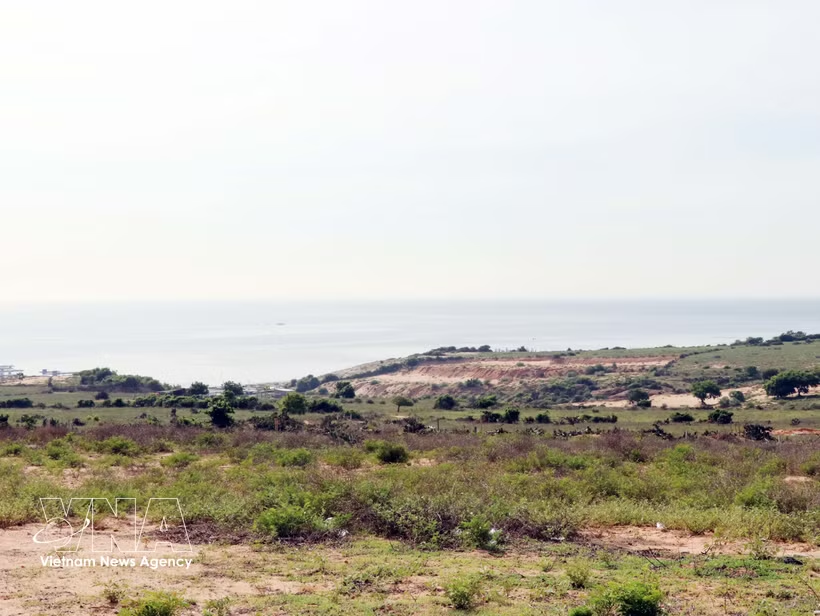
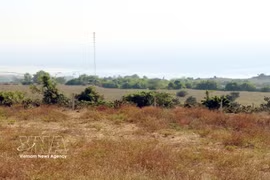
The site planned for the Ninh Thuan 1 nuclear power plant in Phuoc Dinh commune of Khanh Hoa province (Photo: VNA)

Khanh Hoa (VNA) – Two remote communes in the south-central coastal province of Khanh Hoa, long marked by sand dunes, sparse population and scant economic opportunities, are on the cusp of an industrial transformation after being tapped to host the Ninh Thuan 1 and Ninh Thuan 2 nuclear power plants.

Betting on a breakthrough

Phuoc Dinh and Vinh Hai, two newly merged communes, came into existence on July 1, 2025 under a National Assembly Standing Committee resolution reshuffling Khanh Hoa’s commune-level administrative units.

Post-merger, Phuoc Dinh spans roughly 154 sq.km, comprises 13 residential areas, and is home to about 35,300 people, with ethnic minorities making up around 7%. The commune is designated a key economic zone in the province’s south.

Vinh Hai, meanwhile, covers more than 16,000 ha and counts over 36,000 residents, mostly from Kinh and Raglai ethnic groups, who rely on farming, fishing and aquaculture.

Phuoc Dinh and Vinh Hai both benefit from their location along a coastal corridor stretching more than 106 kilometers, with seamless connectivity to National Highway 1, the North–South railway, the North–South expressway, and nearby seaports. Coupled with this well-developed and integrated transport infrastructure, the resumption of the Ninh Thuan 1 and Ninh Thuan 2 nuclear power projects has created additional favourable conditions and growth momentum for the two communes as they embark on a new stage of development.

Reshaping development landscape

The two nuclear plants hold strategic importance for socio-economic development of both the country and Khanh Hoa itself, drawing sustained attention and unified direction from the Party, National Assembly and Government leaders.

With a five-year construction target, Khanh Hoa authorities are under orders to wrap up compensation, site clearance and land recovery for both projects in the second quarter, as demanded by the Prime Minister.

According to Vice Chairman of the provincial People’s Committee Trinh Minh Hoang, strong public backing has accelerated progress, aided by concrete compensation, support and resettlement policies.

The province aims to hand over fully cleared sites to investors by June 30, 2026. For Ninh Thuan 1, both the plant site and the resettlement zone are scheduled for completion by June 30. For Ninh Thuan 2, the plant site is due on June 15, with the resettlement area following by June 30.

Hoang said the plants will deliver 4,600MW of baseload power, reinforce national energy security, and support Vietnam’s shift to cleaner energy generation and its net-zero emissions pledge by 2050.

Beyond electricity, the projects are expected to become a powerful economic engine of Khanh Hoa by drawing new investment, building out supporting industries, upgrading transport links, creating construction and operational jobs, and raising the technical skill base of the local workforce.

Truong Xuan Vy, Secretary of the Phuoc Dinh commune Party Committee, said the locality is accelerating the revision of its master construction plan, reorganise development space, and create land reserves to attract investment in industries and services that directly support the construction of the nuclear power plants. Particular emphasis will be placed on housing services for workers, as well as catering, lodging, leisure, and entertainment-related services.

Both communes count on the projects to fully unlock their existing strengths in marine economy, renewable and conventional energy, tourism, hi-tech agriculture and mineral resources, transforming them into major economic hubs in the province’s south./.

VNA

See more

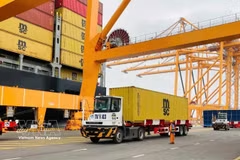
Cargo handling operations at Berths 3 and 4 of the Hai Phong International Gateway Port. (Photo: VNA)

AI reshapes logistics, raising bar for workforce skills

According to the Vietnam Logistics Business Association (VLA), the logistics sector will require around 2.2 million workers by 2030, including 1.6 million employees for logistics service providers and nearly 600,000 personnel supporting logistics operations in manufacturing and trading enterprises.

Professor Tao Yitao, Director of the China Centre for Special Economic Zone Research (Photo: VNA)

Stable beginnings, powerful breakthroughs for Vietnam’s private economic sector

Vietnam is now at a critical juncture in pursuing what its leadership has described as a new era of national rise. In the long term, the development of the private economic sector will depend not only on supportive policies but also on a stable, transparent institutional environment that guarantees fair competition, said Professor Tao Yitao, Director of the China Centre for Special Economic Zone Research.

The trade policy review of Uruguay at the WTO headquarters. (Photo: VNA)

Vietnam participates in WTO review of Uruguay's trade policy

Vietnam also welcomed Uruguay's active engagement in the multilateral trading system as a founding member of the WTO. Uruguay has ratified the Agreement on Fisheries Subsidies, joined the Multi-Party Interim Appeal Arbitration Arrangement (MPIA), and contributed to Joint Statement Initiatives (JSIs) on e-commerce and micro, small and medium-sized enterprises (MSMEs).

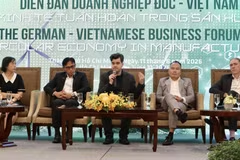
Experts discuss cooperation opportunities in Vietnam-Germany manufacturing value chains at the forum. (Photo: VNA)

Vietnam-Germany cooperation creates new opportunities for sustainable manufacturing

Germany is an important partner of Vietnam and a global leader in green technology, smart manufacturing, automation and circular economy solutions. The combination of German technological expertise and Vietnam's manufacturing capabilities and strong commitment to transformation would create significant opportunities in green production, supporting industries, digital transformation, supply chain management and eco-industrial park development.

Businesses introduce Halal market products at the workshop. (Photo: VNA)

Da Nang businesses eye growth in booming global Halal market

Huynh Xuan Son, Deputy Director of the Da Nang Department of Industry and Trade, said the Halal market has emerged as a strategic destination for Vietnamese exporters amid persistent global economic uncertainties. Serving more than two billion consumers across over 110 countries and territories, the market offers significant opportunities for business expansion.

Vietnamese bananas are sold at an AEON supermarket in Japan. (Photo: VNA)

Vietnamese products promoted at AEON stores across Japan

Speaking at the opening ceremony, Deputy Minister of Industry and Trade Phan Thi Thang highlighted the significance of 2026, which marks a decade of cooperation between the ministry and AEON in organising Vietnam Week in Japan.

Growing demand for financing for infrastructure and green transition projects is driving Vietnam’s search for new sources of capital. In the photo: A section of Noi Bai – Lao Cai Expressway. (Photo: VNA)

Vietnam seeks to unlock capital for infrastructure, green transition

As Vietnam advances its sustainable growth agenda and commitment to achieving net-zero emissions by 2050, the need for long-term capital is rising rapidly. Experts say meeting these financing requirements will depend not only on expanding available resources but also on broadening funding sources and improving project financing models.