AI reshapes logistics, raising bar for workforce skills

According to the Vietnam Logistics Business Association (VLA), the logistics sector will require around 2.2 million workers by 2030, including 1.6 million employees for logistics service providers and nearly 600,000 personnel supporting logistics operations in manufacturing and trading enterprises.

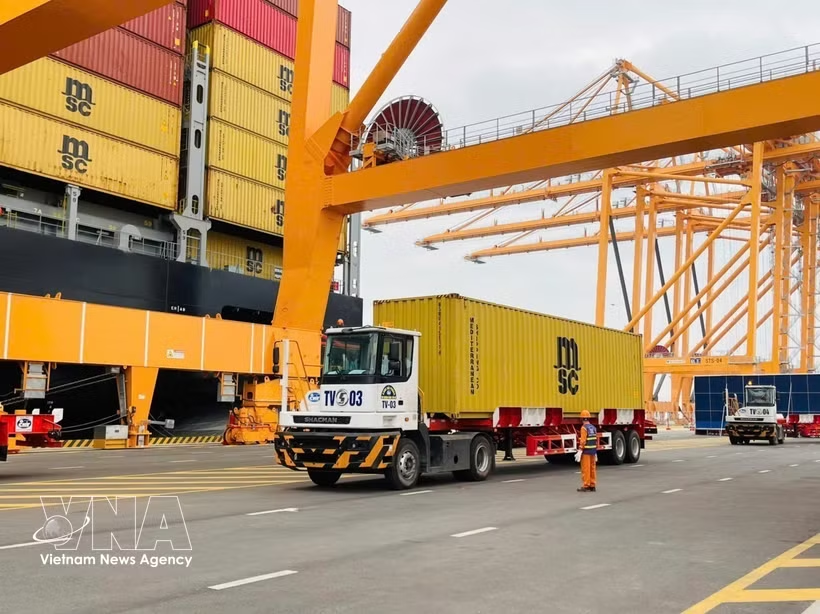
Cargo handling operations at Berths 3 and 4 of the Hai Phong International Gateway Port. (Photo: VNA)

Hanoi (VNA) - As logistics increasingly serves as the backbone of the economy, connecting production with markets and strengthening national competitiveness, Vietnam faces an urgent need to develop a highly skilled workforce capable of adapting to artificial intelligence (AI), big data and the sector’s ongoing digital transformation.

According to the Vietnam Logistics Business Association (VLA), the logistics sector will require around 2.2 million workers by 2030, including 1.6 million employees for logistics service providers and nearly 600,000 personnel supporting logistics operations in manufacturing and trading enterprises.

However, training capacity remains limited. Vietnam currently has only about 30 universities offering logistics-related programmes, enrolling roughly 3,000 students annually, while colleges add just 800–1,000 graduates each year. The widening gap between labour demand and supply is placing increasing pressure on the job market, forcing many companies to recruit workers from other sectors and retrain them.

Experts argue that the challenge lies not only with quantity but also quality. As global supply chains become more complex and volatile, businesses need workers who can analyse data, manage systems, operate digital technologies and respond effectively to emerging challenges, rather than simply perform routine tasks.

Hoang Dinh Kien, General Director of Hoa Phat Logistics JSC, said students generally possess a solid academic foundation but often lack practical skills, particularly problem-solving capabilities in real-world working environments.

According to Nguyen Anh Duong of the Institute for Policy and Strategy Studies under the Party Central Committee's Commission for Policies and Strategies, digital transformation has become essential for enhancing competitiveness. AI can help businesses forecast demand, optimise transportation, improve operational efficiency and reduce costs, while automating many repetitive tasks.

As a result, the labour market is increasingly prioritising candidates who can apply technology, leverage data and use AI as a decision-support tool. Kien stressed that, at a minimum, students should be able to use AI in their work and understand management principles in technology-driven operating environments.

Van Ha, Secretary General of the Vietnam Association for Logistics Manpower Development (VALOMA), said many universities have revamped their curricula to better align with industry needs and strengthen partnerships with businesses. In addition to theoretical coursework, students are gaining exposure to practical modules, management software, enterprise resource planning (ERP) systems and simulation models, enabling them to experience real-world working environments while still at university.

Industry seminars, career talks, scientific research competitions and university-business networking programmes are also being organised regularly, helping students stay abreast of industry trends and improve their readiness for the labour market.

Phan Truong An, a student at CMC University who previously interned at Foxconn Group, said classroom knowledge provides an essential foundation, but hands-on experience in a corporate setting offers deeper insight into supply chain operations while helping students develop communication, teamwork and problem-solving skills.
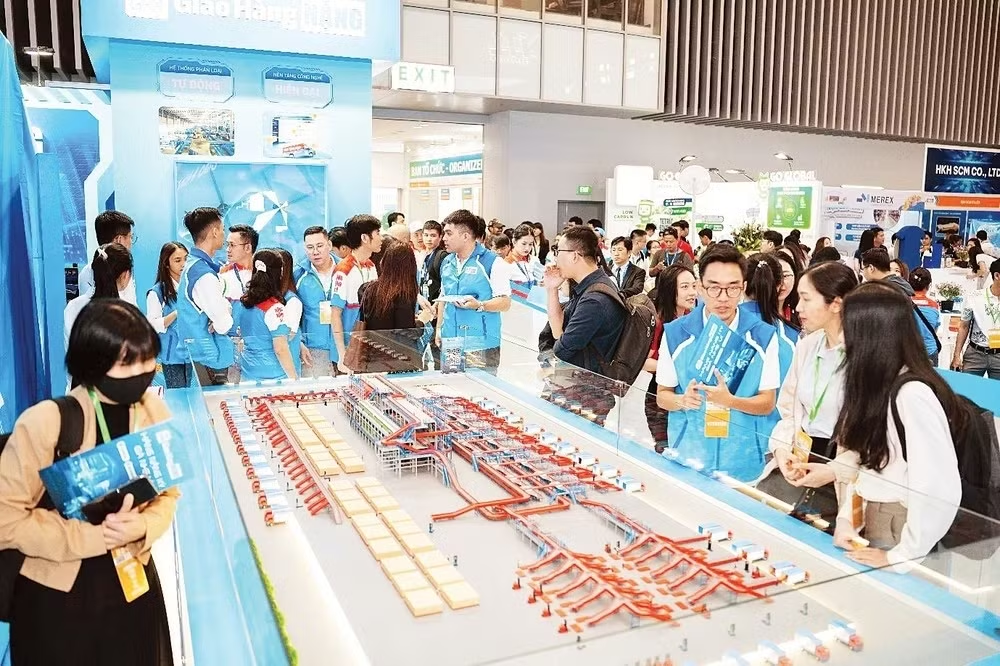
photo-2-1754451157933621307233-1754468908404-17544689085051640651135.jpg
AI-powered logistics solutions showcased at Vietnam International Logistics Exhibition 2025 (VILOG 2025) at the Saigon Exhibition and Convention Centre (SECC) in Ho Chi Minh City. (Photo: nhandan.vn)

Alongside logistics infrastructure development, Vietnam is advancing policies on AI, digital logistics and green logistics to improve supply chain efficiency and foster a high-quality workforce. Experts say training programmes must continue evolving through curriculum standardisation, stronger foreign-language instruction, enhanced digital and data-analysis skills, and the promotion of modern management thinking.

In addition to formal education, expanding short-term training, reskilling and upskilling programmes for the existing workforce will be crucial in helping workers adapt to technology-driven changes.

As AI reshapes the global logistics industry, business competitiveness will increasingly depend on workforce quality and technological capabilities. With logistics infrastructure improving, smart border gates being introduced and digital supply chains expanding, building a workforce with strong professional expertise, innovative thinking and technological adaptability will be key to elevating Vietnam’s logistics sector in the years ahead.

Developing logistics talent is therefore not only a responsibility of educational institutions and businesses but also a strategic imperative for strengthening Vietnam’s competitiveness in the digital era./.
VNA

See more

Coffee, often referred to as the “brown gem” of Lam Dong, is one of the province’s signature agricultural products. (Photo: VNA)

Lam Dong reshapes coffee industry to elevate export value

Lam Dong plans to strengthen branding and trade promotion efforts, develop coffee-growing regions linked to geographical indications, expand digital traceability systems and make greater use of free trade agreements (FTAs) to diversify export markets.

The site planned for the Ninh Thuan 1 nuclear power plant in Phuoc Dinh commune of Khanh Hoa province (Photo: VNA)

Nuclear power projects to transform Khanh Hoa coastal communities

Khanh Hoa province aims to hand over fully cleared sites to investors by June 30, 2026. For Ninh Thuan 1, both the plant site and the resettlement zone are scheduled for completion by June 30. For Ninh Thuan 2, the plant site is due on June 15, with the resettlement area following by June 30.

Professor Tao Yitao, Director of the China Centre for Special Economic Zone Research (Photo: VNA)

Stable beginnings, powerful breakthroughs for Vietnam’s private economic sector

Vietnam is now at a critical juncture in pursuing what its leadership has described as a new era of national rise. In the long term, the development of the private economic sector will depend not only on supportive policies but also on a stable, transparent institutional environment that guarantees fair competition, said Professor Tao Yitao, Director of the China Centre for Special Economic Zone Research.

The trade policy review of Uruguay at the WTO headquarters. (Photo: VNA)

Vietnam participates in WTO review of Uruguay's trade policy

Vietnam also welcomed Uruguay's active engagement in the multilateral trading system as a founding member of the WTO. Uruguay has ratified the Agreement on Fisheries Subsidies, joined the Multi-Party Interim Appeal Arbitration Arrangement (MPIA), and contributed to Joint Statement Initiatives (JSIs) on e-commerce and micro, small and medium-sized enterprises (MSMEs).

Experts discuss cooperation opportunities in Vietnam-Germany manufacturing value chains at the forum. (Photo: VNA)

Vietnam-Germany cooperation creates new opportunities for sustainable manufacturing

Germany is an important partner of Vietnam and a global leader in green technology, smart manufacturing, automation and circular economy solutions. The combination of German technological expertise and Vietnam's manufacturing capabilities and strong commitment to transformation would create significant opportunities in green production, supporting industries, digital transformation, supply chain management and eco-industrial park development.

Businesses introduce Halal market products at the workshop. (Photo: VNA)

Da Nang businesses eye growth in booming global Halal market

Huynh Xuan Son, Deputy Director of the Da Nang Department of Industry and Trade, said the Halal market has emerged as a strategic destination for Vietnamese exporters amid persistent global economic uncertainties. Serving more than two billion consumers across over 110 countries and territories, the market offers significant opportunities for business expansion.

Vietnamese bananas are sold at an AEON supermarket in Japan. (Photo: VNA)

Vietnamese products promoted at AEON stores across Japan

Speaking at the opening ceremony, Deputy Minister of Industry and Trade Phan Thi Thang highlighted the significance of 2026, which marks a decade of cooperation between the ministry and AEON in organising Vietnam Week in Japan.

Growing demand for financing for infrastructure and green transition projects is driving Vietnam’s search for new sources of capital. In the photo: A section of Noi Bai – Lao Cai Expressway. (Photo: VNA)

Vietnam seeks to unlock capital for infrastructure, green transition

As Vietnam advances its sustainable growth agenda and commitment to achieving net-zero emissions by 2050, the need for long-term capital is rising rapidly. Experts say meeting these financing requirements will depend not only on expanding available resources but also on broadening funding sources and improving project financing models.