Ca Mau province tightens fishing vessel controls to combat IUU fishing

The new regulations place strong emphasis on the use of digital management tools, including the Vessel Monitoring System (VMS), the electronic Catch Documentation and Traceability system (eCDT), and the national fisheries database.

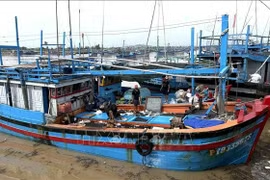
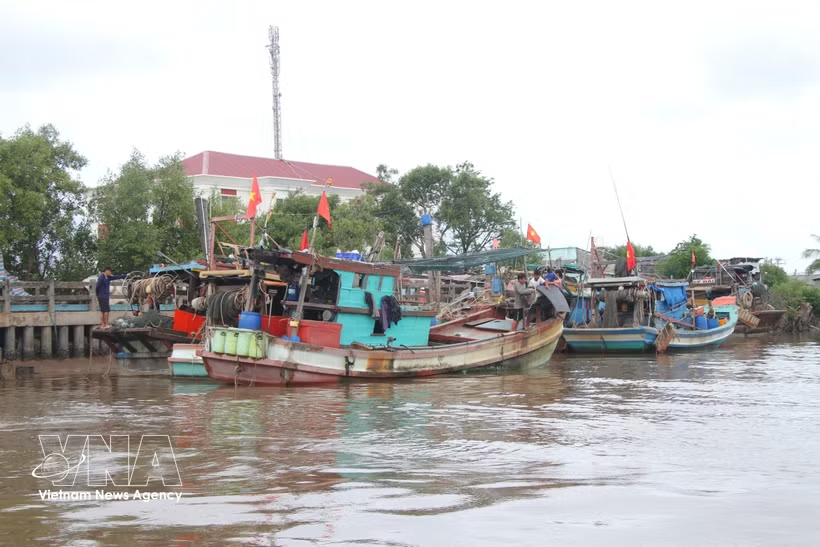
Boats are anchored at the Ganh Hao estuary in Ganh Hao commune, Ca Mau province. (Photo: VNA)

Ca Mau (VNA) – The southernmost province of Ca Mau has taken stricter measures to monitor fishing vessel movements and combat illegal, unreported and unregulated (IUU) fishing as part of efforts to secure the removal of the European Commission’s (EC) yellow card warning against Vietnamese seafood exports.

Chairman of the provincial People’s Committee Lu Quang Ngoi recently signed a decision establishing regulations on coordination in monitoring fishing vessels entering and leaving ports, sharing information and handling IUU-related violations.

The move is considered a key step in cleaning up fishing vessel data, strengthening discipline at sea and promoting a sustainable, responsible and internationally integrated fisheries sector.

Technology-driven monitoring

The new regulations place strong emphasis on the use of digital management tools, including the Vessel Monitoring System (VMS), the electronic Catch Documentation and Traceability system (eCDT), and the national fisheries database.

Under the framework, the provincial Department of Agriculture and Environment will provide fishing licence, vessel safety and voyage data to border guards and relevant agencies to support monitoring and enforcement. It will also maintain continuous surveillance to detect and address violations promptly.

Meanwhile, the provincial Border Guard Command will conduct strict inspections before vessels are allowed to depart. Fishing boats may leave port only if they meet all legal requirements, have functioning VMS equipment and possess valid confirmation from designated fishing ports.

Departure and arrival data recorded in the fishing vessel management system will be linked directly with the eCDT platform to strengthen traceability.

The Department of Agriculture and Environment, including fishing port management boards and the provincial IUU Office, will verify vessel information, monitor unloaded catches, issue port entry and exit certificates, and ensure all data are entered into the eCDT system.

Relevant agencies will conduct weekly or ad hoc data cross-checks to identify and address inaccurate declarations.

Rapid information sharing, stricter enforcement

The province has also established a mechanism for rapid information exchange among authorities to prevent violations such as incursions into foreign waters and disruptions to VMS signals.

Information on vessels losing VMS connection, crossing maritime boundaries or failing to meet operating requirements must be shared promptly through electronic systems and direct communication channels.

Direct links have been established among commune-level authorities, border guard stations, fisheries surveillance units and IUU offices. When unusual signals are detected, authorities will coordinate with vessel owners’ families to issue timely warnings.

For enforcement, agencies are required to cooperate closely from documenting violations and conducting investigations to completing legal procedures. Cases showing signs of criminal offences must be handled without delay, while any decision not to impose penalties must be supported by clear evidence.

The Department of Agriculture and Environment is designated as the lead agency responsible for coordinating and monitoring implementation across the province.

The provincial Border Guard Command will provide timely information on violating vessels, particularly those at high risk of entering foreign waters, and coordinate enforcement measures.

At the grassroots level, commune authorities must compile lists of vessels that fail to meet operating requirements and assign officials to monitor them. Local administrations will be held accountable for failing to detect or address violations in their jurisdictions.

Ca Mau has implemented a range of measures in recent years to strengthen fisheries management, including awareness campaigns aimed at improving compliance among fishing communities.

With more than 310 kilometres of coastline and a fishing fleet of over 5,000 vessels, the province has significant marine economic potential. However, the EC’s yellow card warning remains a major obstacle to the fisheries sector.

Provincial authorities view efforts to have the warning removed not only as a way to facilitate seafood exports and expand market access, but also as part of a broader commitment to protecting marine resources and building a transparent, sustainable fisheries industry./.

VNA
See more

Czech Deputy Prime Minister and Finance Minister Alena Schillerová expresses her delight at meeting the Vietnamese community in Brno. (Photo: VNA)

MoU expected to support Vietnamese businesses in Czech Republic

The signing marked a new step forward in enhancing connectivity between Czech state management agencies and the Vietnamese business community and household businesses, helping citizens gain faster and more accurate access to legal regulations related to business activities in the Czech Republic.

Delegates at the France-Vietnam Business Forum 2026 (Photo: VNA)

FPT links Vietnamese, French businesses to advance AI transformation

Present in France since 2008, FPT now serves as a technology partner to major enterprises including La Poste, Air Liquide, Quadient, Sagemcom, SNCF and Geopost. It aims to become one of the top 50 IT firms in France while further expanding its footprint across French-speaking markets.

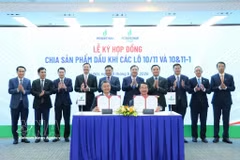
Participants at the signing ceremony (Photo: VNA)

Petrovietnam signs two major oil, gas agreements

The agreements underscore the commitment of Petrovietnam, the Petrovietnam Exploration Production Corporation (PVEP) and their partners to advancing oil and gas exploration, development and production activities, contributing to national energy security, optimising existing resources and creating new growth drivers for Vietnam’s energy industry.

At the investment promotion conference in Belgium on June 19 (Photo: VNA)

Tay Ninh seeks Belgian investment across sectors

Tay Ninh wishes to become a trusted partner of the Belgium business community, particularly in areas such as circular economy, clean energy, environmental technology, biotechnology and advanced agriculture.

The operation centre of the Vietnam International Financial Centre in Da Nang (Photo: VNA)

Da Nang seeks opportunities in emerging fintech, Web3 wave

With special policy mechanisms approved by the National Assembly, plans for a free trade zone, an international financial centre and regional semiconductor and AI hubs, Da Nang has significant opportunities to pilot new technology and financial models while maintaining effective risk controls.

The factory area of ​​Intel, a major investor in the Ho Chi Minh City High-Tech Park (Photo: VNA)

Ho Chi Minh City targets AI, semiconductor investment in new-generation FDI drive

To prepare for a new generation of FDI attraction in line with Resolution No. 10-NQ/TW on the development of the foreign-invested sector, the city is expanding its high-tech development space. A newly approved 194.84ha expansion area in Long Phuoc ward is being planned under a “Green–Clean–Digital” model, with the goal of achieving carbon neutrality before 2050.

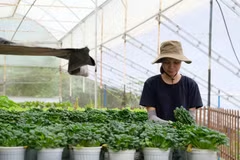
A worker harvest VietGAP-certified vegetables at a greenhouse farm in Da Lat, Lam Dong province, supplying both domestic and international markets. (Photo: VNA)

Lam Dong eyes opportunities in multi-trillion-dollar Halal market

Lam Dong boasts a diverse range of high-quality agricultural products, including vegetables, flowers, coffee, tea, fruit and processed food products, providing a strong foundation for developing Halal-certified goods and services for markets in the Middle East, South Asia, Southeast Asia and Africa.

Vietnam has a total of 374,816 electric vehicles (EVs) in circulation nationwide as of the end of May 2026 (Photo: VNA)

Electric vehicle adoption accelerates in Vietnam

In the period leading up to 2030, the construction sector will prioritise areas with strong potential for reducing urban air pollution, particularly rail and road transport. Relevant agencies are developing criteria for green rest stops, green railway stations, green seaports, and green airports. These standards are expected to be finalised in 2026 and widely applied from 2027.

Within the framework of the conference, representatives from Cambodia's Stung Treng province and Phu Tai JSC of Vietnam's Gia Lai province sign a MoU on large-timber plantation investment research project (Photo: VNA)

Vietnamese, Cambodian localities boost investment cooperation

Permanent Vice Chairman of the Gia Lai People’s Committee Nguyen Tuan Thanh said the conference not only showcased Stung Treng’s investment potential and business environment, but also served as a practical platform for local authorities and enterprises of the two countries to exchange information, strengthen connections and explore new cooperation opportunities in investment, trade, agriculture, tourism, logistics and other sectors of mutual interest.

Container of ready-to-eat eggs exported to Japan by Vinh Thanh Dat (Photo: Thanhnien.vn)

Vietnamese poultry eggs enter Japanese market

The first shipment to Japan not only reflects Vinh Thanh Dat’s efforts to enhance the value of Vietnamese eggs but also opens new opportunities for processed egg products to access demanding international markets.

Vietnam is set to make long-term rental housing a key pillar of its social welfare strategy through 2030 - Illustrative image (Photo: VNA)

Vietnam advances long-term rental housing to meet growing housing demand

The accelerated development of social housing, along with the gradual formation of a long-term rental housing market, is expected to create a more diversified housing ecosystem that meets the needs of various groups, contributing to developing a more sustainable social welfare policy in the time to come