
Hanoi (VNA) – Vietnam’s growing demand for infrastructure investment and green transition financing is driving the need for more diversified funding channels, stronger project financing structures and a more robust policy framework to attract long-term capital from domestic and international investors.
As Vietnam advances its sustainable growth agenda and commitment to achieving net-zero emissions by 2050, the need for long-term capital is rising rapidly. Experts say meeting these financing requirements will depend not only on expanding available resources but also on broadening funding sources and improving project financing models.
Nguyen Quang Thuan, Chairman and CEO of FiinGroup and FiinRatings, said infrastructure projects require financing structures tailored to their specific characteristics. To attract international capital, Vietnam should make greater use of debt-market instruments alongside traditional funding channels.
Bank lending is expected to remain the main source of infrastructure financing, particularly for large-scale projects. However, financing arrangements should be designed to better match long-term capital needs, with syndicated loans playing a larger role. Project bonds, corporate bonds and export credit facilities could also help diversify funding sources.
According to Thuan, successful capital mobilisation depends as much on transaction design as on the availability of funding. Credit enhancement mechanisms, including guarantees from specialised financial institutions, can improve project bankability and have already been applied in sectors such as water supply, renewable energy and transport.
He added that clear risk allocation between construction and operation phases, supported by appropriate risk-sharing arrangements, is essential to project viability. Credit ratings and financial profiles of project sponsors also provide important benchmarks for lenders and investors when assessing risk and commitment.
Drawing on FiinRatings’ experience, Thuan said financial feasibility remains the decisive factor in attracting capital. Some large-scale projects may benefit from build-transfer models supported by revenues linked to real estate development. However, such structures are generally more suitable for domestic investors and commercial banks, highlighting the need to align financing models with project-specific requirements.
In this context, public-private partnership (PPP) project bonds are emerging as a promising option for expanding infrastructure funding as the regulatory framework continues to evolve.
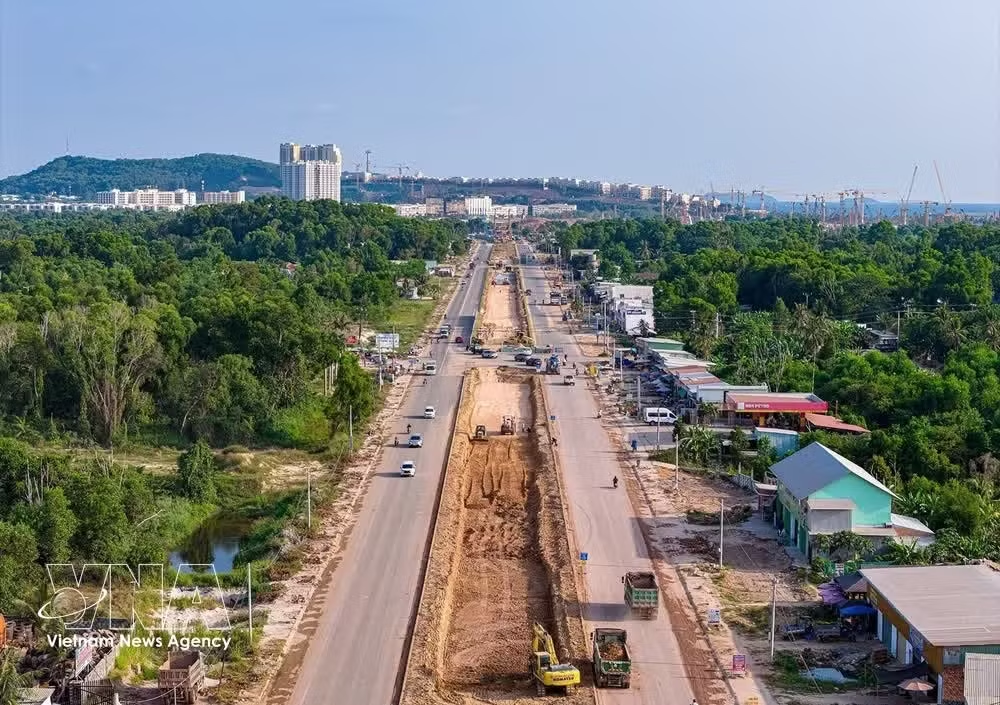
Alongside infrastructure financing, the adoption of green and sustainable finance standards is becoming increasingly important in capital-raising activities. A growing number of green bonds and green loans in Vietnam have incorporated international standards to define green project criteria more clearly and minimise the risk of greenwashing.
To attract international investors, businesses need to establish sustainable finance frameworks, transparent project selection processes, clear mechanisms for managing the use of proceeds, impact reporting systems and independent third-party assessments, Thuan said.
Beyond conventional financing channels, instruments such as sustainable infrastructure bonds, multi-tier investment funds, specialised guarantee funds and the securitisation of projects with stable cash flows could help mobilise long-term capital for infrastructure and green transition projects. These tools can attract long-term investors, improve capital circulation and support more effective risk allocation.
Thuan noted that fundraising capacity is also influenced by broader factors, including the legal environment, contract enforcement, dispute resolution mechanisms and the capabilities of project sponsors. Strong institutional foundations help strengthen investor confidence and improve risk assessment.
Meanwhile, Ta Duc Binh, an expert at the Institute of Strategy and Policy on Agriculture and Environment under the Ministry of Agriculture and Environment, said Vietnam is gradually strengthening its green finance framework to support its net-zero target.
In recent years, the country has introduced a range of policies on green growth, carbon markets and sustainable finance. Among them, Decision No. 21/2025/QD-TTg on the national green taxonomy is considered a key milestone, providing a basis for classifying green projects and directing capital towards sustainable development.
According to Binh, Vietnam has already completed one of the core pillars of a green finance ecosystem through the establishment of its national green taxonomy. However, further efforts are needed to accelerate green capital flows, including the development of green bond standards, transition finance mechanisms and stronger data systems to support investment appraisal./.