Finance Ministry, JICA to hasten major joint projects

JICA President Tanaka Akihiko said he is pleased to return to Vietnam and see landmark projects of bilateral ties now operational and delivering clear benefits to the public, including Nhat Tan Bridge and Ho Chi Minh City’s metro line No. 1.

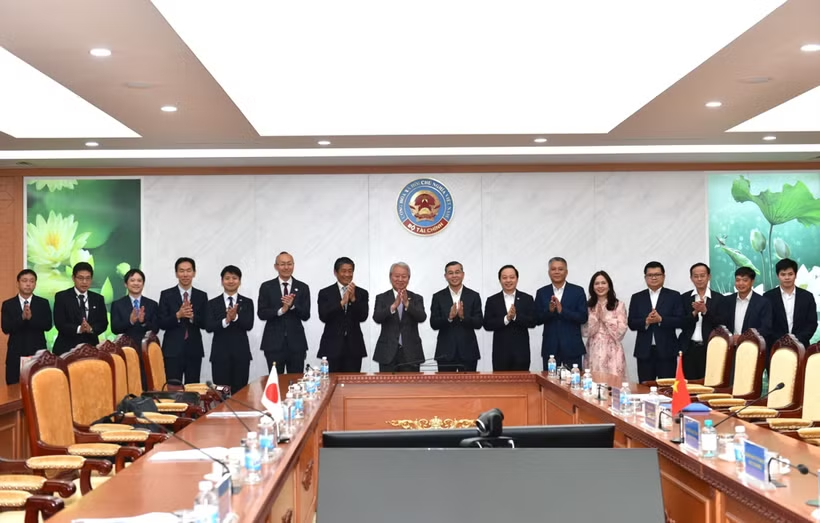
Officials of the Vietnamese Ministry of Finance and the Japan International Cooperation Agency (JICA) at the meeting in Hanoi (Photo: Ministry of Finance)

Hanoi (VNA) – Minister of Finance Ngo Van Tuan has expressed sincere thanks to the Japanese Government, people and embassy and the Japan International Cooperation Agency (JICA) for their meaningful contributions to bilateral friendship and cooperation over the past years.

During a recent reception for JICA President Tanaka Akihiko, Tuan said his ministry regularly benefits from JICA and member organisations' support through concessional financing for key infrastructure projects and technical assistance for a range of specific projects.

The JICA President, in reply, said he is pleased to return to Vietnam and see landmark projects of bilateral ties now operational and delivering clear benefits to the public, including Nhat Tan Bridge and Ho Chi Minh City’s metro line No. 1.

Tanaka also spotlighted training opportunities that JICA-funded courses in Japan have given to generations of personnel from Vietnamese ministries, agencies, and localities, calling them concrete proof of close bilateral cooperation.

Referring to the Japanese Prime Minister’s May visit to Vietnam, he noted that leaders of the two Governments agreed to further elevate bilateral ties, and JICA will continue supporting Vietnam’s pursuit of high growth and a new economic growth model for the next development phase.

Recalling a recent meeting between JICA and Finance Ministry leaders, Tanaka highlighted four major pillars of JICA’s support for Vietnam in the coming years, including training the workforce in science – technology, innovation and digital transformation; sharpening the competitiveness of Vietnamese firms to deepen their role in global value chains; improving the local business climate; and developing strategic infrastructure to drive sustainable economic growth.

These priorities, he said, have drawn strong backing from the Vietnamese Ministry of Finance.

To effectively carry out cooperation under the four pillars, the JICA leader stressed the need to accelerate negotiations and preparations for joint projects.

The two sides discussed a number of projects of mutual interest, including the Hanoi metro line No. 2’s Nam Thang Long – Tran Hung Dao section, the Vietnam Japan University, a proposed policy-based loan for artificial intelligence, and efforts to expedite a loan agreement for the O Mon No. 3 thermal power plant.

They called for regular reviews of project progress, clear identification of causes and responsibilities for any delays, and timely solutions tailored to each specific project./.
VNA

See more

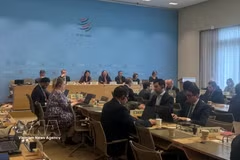
The trade policy review of Uruguay at the WTO headquarters. (Photo: VNA)

Vietnam participates in WTO review of Uruguay's trade policy

Vietnam also welcomed Uruguay's active engagement in the multilateral trading system as a founding member of the WTO. Uruguay has ratified the Agreement on Fisheries Subsidies, joined the Multi-Party Interim Appeal Arbitration Arrangement (MPIA), and contributed to Joint Statement Initiatives (JSIs) on e-commerce and micro, small and medium-sized enterprises (MSMEs).

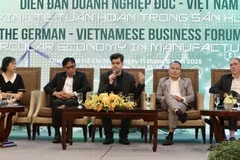
Experts discuss cooperation opportunities in Vietnam-Germany manufacturing value chains at the forum. (Photo: VNA)

Vietnam-Germany cooperation creates new opportunities for sustainable manufacturing

Germany is an important partner of Vietnam and a global leader in green technology, smart manufacturing, automation and circular economy solutions. The combination of German technological expertise and Vietnam's manufacturing capabilities and strong commitment to transformation would create significant opportunities in green production, supporting industries, digital transformation, supply chain management and eco-industrial park development.

Businesses introduce Halal market products at the workshop. (Photo: VNA)

Da Nang businesses eye growth in booming global Halal market

Huynh Xuan Son, Deputy Director of the Da Nang Department of Industry and Trade, said the Halal market has emerged as a strategic destination for Vietnamese exporters amid persistent global economic uncertainties. Serving more than two billion consumers across over 110 countries and territories, the market offers significant opportunities for business expansion.

Vietnamese bananas are sold at an AEON supermarket in Japan. (Photo: VNA)

Vietnamese products promoted at AEON stores across Japan

Speaking at the opening ceremony, Deputy Minister of Industry and Trade Phan Thi Thang highlighted the significance of 2026, which marks a decade of cooperation between the ministry and AEON in organising Vietnam Week in Japan.

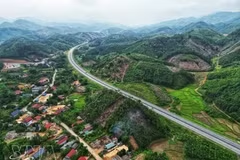
Growing demand for financing for infrastructure and green transition projects is driving Vietnam’s search for new sources of capital. In the photo: A section of Noi Bai – Lao Cai Expressway. (Photo: VNA)

Vietnam seeks to unlock capital for infrastructure, green transition

As Vietnam advances its sustainable growth agenda and commitment to achieving net-zero emissions by 2050, the need for long-term capital is rising rapidly. Experts say meeting these financing requirements will depend not only on expanding available resources but also on broadening funding sources and improving project financing models.

Private technology enterprises are increasingly viewed as a driving force at the heart of the innovation ecosystem. (Photo: VNA)

Vietnam pushes to develop world-class technology startups

Vietnam’s startup ecosystem now comprises roughly 4,000 startups, 208 investment funds, 84 incubators and more than 20 startup support centres. With an estimated valuation of 75 billion USD, the ecosystem has established most of the key foundations needed for long-term growth.