Vietnam contributes to shaping regional agenda at 23rd Shangri-La Dialogue: Indian expert

Speaking to Vietnam News Agency correspondents in New Delhi, Pradhan noted that, drawing on his extensive experience in national security and international relations, as well as his deep knowledge of international law, the top Vietnamese leader identified three closely interrelated crises facing the world today: a crisis of the international order, a crisis of the development model, and a crisis of strategic trust.

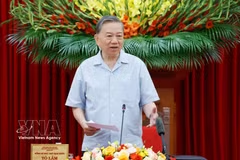
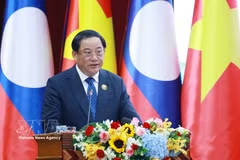
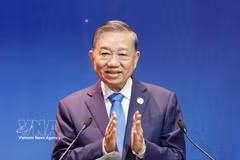
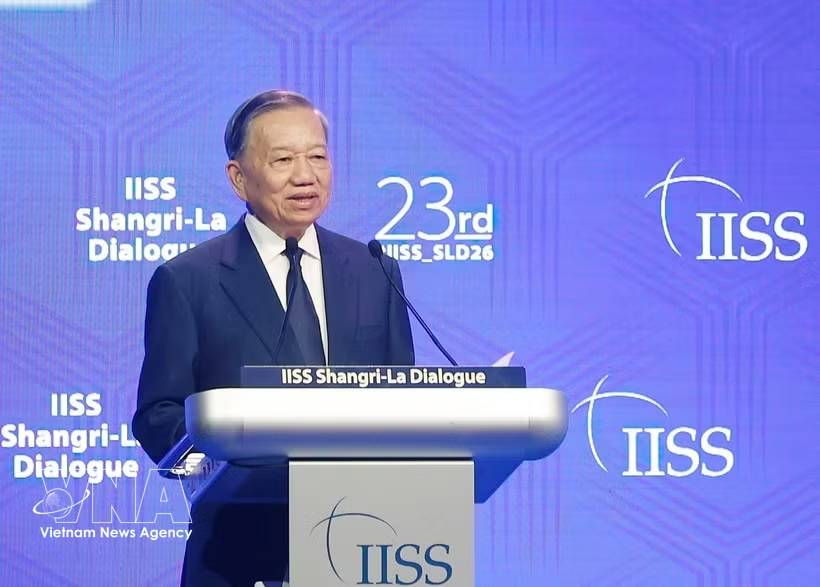
General Secretary of the Communist Party of Vietnam Central Committee and State President To Lam speaks at the 23rd Shangri-La Dialogue on May 29, 2026. (Photo: VNA)

New Delhi (VNA) – The keynote address delivered by General Secretary of the Communist Party of Vietnam Central Committee and State President To Lam at the 23rd Shangri-La Dialogue on May 29 demonstrates a profound understanding of contemporary global challenges and their interconnected nature, while offering practical solutions to build trust, manage risks and promote international cooperation, SD Pradhan, former Chairman of India’s Joint Intelligence Committee and former Deputy National Security Adviser, has assessed.

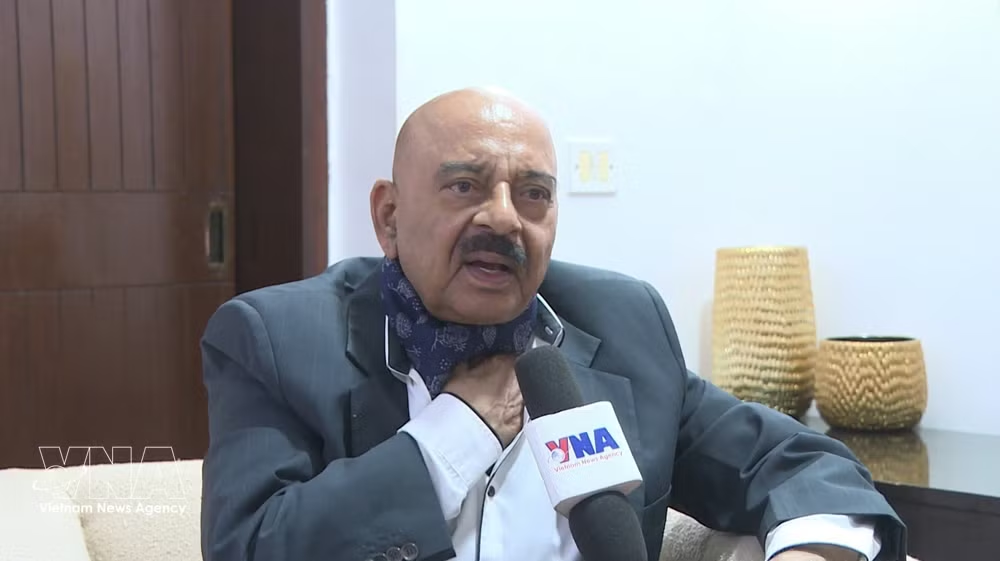
Speaking to Vietnam News Agency correspondents in New Delhi, Pradhan noted that, drawing on his extensive experience in national security and international relations, as well as his deep knowledge of international law, the top Vietnamese leader identified three closely interrelated crises facing the world today: a crisis of the international order, a crisis of the development model, and a crisis of strategic trust.

According to Pradhan, these challenges are unfolding against a backdrop of declining effectiveness of multilateral institutions, intensifying and increasingly unrestrained strategic competition, and mounting pressures on the international legal order.

The former intelligence chief commended General Secretary and Presdent Lam’s pragmatic assessment that the Asia-Pacific region is not confronted with a choice between competition and non-competition, as competition is an inherent feature of international relations.

Pradhan highlighted six key directions proposed by the Vietnamese Party and State leader to address the current challenges.

First, dialogue should serve as an effective tool for risk reduction through the early identification of threats, enhanced information-sharing, the maintenance of communication channels during periods of tension, and the prevention of disagreements escalating into crises.

Second, he advocated the development of an open and inclusive regional architecture with the Association of Southeast Asian Nations (ASEAN) at its centre, capable of bridging interests, reducing mistrust, strengthening existing mechanisms, and ensuring transparency and respect for international law.

Third, human security and societal resilience should be placed at the heart of sustainable development efforts through the creation of open and diversified supply chains, enhanced infrastructure connectivity, and expanded cooperation in finance, technology, cybersecurity, critical infrastructure protection, and search and rescue operations.

Fourth, responsible norms should be established for emerging technologies and the defence industry. Fifth, greater awareness is needed of the harmful effects of disinformation and influence operations, which can undermine social cohesion and distort public perceptions. Sixth, capacities for preventive diplomacy, mediation and conflict resolution should be strengthened through flexible mechanisms and multiple channels of dialogue.
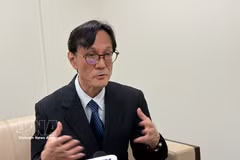
vnanet-pradhan.jpg
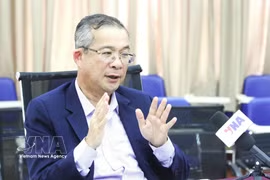
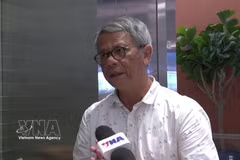
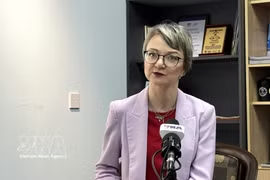
SD Pradhan, former Chairman of India’s Joint Intelligence Committee and former Deputy National Security Adviser (Photo: VNA)

Pradhan said the considerable attention paid by international media to the speech reflected growing global interest in Vietnam’s approach to issues of peace, security and development, while also underscoring the country’s increasingly prominent role in multilateral forums.

Referring to the Party and State leader’s recent interview with Reuters, Pradhan observed that his reaffirmation of Vietnam’s foreign policy of independence and self-reliance, encapsulated in the message that Hanoi sides with no one, clearly reflected the country’s long-standing policy of diversification and multilateralisation of external relations.

He added that his emphasis placed on the Charter of the United Nations and the 1982 United Nations Convention on the Law of the Sea (UNCLOS) is particularly significant amid rising tensions in the East Sea and is consistent with the views of many countries in the Global South, including India.

According to Pradhan, General Secretary and President Lam’s participation in the Shangri-La Dialogue demonstrates Vietnam’s role not merely as a participant in regional affairs, but as a country actively contributing to the shaping of both regional and global agendas./.
VNA

See more

Administrative procedures cut and simplified will be publishedNational Public Service Portal (Photo: VNA)

Administrative procedures cut, simplified to be published online

The dispatch states that in implementing Conclusion No. 18-KL/TW dated April 2, 2026 of the 14th Party Central Committee on the 2026–2030 socio-economic development plan, national finance, public debt management and medium-term public investment, linked to the goal of achieving double-digit economic growth, the Government on April 29 issued 11 resolutions on cutting, decentralising and simplifying administrative procedures, business conditions, and conditional business lines. The Prime Minister subsequently directed ministries, agencies and localities to implement these resolutions.

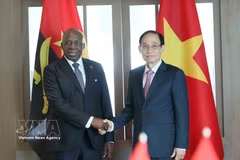
Minister of Foreign Affairs Le Hoai Trung (R) welcomes visiting Angolan Minister of External Relations Téte António in Hanoi on June 4 (Photo: VNA)

Vietnamese, Angolan foreign ministers hold talks in Hanoi

The Vietnamese FM proposed that the two sides strengthen political trust through high-level exchanges, while maintaining existing cooperation mechanisms, particularly the Vietnam–Angola Intergovernmental Committee and Political Consultations between the two foreign ministries.

Party General Secretary and State President To Lam chairs a working session with the Party Central Committee’s Commission for Policies and Strategies and relevant agencies on a project to renew the country’s development model based on science, technology, innovation and digital transformation on June 4, 2026. (Photo: VNA)

Top leader calls for building national capacity for innovation, adaptation

The new development model must place people at the centre as the objective, driving force and key actor of development. All development policies should aim to improve people’s material and spiritual well-being, creative capacity, dignity, opportunities for advancement and equitable access to development benefits, said top leader To Lam.

Nguyen Hong Thanh (R), Permanent Vice Chairman of the Tay Ninh provincial People's Committee, and Vipra Pandey, Consul General of India in Ho Chi Minh City, discuss cooperation opportunities during a working session in Tay Ninh province on June 4. (Photo: VNA)

Tay Ninh seeks stronger cooperation with Indian partners

Tay Ninh is home to 14 Indian-invested projects with total registered capital of about 108 million USD. These projects are mainly engaged in industrial production and processing, including garment manufacturing, rice bran oil production, sugar production, seed processing and agricultural product processing.

Party General Secretary and State President To Lam speaks at the 14th Vietnam Trade Union Congress on June 4. (Photo: VNA)

Vietnam needs more modern, creative working class: Top leader

Party General Secretary and State President To Lam urged the Vietnam Trade Union to reform more rapidly, deeply and substantively. It must work together with the State, enterprises and training facilities to improve workers’ professional qualifications, digital skills and adaptability.

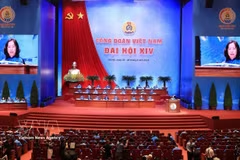
A view of the 14th Vietnam Trade Union Congress for the 2026–2031 term (Photo: VNA)

Grand opening of 14th Vietnam Trade Union Congress for 2026–2031 term

VGCL President Nguyen Anh Tuan said achievements obtained over the past ternure reflect the close guidance of the Party, effective coordination among State agencies, local authorities, the Vietnam Fatherland Front and socio-political organisations, support from employers and, above all, the dedication and innovation demonstrated by trade union officials, members and workers across the country.