Top Vietnamese leader’s Shangri-La Dialogue speech reflects Vietnam’s responsible approach to regional security: Chinese scholar

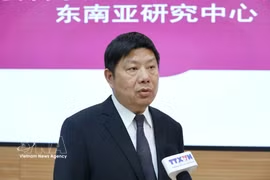
Prof. Huang Rihan of Huaqiao University in China’s Fujian province said the Vietnamese leader’s address highlighted three major crises currently facing the world - the crisis of the international order, the crisis of development models, and the crisis of strategic trust.

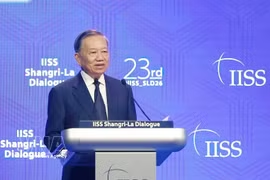
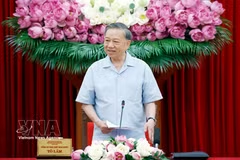
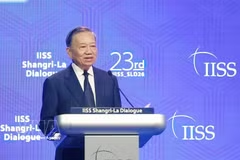
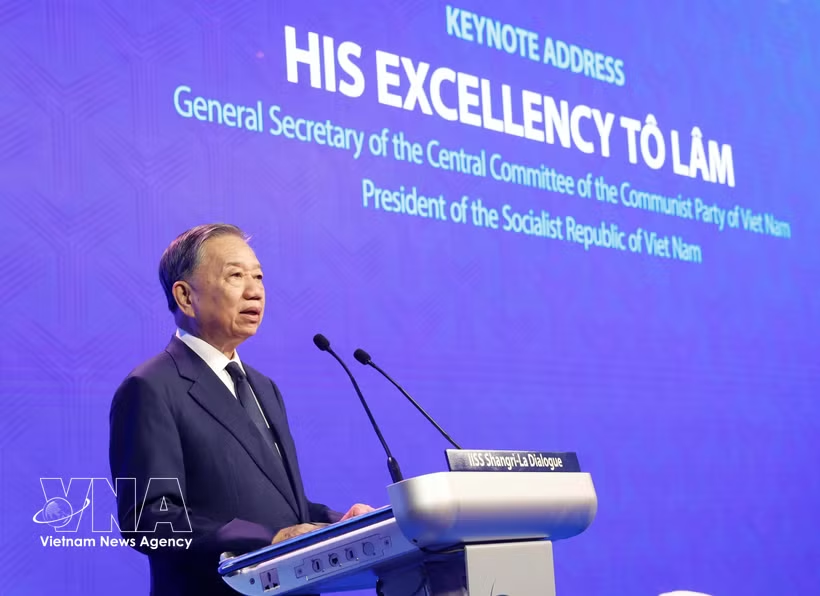
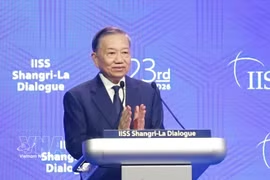
General Secretary of the Communist Party of Vietnam Central Committee and President of Vietnam To Lam delivers a keynote address the 23rd Shangri-La Dialogue on May 29. (Photo: VNA)

Beijing (VNA) – The keynote address delivered by General Secretary of the Communist Party of Vietnam Central Committee and President of Vietnam To Lam at the 23rd Shangri-La Dialogue reflects Vietnam’s consistent foreign policy of promoting peace, cooperation, dialogue and consultation, according to a Chinese scholar.

Speaking to the Vietnam News Agency (VNA)'s correspondent in Beijing, Prof. Huang Rihan of Huaqiao University in China’s Fujian province said the Vietnamese leader’s address highlighted three major crises currently facing the world – the crisis of the international order, the crisis of development models, and the crisis of strategic trust.

According to Huang, the Vietnamese leader stressed the need for countries in the region to pursue a more inclusive development model, placing people’s well-being and social resilience at the centre of policymaking. This, he said, demonstrates Vietnam’s rational, pragmatic and responsible approach to regional security issues.

​The scholar noted that the Vietnamese leader emphasised resolving differences through multilateral mechanisms, international law, dialogue and consultation, while opposing bloc confrontation and the escalation of conflicts. Such views, he said, are aligned with the shared security concerns and development aspirations of countries in the region, contributing to peace, stability and common development in Southeast Asia and beyond.

​Huang observed that the keynote address, grounded in the common interests of ASEAN, reflected the vision of sustainable security pursued by regional countries and underscored respect for the sovereignty and territorial integrity of all nations while rejecting unilateralism and power politics.

Amid profound global changes and growing regional security challenges, Vietnam’s commitment to pursuing a policy of non-alignment, non-confrontation and not targeting any third party will provide stability and a constructive voice for the region, he said.

The scholar added that this approach contributes to building a balanced, effective and sustainable regional security architecture while supporting global stability and prosperity.

Assessing Vietnam’s efforts to promote strategic trust and minimise conflict risks, Huang said the country has consistently pursued a foreign policy of independence, self-reliance, peace, friendship and balanced multilateralisation.

Vietnam has long advocated strengthening mutual strategic trust and minimising conflict risks through equal dialogue, confidence-building measures and the effective management of differences, he noted.

The scholar also highlighted Vietnam’s active participation in ASEAN-led dialogue and security cooperation mechanisms, helping foster an open, inclusive and non-confrontational regional security architecture. At the same time, the country advocates managing interstate relations based on international law and the United Nations Charter.

Faced with complex and sensitive issues, Vietnam has maintained a restrained, rational and pragmatic approach, promoting their settlement through bilateral consultations and multilateral channels to prevent escalation, Huang said.

This approach has effectively reduced the risks of miscalculation and conflict, laid an important foundation for long-term regional peace and stability, and demonstrated Vietnam’s sense of responsibility and commitment to regional governance, he added./.
VNA

See more

Standing Deputy Minister of Foreign Affairs Nguyen Minh Vu receives Representative Director and Executive Vice President of Idemitsu Kosan Atsuhiko Hirano in Hanoi on June 12, 2026. (Photo: Ministry of Foreign Affairs)

Deputy FM urges Idemitsu Kosan to expand green energy investment in Vietnam

Receiving IKC Representative Director and Executive Vice President of Idemitsu Kosan Atsuhiko Hirano in Hanoi on June 12, Deputy FM Vu commended the company’s efforts in promoting investment and cooperation in Vietnam over the years, especially its role as a shareholder in the Nghi Son Refinery and Petrochemical (NSRP) project.

Prime Minister Le Minh Hung chairs a working session with the Standing Board of the Ho Chi Minh City Party Committee on June 13, 2026. (Photo: VNA)

Ho Chi Minh City must maximise role as economic powerhouse: PM

Prime Minister Le Minh Hung called for a comprehensive review of Ho Chi Minh City’s 2026 economic growth scenarios, with a focus on identifying untapped potential across sectors and deploying effective measures to maximise growth in the remaining quarters of the year, particularly in manufacturing, pharmaceuticals, logistics, finance and banking, and other high-value-added industries.

The national flags of Vietnam and the Philippines. Photo: VNA

Vietnam congratulates Philippines on Independence Day

General Secretary of the Communist Party of Vietnam and State President To Lam and Prime Minister Le Minh Hung on June 12 sent congratulatory messages to Philippine President Ferdinand Romualdez Marcos Jr on the occasion of the 128th anniversary of the Declaration of Independence of the Republic of the Philippines (June 12, 1898 – 2026).

Former Deputy Minister of Foreign Affairs Ambassador Pham Quang Vinh. (Photo: VNA)

AFF 2026 marks Vietnam’s transition from participant to regional agenda-setter

With sharp strategic mindset and a proven capacity for practical action at both bilateral and multilateral levels, Vietnam has demonstrated its role as a builder and agenda-setter, contributing to a robust platform for dialogue and cooperation in pursuit of a resilient, peaceful, and truly people-centred ASEAN Community by 2045

Party General Secretary and State President To Lam addresses the national conference disseminating and implementing Politburo Resolution No. 06-NQ/TW (Photo: VNA)

📝OP-ED: When foreign affairs pioneer in shaping nation's future

Resolution No. 06-NQ/TW represents both a continuation and a development of the Party’s comprehensive foreign policy and President Ho Chi Minh’s thought. If international integration helped create a favourable environment for development, diplomacy today is tasked with protecting and expanding that space.

An overview of the 4th session of the 17th Hanoi People’s Council for the 2026–2031 term. (Photo: VNA)

Capital Law 2026 paves way for Hanoi’s new development model

One of the key breakthroughs of the new resolutions is the shift from a traditional management-oriented approach to a development-enabling model. The proposed policies are designed not only to address current issues but also to establish the foundation for a more modern, proactive and flexible system of urban governance.

Vietnamese Ambassador to Algeria Tran Quoc Khanh (seventh from left) poses for a group photo with the leaders and staff of the University of Skikda. (Photo: VNA)

Vietnam, Algeria strengthen agricultural trade connectivity

Vietnam’s main exports to Algeria include coffee, cashew nuts, pepper, textiles and garments, steel and selected industrial products, while the North African country sells animal feed, chemicals, dates and other agricultural products to Vietnam.

Vietnamese Deputy Minister of Foreign Affairs Le Thi Thu Hang speaks at the forum. (Photo: VNA)

Vietnam, Switzerland eye stronger economic connectivity

Vietnamese Deputy Minister of Foreign Affairs Le Thi Thu Hang expressed Vietnam’s desire to see Swiss enterprises expand their long-term presence and investment in the country, particularly in high technology, innovation, renewable energy, pharmaceuticals, healthcare and digital transformation. She also emphasised cooperation in talent development, high-end tourism and international financial centre development.

Chairman of the People’s Committee of Hue city Nguyen Khac Toan (right) presents a souvenir to Karl Wilfing, President of the State Parliament of Lower Austria. (Photo: People’s Committee of Hue city)

Hue city moves to deepen multifaceted cooperation with Austrian partners

Toan proposed Lower Austria consider establishing an official cooperation mechanism with Hue to facilitate investment collaboration in tourism, education and training, healthcare, information technology, green and smart urban development, heritage conservation, hi-tech agriculture and sustainable development.