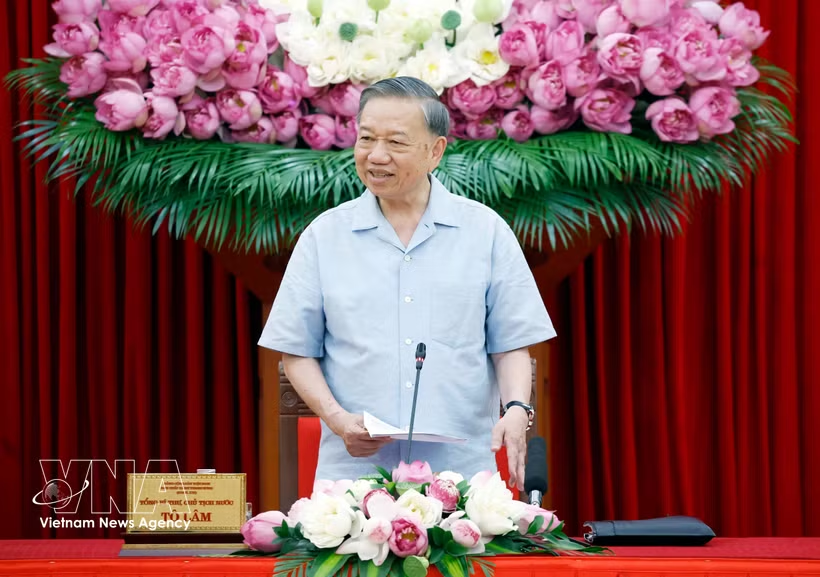
Hanoi (VNA) – Administrative reform isn’t not merely about slashing organisational units, but building a governance structure that is stronger, leaner, more accountable, more effective and better equipped to serve the public as the foundation for rapid, sustainable development in a new era, Party General Secretary and State President To Lam said.
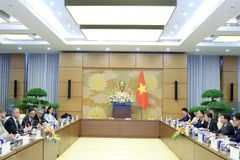
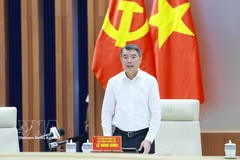
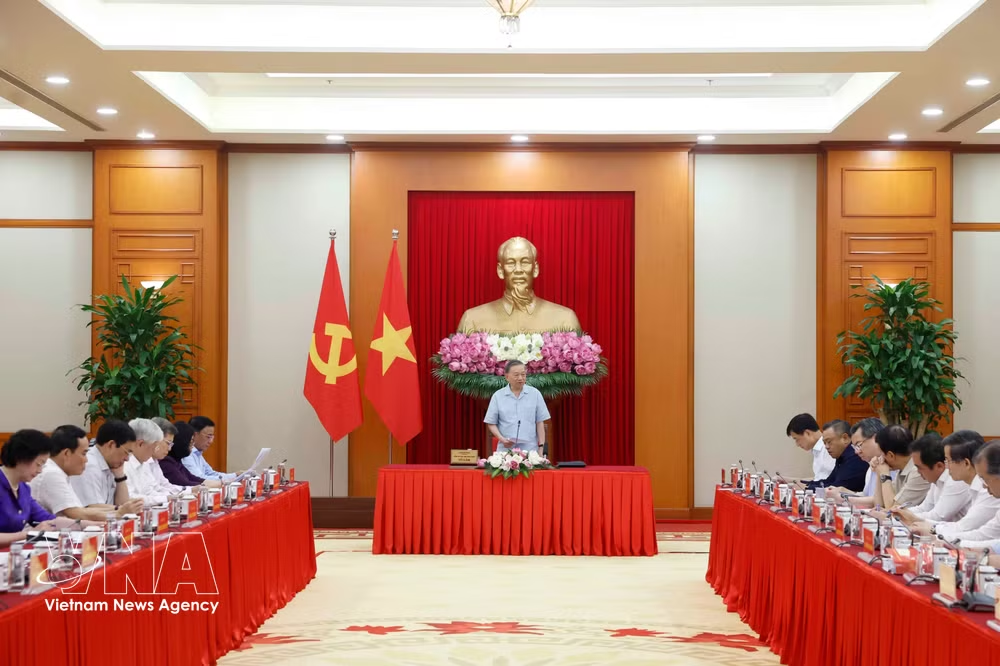
Chairing a working session in Hanoi on June 2 with the Central Steering Committee responsible for reviewing one year of the political system’s new organisational model and the three-tier administration model, General Secretary and President Lam stressed that the review must answer fundamental questions: Has the apparatus become leaner? Does it run more smoothly? Are powers and responsibilities clearer? Has service delivery to citizens and businesses improved? Is the new model generating additional development momentum? And, crucially, has it lifted the performance, effectiveness and efficiency of the political system?.
The reform has already covered an enormous volume of work across a vast scope under demanding conditions but success in restructuring doesn’t automatically mean success in operations, he noted. The priority now, he said, is to shift from completing organisational redesign to ensuring effective functioning, from stabilising structures to improving governance quality, and from assigning responsibilities to guaranteeing real capacity.
On the institutional framework and operating mechanisms, he noted that while numerous regulations and guidelines have been issued, some remain poorly integrated and haven’t kept pace with what the new governance model demands.
On decentralisation and delegation of authority, he said the transfer of powers must be tied to matching responsibilities, financial resources, personnel, data, and tools.
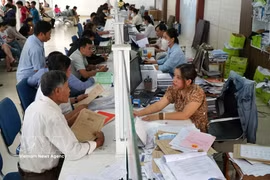
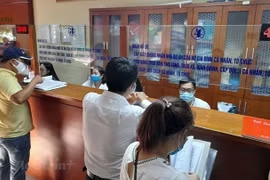
Turning to commune-level authorities after the launch of the two-tier local administration model, he pointed out that many functions previously handled at the district level have been pushed down to the commune level. Yet local officials’ capacity, infrastructure, facilities, working conditions, financial resources and professional support remain uneven across localities.
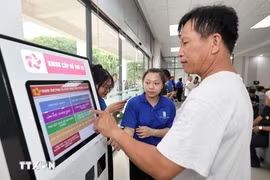
The leader singled out digital transformation and data management as critical bottlenecks. The report, he said, must identify exactly which localities and agencies have performed well, where difficulties linger, which levels remain weak, which stages are slow, and who are responsible at every level, including ministries and local authorities.
He called for greater conceptual depth, stronger theoretical foundations, sharper practical relevance and more persuasive power. The report, he said, must present a clear central argument that directly links organisational restructuring with improvements in leadership capacity, governance capability and effectiveness across the entire political system.
The report’s approach must shift from listing achievements to analysing impacts, from describing activities to evaluating operational quality, from outlining pros and cons to naming genuine bottlenecks, and from non-specific recommendations to concrete actions with clearly defined tasks, authority, responsibilities, timelines and accountable roles, he said.
In particular, he demanded a deeper assessment of several critical issues, including the Party’s leadership methods under the new organisational model; the operational capacity of the two-tier local administration, especially at the commune level, with a focus on grassroots officials; the effectiveness of decentralisation and delegation of authority tied to resources and oversight; digital transformation, data management and data-driven governance; and a set of criteria to evaluate the performance, effectiveness and efficiency of the new governance model going forward. He also ordered a review of functions and responsibilities to pinpoint where adjustments are required./.