Top Vietnamese leader’s Shangri-La Dialogue keynote address reflects strategic vision: Chinese scholar

The keynote address reflected the balance and wisdom of Vietnam’s diplomacy while also providing practical approaches for countries in the Asia-Pacific region to navigate emerging challenges.

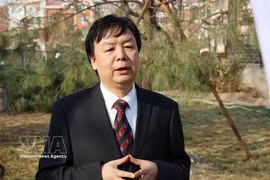
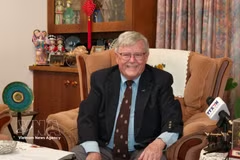
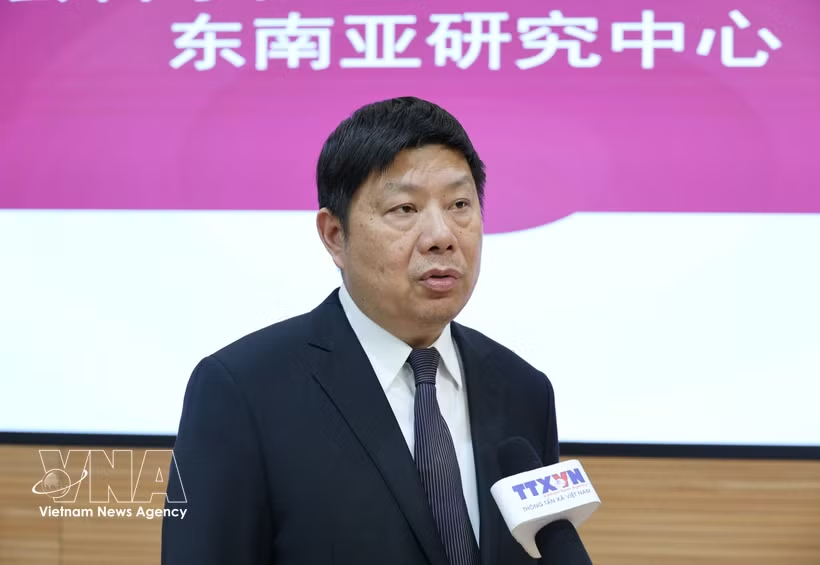
Professor Xu Liping, Director of the Centre for Southeast Asian Studies at the National Institute of International Strategy under the Chinese Academy of Social Science (CASS), in an interview granted to the Vietnam News Agency (Photo: VNA)

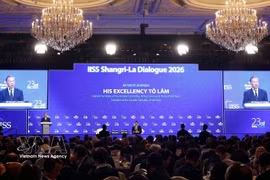
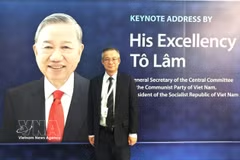
Beijing (VNA) – The keynote address delivered by General Secretary of the Communist Party of Vietnam Central Committee and President of Vietnam To Lam at the 23rd Shangri-La Dialogue in Singapore demonstrated the leader’s strategic vision and sound judgement, according to a leading Chinese scholar.

In an interview with the Vietnam News Agency (VNA)'s resident correspondent in Beijing, Professor Xu Liping, Director of the Centre for Southeast Asian Studies at the National Institute of International Strategy under the Chinese Academy of Social Science (CASS), noted that the world is facing growing instability and uncertainty, while the rise of unilateralism and hegemonic behaviour has created unprecedented challenges for global governance.

Against that backdrop, General Secretary and State President Lam’s keynote address identified three major crises confronting the international community and outlined Vietnam’s proposals for addressing them. The speech carried significant practical value in promoting a fairer and more equitable international political and economic order, he said.

Xu noted that the Vietnamese leader accurately identified what he described as three major “crises” of the current era - the crisis of international order, the crisis of development models and the crisis of strategic trust.

He said the keynote address reflected the balance and wisdom of Vietnam’s diplomacy while also providing practical approaches for countries in the Asia-Pacific region to navigate emerging challenges.

Commenting on the significance of the messages delivered in the speech amid intensifying strategic competition, Xu said the emphasis on dialogue, cooperation and respect for international law offers an effective framework for managing geopolitical matters and strategic competition.

He explained that prioritising dialogue means resolving differences and disputes through peaceful means, reflecting fundamental regional and international norms.

The emphasis on cooperation, he added, reflects efforts to expand the scope of common interests, promote mutually beneficial partnerships and foster peaceful coexistence among countries in the region.

Xu further highlighted the importance of respecting international law, saying it underscores that disputes and international issues should be addressed on the basis of equality among nations rather than power, regardless of a country’s size or strength, and in line with the United Nations Charter./.

VNA
See more

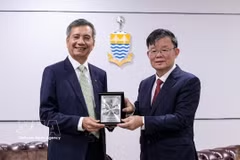
Vietnamese Ambassador Dinh Ngoc Linh (left) and Penang Chief Minister Chow Kon Yeow at their meeting in Penang, Malaysia. (Photo: VNA)

Vietnam, Malaysia strengthen local-level cooperation

A key focus of the discussion was a proposal to foster links between Penang and Gia Lai, Vietnam’s second-largest province by area and home to more than 3.5 million people, with a view to establishing a formal local partnership and eventually a sister-province relationship.

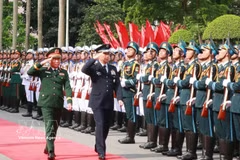
Chief of the General Staff of the Vietnam People’s Army and Deputy Minister of National Defence Gen. Nguyen Tan Cuong (left) and Chief of Staff of the Japan Self-Defense Forces Gen. Uchikura Hiroaki review the guard of honour of the Vietnam People's Army at the welcome ceremony for the latter in Hanoi on June 2. (Photo: VNA)

Vietnam, Japan step up defence cooperation

Gen. Nguyen Tan Cuong proposed that the two sides push ahead with implementing the agreed areas of cooperation, with priority given to delegation exchanges, annual cooperation mechanisms, cyber defence training, UN peacekeeping operations, defence industry, and coordination at international multilateral forums.

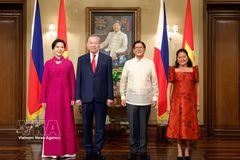
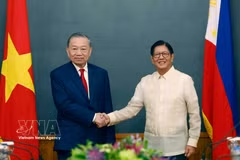
General Secretary of the Communist Party of Vietnam Central Committee and State President To Lam (L) and Philippine President Ferdinand Romualdez Marcos Jr. before their talks in Manila on June 1. (Photo: VNA)

Vietnam's top leader holds talks with Philippine President

Vietnam always values and wishes to further deepen its friendly neighbourly relations with the Philippines in all areas on the basis of a shared commitment to peace, stability and respect for international law, affirmed General Secretary of the Communist Party of Vietnam (CPV) Central Committee and State President To Lam.

The Cambodian scholar is impressed by Party Genereral Secretary and State President To Lam's keynote address. (Photo: VNA)

Vietnam’s hallmark at 23rd Shangri-La Dialogue: Active peace builder in volatile world

Vietnam called for an open, inclusive regional architecture with ASEAN at its core, insisting that all new initiatives be transparent, respect international law, complement one another, and avoid undermining ASEAN centrality or turning Southeast Asia into an arena for great power rivalry. It expressed full support for and readiness to cooperate with the Philippines - ASEAN Chair 2026.

Professor Carl Thayer from the Australian Defence Force Academy at the University of New South Wales. (Photo: VNA)

Vietnam's strategic autonomy earns praise from Australian expert

Vietnam has an opportunity to further entrench its leadership position within ASEAN, collaborate with like-minded partners, and demonstrate that Hanoi is, and will continue to be, a friend, a reliable partner, and an active and responsible member of the international community, said Professor Carl Thayer from the Australian Defence Force Academy at the University of New South Wales.