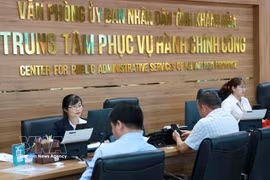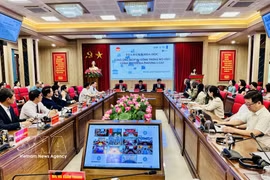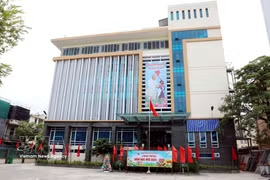
Hanoi (VNA) – One year after the implementation of the two-tier local administration model, alongside efforts to streamline the apparatus, a significant shift has begun to emerge across many localities: public assets are no longer viewed solely through the lens of management and preservation, but are increasingly being regarded as a valuable resource for development.
From surplus office buildings to fragmented land and property holdings left after administrative restructuring, many localities have started to reorganise public spaces, creating new opportunities for infrastructure investment, public services and socio-economic development.
According to the Ministry of Finance's one-year review report on the restructuring of administrative units and the operation of the two-tier local administration model, the first phase of handling 25,885 state-owned land and property facilities has been completed nationwide. Of the more than 11,000 surplus facilities recovered and transferred to local authorities, over 5,000 have already been processed or put into use. Significantly, behind these figures lies not merely the disposal of redundant assets, but a large-scale reallocation of public resources.
In Hanoi, for example, many properties and land plots made available through administrative restructuring are being reviewed for allocation to education, healthcare and public works projects, at a time when urban land resources are becoming increasingly scarce. The capital is also promoting the shared use of government office buildings to reduce dispersed investment and free up land for social infrastructure development.
Hai Phong is regarded as one of the localities that has proactively linked the management of public assets with urban and logistics planning. Several land plots released through restructuring are being assessed for industrial infrastructure, warehousing and port-related services – sectors that are key drivers of the northern port city's economic growth.
Experts note that, if managed in a coordinated manner and integrated closely with development planning, public assets made available through restructuring could become vital seed capital for future infrastructure, public service and urban development projects. In this context, the effectiveness of the two-tier model will be measured not only by administrative efficiency but also by its ability to unlock and regenerate resources for national development.
In the northern province of Bac Ninh, where urbanisation and industrial expansion are progressing rapidly, authorities are also reviewing surplus land and property assets to create clean land reserves for expanding industrial infrastructure and urban services. Some former administrative facilities are being considered for conversion into community cultural and educational centres.
Beyond major urban centres, several provinces in central Vietnam are using the administrative restructuring process as an opportunity to reorganise public spaces. In Ha Tinh, for instance, former commune offices merged under the new model are being assessed for use as grassroots healthcare facilities, commune police stations or community centres, rather than being left vacant or falling into disrepair. Other localities are exploring the auction of surplus land to generate funding for transport infrastructure, schools and public welfare projects.
A notable outcome of the restructuring is that many previously fragmented public land parcels have been consolidated into larger sites, making comprehensive planning and long-term utilisation more feasible. Such consolidation was difficult to achieve in the past when public assets were divided among multiple administrative levels and agencies.
Beyond changes in scale and organisation, perhaps the most important development is the shift in thinking regarding public asset management. Assets made available through restructuring are no longer regarded as residual matters requiring administrative disposal; instead, they are increasingly seen as strategic reserves for development.
According to the Ministry of Finance, the restructuring of administrative units and government organisations has generated substantial land and property resources that can be prioritised for healthcare, education, culture, sports and other public projects. This approach helps reduce compensation, land clearance and infrastructure development costs.
At the same time, a number of these land reserves are being entrusted to local land development organisations or housing management agencies for further utilisation, creating additional budget revenues through land allocation and leasing in accordance with the law.
Experts also point out that centralising management responsibilities helps curb fragmented and inefficient investment practices, which have long been a source of budgetary pressure in many localities./.
See more
US announces 450,000 USD support for Vietnam’s search for persons missing in war
The funding is expected to help accelerate the search for and identification of war victims through the application of modern technologies.
Vietnam Museum of Ethnology embraces AI to shape digital future
In recent years, the museum has stepped up the application of technology to transform traditional exhibition spaces into interactive and immersive experiences. The process began in 2021 with the launch of an exploration room for children featuring interactive screens.
Vietnam to develop four universities comparable to Asia’s leading institutions
The institutions covered by the scheme are the University of Economics Ho Chi Minh City (UEH), University of Medicine and Pharmacy Ho Chi Minh City (UMP), Vietnamese-German University (VGU) and Vietnam National University Ho Chi Minh City (VNUHCM).
Communication drive promoted for 500-day campaign to locate, identify fallen soldiers’ remains
Under the plan, all central and local media outlets are required to launch columns on the campaign, maintain regular coverage, and produce at least five to seven in-depth reports each month in key search areas. Media agencies will also be encouraged to gather and verify valuable information and develop high-quality products in both Vietnamese and foreign languages, including feature articles, documentaries, reports and short videos.
Vietnam's First Lady visits disadvantaged children in Philippines
Ngo Phuong Ly, spouse of Party General Secretary and State President To Lam, expressed her emotion at seeing the children’s optimism despite difficult circumstances, noting that both Vietnam and the Philippines place children at the centre of their development policies, from education, health care to child protection.
School nutrition key to tackling double burden of malnutrition among children
Vietnam has made measurable strides in school nutrition over the recent years. The legal framework has gradually been refined, the average height of Vietnamese youth has improved markedly, and school meal models now reach preschools and primary schools nationwide.
Amnesty policy reflects humanitarian tradition, gives offenders chance to rebuild lives: Deputy PM
Since 2009, the State President has granted amnesty on 12 occasions, resulting in the early release of more than 120,000 prisoners. Most beneficiaries have successfully reintegrated into their communities, secured stable livelihoods, and led law-abiding lives. Many have gone on to become successful entrepreneurs or actively contributed to social activities in their localities.
Buddhist activities help strengthen Vietnam–Laos special relationship
Addressing the event, Venerable Thich Minh Quang, abbot of Phat Tich Pagoda, said Vesak not only meets the spiritual needs of the Vietnamese community in Laos but also contributes to promoting people-to-people exchanges and deepening the special friendship between the two neighbouring countries.
📝 OP-ED: Vietnam’s media landscape challenges narrow assessments of press freedom
As digital transformation and global integration reshape the information landscape, Vietnam’s press sector continues to solidify its role as a key channel connecting the Party, State and people while providing comprehensive coverage of social life. The sector’s evolution reflects the country’s efforts to advance press freedom in line with its development goals and national circumstances.
Vietnam attracts growing interest through NUS friendship initiative
The 2026 Southeast Asian Friendship Initiative (SFI) programme enabled students to experience Vietnamese culture first-hand through a course on Vietnamese history combined with a 10-day educational tour from northern to southern Vietnam.
Singapore seen as key partner for Vietnam in developing high-quality human resources
Associate Professor Dr Luu Anh Tuan said bilateral cooperation in developing high-quality human resources still holds considerable untapped potential and should be promoted through flexible mechanisms tailored to practical needs.
First Vietnamese pagoda in Tokyo inaugurated
Ambassador Pham Quang Hieu expressed confidence that the establishment will serve as a strong spiritual anchor for Vietnamese people living in Japan while contributing to friendship and cultural exchanges between the two countries.
State President approves amnesty for 9,950 prisoners
Among the 9,950 inmates granted amnesty are 133 prisoners linked to cases monitored by the Central Steering Committee for Prevention and Control of Corruption, Wastefulness, and Negative Phenomena. The list also includes 63 foreign nationals, comprising 56 men and seven women.
Vietnam urges US to fairly assess intellectual property enforcement efforts in wake of investigation
Vietnam is committed to building a transparent and healthy business and investment environment, promoting innovation and fully implementing its international commitments.
Vietnam seeks UNFPA support in negotiations on convention on older persons’ rights
Vietnam is stepping up international cooperation on ageing-related issues and requested UNFPA’s continued support through technical expertise, international experience and policy recommendations in areas such as population ageing, long-term care, the care economy, the silver economy and promoting the role of older persons in society.
Remains of fallen Vietnamese volunteer soldiers, experts repatriated from southern Laos
Speaking at the ceremony, Sisanga Keodouangdy, Vice President of the Sekong provincial Administration Committee and head of the province’s Special Task Committee, expressed profound gratitude to the Vietnamese volunteer soldiers and experts who made great sacrifices for the independence and freedom of both nations and for the noble international mission.
Nearly 1.9 million USD in relief aid for Dak Lak flood victims
The assistance was provided through a programme jointly organised by the standing board of the Vietnam Fatherland Front Committee of Dak Lak province and the Buddhist Compassion Relief Tzu Chi Foundation (Taiwan, China).
National drive kicks off to protect, support children online
Cyberspace now runs through children’s learning, entertainment, and daily lives, but warned it is laced with dangerous content, online insults, threats, and seemingly harmless clicks that can trigger fraud, data breaches, and risks children who are not yet equipped to handle.
109 Vietnamese citizens handed over by Cambodia
Cambodia’s General Department of Immigration under the Ministry of Interior deported the group for violations of regulations related to immigration, labour and residency.
ASEAN shares VNU-HCM’s quality assurance framework as best practice
The Southeast Asian Ministers of Education Organisation Regional Centre for Higher Education and Development (SEAMEO RIHED) published and shared VNU-HCM’s Regulation on Education Quality Assurance on its website on May 22.