Hanoi (VNA) - The right to freedom of belief and religion in Vietnam is consistently respected and guaranteed through an increasingly perfect legal framework that adapts to practical realities. In the face of facts, all attempts to distort the situation of freedom of religion in the country are bound to fail.
For years, a number of ill-intentioned organisations and individuals have continued to recycle outdated and misleading narratives about freedom of belief and religion in Vietnam. They either deliberately ignore realities, distort the nature of issues, or conflate legitimate religious practices with acts that exploit religion to violate the law and undermine social stability. Such tactics are not new. What is notable, however, is that while these claims are repeatedly echoed, Vietnam has steadily, transparently, and persistently improved its institutions, legal system, and implementation mechanisms to better ensure human rights, including freedom of belief and religion. The truth does not lie in one-sided, unverified reports circulated by overseas reactionary groups such as Boat People SOS or Montagnards Stand for Justice. Rather, it is reflected in social life, the legal system, and concrete, verifiable institutional progress.
From consistent policy to increasingly complete legal framework
Respect for human rights in general, and freedom of belief and religion in particular, has been a consistent policy of the Party and the State of Vietnam. This principle was enshrined in the country’s first Constitution in 1946, two years before the adoption of the United Nations Universal Declaration of Human Rights in December 1948, and two decades before the International Covenant on Civil and Political Rights and the International Covenant on Economic, Social and Cultural Rights were adopted by the UN General Assembly on December 16, 1966. These international instruments reaffirm and elaborate the right to freedom of belief and religion.
At Article 10, Chapter 2 on “Citizens’ rights and duties,” the 1946 Constitution stipulates that Vietnamese citizens have the right to freedom of belief. In the book “Ton giao va chinh sach ton giao o Viet Nam” (Religion and religion policy in Vietnam - published in 2015, reprinted in 2020 and 2023), researcher Nguyen Thanh Xuan observed that by affirming respect for citizens’ freedom of belief, the 1946 Constitution laid a legal foundation for the implementation of religion-related policy nationwide. This right has since been inherited, supplemented, and further developed in the subsequent Constitutions in 1959, 1980, 1992, and 2013, as well as in various documents of the Party.
To fully institutionalise human rights in general, and the right to freedom of belief and religion in particular, in line with the 2013 Constitution and in compatibility with international treaties to which Vietnam is a party, the National Assembly adopted the Law on Belief and Religion on November 18, 2016. The promulgation of this law was an objective necessity to ensure constitutionality, legality, coherence, and consistency within the legal system, thereby providing a solid legal basis for the effective exercise of freedom of belief and religion in practice.
After years of implementation, religious life in Vietnam has become increasingly diverse and dynamic. Alongside the country’s development, legitimate religious and belief-related needs of the people have been more clearly expressed, expanding in forms, scale, and modes of organisation.
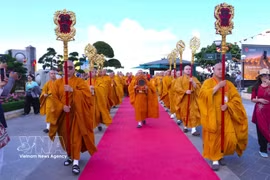
According to the Ministry of Ethnic and Religious Affairs, more than 95% of the population engage in religious or belief-related activities. A total of 43 organisations representing 16 religions have been officially recognised and granted registration certificates, with nearly 28 million followers. Major religions such as Buddhism, Catholicism, Hoa Hao Buddhism, Protestantism, and Cao Dai each have more than one million followers. Nationwide, there are over 54,000 dignitaries, 135,000 religious assistants, and 29,658 places of worship. In addition, thousands of concentrated religious groups are operating, including those formed by foreign nationals legally residing in Vietnam. Religious organisations continue to play an increasingly active role across various aspects of social life, from humanitarian and charitable activities to education, healthcare, social welfare, and the promotion of community solidarity.
However, this fact also poses new requirements for the legal system. Whereas in the past, many religious and belief-related activities primarily took place in physical venues such as places of worship or community gathering sites, the rapid expansion of digital technologies has now extended communication, outreach, organisation, and community interaction into cyberspace. Likewise, while administrative procedures were once largely centralised, current requirements for administrative reform, streamlined governance, and clearer delineation of authority between central and local levels have become more pressing. Traditional modes of management are increasingly giving way to expectations for more modern, transparent, and user-friendly approaches.
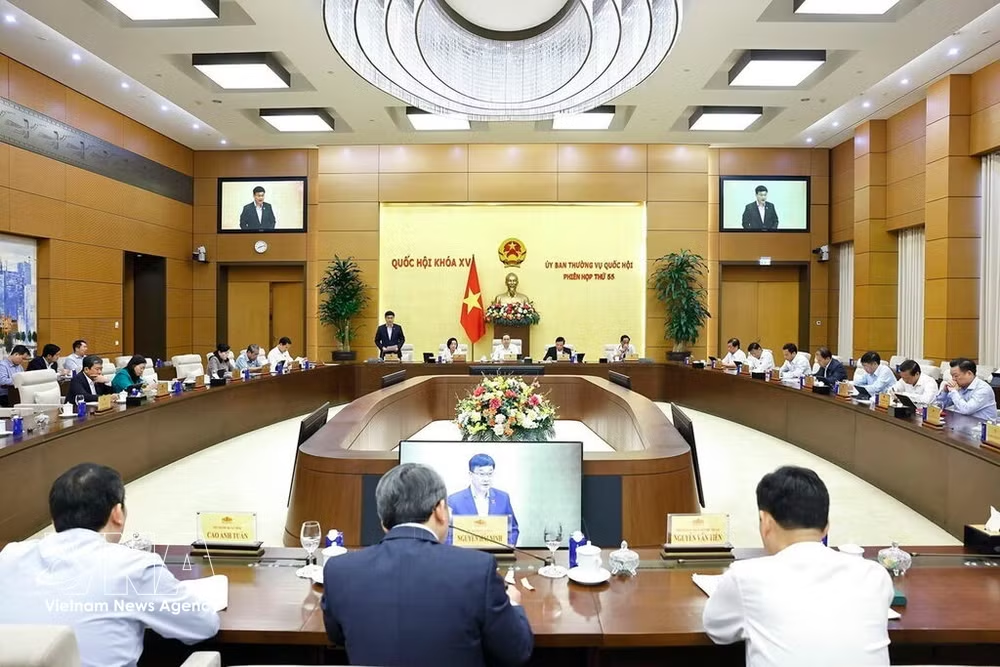
Against this backdrop, amending the Law on Belief and Religion has become an objective necessity. On April 23, 2026, at the first session of the 16th National Assembly, the revised Law on Belief and Religion was adopted with overwhelming consensus, receiving 492 out of 492 votes in favour. It will take effect on January 1, 2027. This outcome reflects not only the strong unity of the highest state authority in improving the legal framework governing belief and religion, but also a clear commitment to better safeguarding freedom of belief and religion while enhancing the effectiveness of state management in line with the country’s development requirements in the new period.
Decentralisation and accountability go hand in hand
One of the key highlights of the revised law is the promotion of administrative decentralisation, ensuring that ministry-level authorities handle no more than 30% of total administrative procedures in this field. The Government has transferred eight areas of authority and related procedures from the Ministry of Ethnic and Religious Affairs to provincial-level People’s Committees. This marks an important shift toward a governance approach that is closer to citizens, more responsive to practical conditions, and more accountable at the local level.
In many areas of public administration, decentralisation is not only an organisational requirement but also a means to improve service delivery. In the field of belief and religion, this is particularly significant, as most activities take place locally and are closely tied to specific historical, cultural, and demographic contexts. Granting greater authority to provincial administrations enables more context-sensitive handling of procedures and emerging issues, reduces bureaucratic layers, shortens processing time, and strengthens the direct accountability of competent authorities.

Decentralisation, however, does not imply a loosening of oversight, nor does the delegation of authority mean a dilution of responsibility. On the contrary, both must go hand in hand with strengthened state management accountability. This is a crucial factor in ensuring that sound policies are implemented effectively and as intended.
Simplifying procedures and enhancing transparency
The revised Law on Belief and Religion removes provisions related to reducing dossier requirements. It also introduces three administrative procedures that shift from a registration-based approach to a notification mechanism. These include two procedures concerning the registration of belief-related activities at belief establishments, and one for registering training courses on religion for religious practitioners.
The amendments, aimed at reducing procedural barriers, clarifying the responsibilities of state authorities, and facilitating the conduct of belief and religious activities by organisations and individuals, represent a practical step forward in ensuring human rights.
In a rule-of-law state, safeguarding rights is not merely about granting permission but also about creating conditions for those rights to be effectively exercised. Therefore, the revised law’s emphasis on administrative simplification and greater convenience reflects a more substantive approach to guaranteeing the right to freedom of belief and religion.
Digital transformation in field of belief and religion
A notable feature of the amended law is the inclusion of provisions governing belief and religious activities in cyberspace. The rapid development of the Internet, social media, and digital platforms has fundamentally reshaped how people communicate, connect, and organise social activities, including those related to belief and religion. From sharing information and organising online gatherings to disseminating teachings, fostering community engagement, and mobilising contributions, cyberspace has become an increasingly integral part of contemporary religious life.
In this context, the law cannot remain detached. Without appropriate regulations, legal gaps could create difficulties in implementation, blurring the line between legitimate activities and the misuse of belief and religion in the digital environment for profiteering, incitement, distortion, or other legal violations. The amendments are therefore a necessary step to adapt to new realities and ensure that the right to freedom of belief and religion is exercised in accordance with the law, including in the digital sphere.

In practice, adapting to the digital environment is a requirement of modern governance, not an issue unique to religion. In any country, as social activities increasingly shift online, legal frameworks must evolve to both facilitate development and mitigate risks. From this perspective, the amended law reflects Vietnam’s proactive approach in identifying emerging challenges early and refining its policies accordingly.
Certain hostile forces have sought to deliberately conflate concepts - portraying the enforcement of law as “religious repression,” the upholding of the rule of law as “restrictions on freedom,” and legitimate state management as grounds for distortion. However, such narratives are increasingly untenable in light of practical realities in Vietnam. If freedom of belief and religion were not respected, why would the State continue to improve its legal framework to better safeguard these rights? If these rights were not ensured, why would the National Assembly adopt amendments aimed at simplifying procedures and facilitating the activities of individuals and organisations? And if Vietnam intended to “tighten control” as alleged, why would it decentralise authority, reduce centralised administrative intervention, and introduce regulations to accommodate new development realities?
The amended law marks a new phase in the continued perfection of the institutional framework for ensuring freedom of belief and religion in Vietnam. This progress is reflected not only in legal provisions, but also in the message conveyed by the legislature and the State to the people and the international community: Vietnam consistently respects, protects, and guarantees human rights; it does not shy away from emerging challenges; and it remains committed to refining its institutions to better serve its people and to ensure that freedom of belief and religion is increasingly realised in a substantive and meaningful manner./.