Vietnam, Cambodia, Laos promote border trade connectivity

The Mekong Delta spans more than 40,500 sq.km, holds roughly 18 million people and shares a nearly 386km border with Cambodia, making it a key gateway to the Greater Mekong Sub-region. An Giang has emerged as a major agro-fisheries hub, with seaports and strategic trade hubs delivering maritime advantages and creating a seamless corridor to Cambodia and beyond.

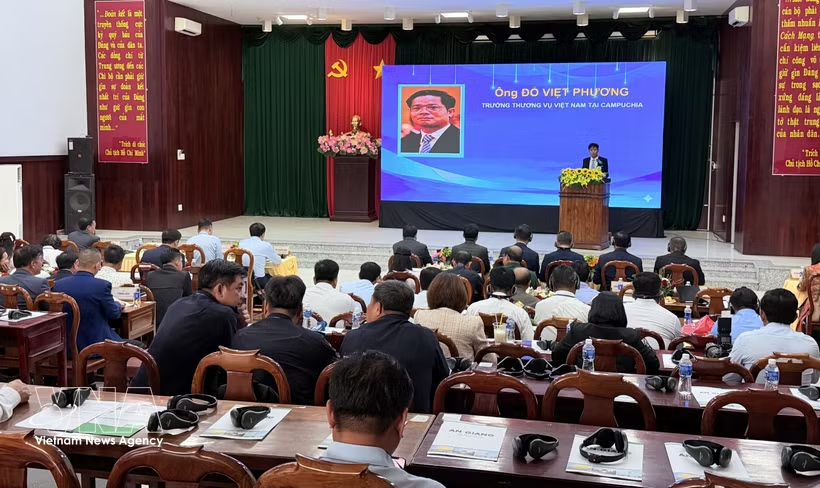
At the Vietnam – Cambodia - Laos border trade connectivity conference (Photo: VNA)

An Giang (VNA) – Authorities in the Mekong Delta province of An Giang, in coordination with the Ministry of Industry and Trade (MIT), hosted the Vietnam – Cambodia - Laos border trade connectivity conference on June 5.

Faster trade flows

According to the MIT, economic corridors, international border gates, border gate economic zones, and cross-border logistics networks linking the three nations are deepening their role in moving goods and services and pulling in capital.

Cambodia ranks among Vietnam's top ASEAN trading partners. Two-way trade hit nearly 11.33 billion USD in 2025, an 11.7% jump from a year earlier. A bilateral trade promotion pact signed for 2025-2026 is opening door for border trade, logistics, supply chain links and market expansion. The two countries now target over 20 billion USD in bilateral trade in coming years.

For Laos, 2025 delivered upbeat signals on trade and economic cooperation. New mechanisms covering trade, energy, coal and power are fueling growth. The bilateral trading relationship draws support from the amended 2024 Vietnam-Laos trade pact, a border trade agreement and deals on electricity and coal signed last year.

The Vietnam-Laos trade structure is highly complementary. Vietnam ships machinery and equipment, construction materials, consumer goods, petroleum and processed industrial products to Laos. In return, it buys electricity, coal, minerals, rubber, timber and a range of agricultural goods.

Fostering trade linkages

Bui Quang Hung, Deputy Director of the MIT’s Vietnam Trade Promotion Agency, said the ministry, together with relevant agencies, local authorities, and Vietnam trade offices in Cambodia and Laos, has staged numerous trade fairs, exhibitions, business forums, trade connectivity conferences, and trade missions in recent years.

With the global economy in flux, he said the three countries need to modernise border trade management and operations to seize existing potential and embed themselves deeper in global value chains.

The MIT will keep working with Vietnamese ministries and Cambodian and Lao authorities to build a friendlier trade environment, Hung affirmed. At the same time, they'll step up administrative reforms, develop border trade infrastructure, logistics and cross-border e-commerce, and expand trade promotion while helping companies with digital transformation and green transition.

The Mekong Delta spans more than 40,500 sq.km, holds roughly 18 million people and shares a nearly 386km border with Cambodia, making it a key gateway to the Greater Mekong Sub-region. An Giang has emerged as a major agro-fisheries hub, with seaports and strategic trade hubs delivering maritime advantages and creating a seamless corridor to Cambodia and beyond.

Expanding cross-border supply chains

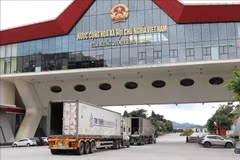
Le Trung Ho, Vice Chairman of the provincial People’s Committee, said An Giang shares a nearly 148-km land border and hosts the Vinh Xuong, Tinh Bien, and Ha Tien international border gates, plus a seaport network and Phu Quoc International Airport. That makes it a major Mekong Delta logistics gateway linking to Phnom Penh and the Gulf of Thailand.

According to him, trade through the local border gates hit 1.287 billion USD in 2025, including 561.35 million USD in exports and 718 million USD in imports. Key items include production materials, farm produce, seafood, rice, fertilisers, and consumer goods.

Ho Sivyong, Government Special Envoy and Director General of Trade Support Services under the Cambodian Ministry of Commerce, said Vietnam and Cambodia need more investment in technical infrastructure and logistics systems at border gate areas, plus better links among regional logistics and trade hubs to cut cross-border transport costs.

He also stressed the importance of coordinated digital transformation in trade promotion, helping small and medium-sized enterprises access markets through cross-border e-commerce. In addition, he called for transnational agricultural and processing industry supply chains to lift product value.

Souksuan Vilayvong, Vice Secretary of the Champasak provincial Party Committee and Chairman of the provincial Administration Committee, encouraged Vietnamese enterprises to scale up investment in Laos, particularly in Champasak, to tap local strengths and deepen regional economic integration.

On the occasion, An Giang authorities also invited firms from Cambodia, Laos, and around the world to invest in hi-tech and eco-friendly projects tied to green growth and digital transformation. The province pledges all possible support to investors while continuing to improve business climate and service quality, aiming to turn itself into a magnet for global and regional capital, they said./.


VNA

See more

Consumers buy fruit at a supermarket in Vietnam. (Photo: VNA)

US highlights potential in Vietnam’s fruit market

The US was Vietnam's second-largest supplier of agricultural products, with export turnover reaching 4.7 billion USD in 2025, a remarkable increase from less than 3.5 billion USD in 2024, Fruitnet said, citing a new report by the US Department of Agriculture (USDA).

Vietnamese Ambassador to Thailand Pham Viet Hung (thitd, left) attends the opening ceremony of Grand Halal Bangkok 2026 (Photo: VNA)

Vietnamese firms seek global Halal opportunities at Bangkok exhibition

Ambassador Pham Viet Hung described Grand Halal Bangkok 2026 as an important opportunity for Vietnamese businesses to connect not only with Thailand's Halal industry but also with Halal food producers worldwide, while learning from experience of Thailand and international partners.

Marnufacturing garments for export at Hung Yen Jute and Garment Joint Stock Company. (Photo: VNA)

GDP expands 8.18%, with new growth drivers taking shape

According to the National Statistics Office under the Ministry of Finance, GDP expanded by 8.39% in the second quarter, up from 8.14% a year earlier. Growth for the first six months reached 8.18%, exceeding the 7.63% recorded in the same period of 2025. The performance reflected broad-based contributions from both the supply and demand sides of the economy.

Production line at Honda Vietnam's manufacturing facility in Dong Van II Industrial Park, Ninh Binh province. (Photo: VNA)

Vietnamese economy sustains momentum on strong industrial production

The National Statistics Office (NSO) under the Ministry of Finance reported that the manufacturing and processing sector remained the principal driver of economic growth, accounting for 33.07% of the economy's total value-added growth during the first six months of the year.

Investors conduct transactions at Bao Viet Securities' headquarters in Hanoi. (Photo: VNA)

Vietnam eyes 205.6 billion USD in stock market funding for 2026–2030

Addressing a seminar on restructuring capital mobilisation channels hosted by the Finance and Investment newspaper on July 15, Bui Hoang Hai, Vice Chairman of the State Securities Commission of Vietnam (SSC), said the domestic economy continues to face considerable external challenges in 2026, including the effects from the Middle East conflict.

Workers process farm produce at the Coastal Fisheries Development Company (Cofidec) in Ho Chi Minh City. (Photo: VNA)

Vietnam remains ASEAN’s fastest-growing economy in first half of 2026: experts

Economists at United Overseas Bank (UOB), a Singapore-based multinational bank, said Vietnam’s gross domestic product (GDP) expanded by 8.39% in the second quarter of 2026, from 7.94% in the first quarter. As a result, economic growth for the first half of the year reached 8.18%, keeping Vietnam at the top among ASEAN economies.

The interface of Vietnam's foreign supplier portal for tax registration, declaration and payment by overseas suppliers. (Photo: dientuungdung.vn)

Foreign digital service providers pay nearly 480 million USD in taxes

According to the Department of Taxation, 259 overseas suppliers have registered, declared and paid taxes through the portal. Tax revenue from the group reached 78.1% of the full-year target, surging 119% from a year earlier and making foreign suppliers the fastest-growing source of tax revenue in Vietnam's digital economy.

Ca Mau companies and households use rooftop solar to cut expenses. (Photo: VNA)

Vietnam raises rooftop solar sales cap to 50%, widens direct power deals

Rooftop solar power is entering a new phase of development with a more solid foundation. When integrated with energy storage systems and direct power purchase mechanisms, it not only contributes to supplementing distributed energy sources and reducing pressure on the national power system, but also serves as a driving force for green growth, enhances the competitiveness of the economy, and ensures energy security.

Production of electrical wiring harnesses at Bandai Vietnam Co., Ltd. in the Left Bank Industrial Park, Phu Tho province. (Photo: VNA)

Record FDI Inflows signal strong investor confidence, but absorptive capacity remains key

Vietnam's competitive advantages are evolving. Rather than relying primarily on low labour costs and tax incentives, the country's future competitiveness will increasingly depend on structural and long-term factors, including transparent institutions, policy predictability and an investment environment capable of supporting long-term strategic investors.

Vietnamese Ambassador to the RoK Vu Ho (first, left) and other participants in the conference in Seoul on July 14 (Photo: VNA)

Vietnam, RoK strengthen investment links at Seoul conference

Vietnamese Ambassador to the RoK Vu Ho said bilateral relations are currently enjoying the best conditions, underpinned by what he described as the three key factors of “favourable timing, geographical advantages, and strong public support”.