Bangkok (VNA) – Vietnam views regional cooperation as the foundation of its broader international strategy, according to Thai scholar Supalak Ganjanakhundee.
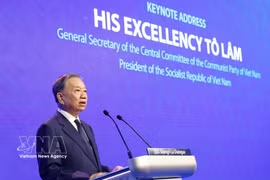
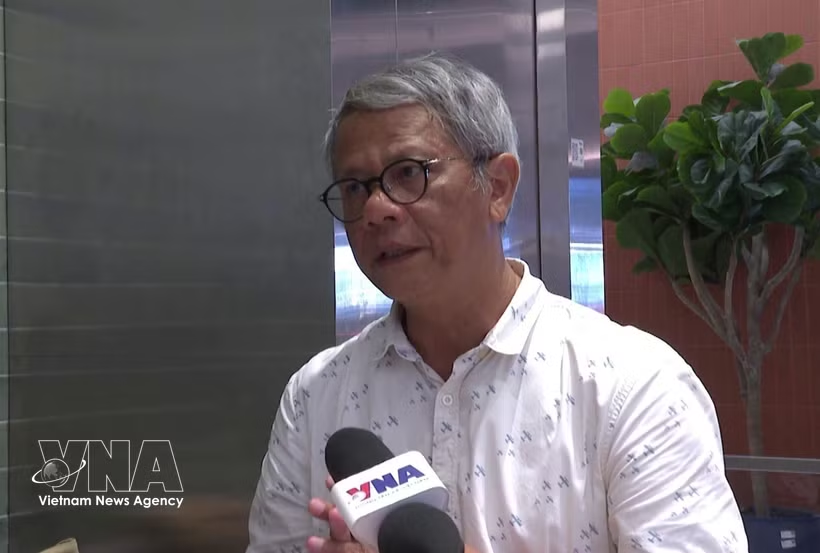
Speaking in an interview with Vietnam News Agency (VNA) correspondents in Bangkok regarding the recent visits by General Secretary of the Communist Party of Vietnam (CPV) Central Committee and State President To Lam to three Southeast Asian countries and his keynote address at the Shangri-La Dialogue, Supalak noted that before presenting Vietnam’s vision for regional peace and security at a major international forum, the top Vietnamese leader visited Thailand, one of the key members of the Association of Southeast Asian Nations (ASEAN). This underscored the importance Vietnam attaches to ASEAN and its relations with neighbouring countries.
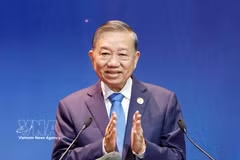
Commenting on General Secretary and President Lam’s keynote speech at the Shangri-La Dialogue, Supalak said the Vietnamese leader identified three interrelated crises shaping the current global landscape – the crisis of international order, the crisis of development models and the crisis of strategic trust.
This analytical framework, he noted, reflects Vietnam’s broader understanding of contemporary security, extending beyond traditional military concerns to include economic resilience, technology governance and the maintenance of stable international rules.
One of the most notable aspects of the speech was Vietnam’s emphasis on preventive diplomacy, dialogue, reconciliation, mediation and confidence-building mechanisms. According to Supalak, the call for risk-reduction measures reflects Vietnam’s growing confidence as a regional actor willing to contribute to shaping the regional environment.
The scholar also highlighted Vietnam’s strong support for ASEAN centrality as a key message of the speech. In his view, the top Vietnamese leader’s interpretation of ASEAN centrality goes beyond merely preserving ASEAN-led forums. Instead, ASEAN should become more effective in preventing conflicts, managing tensions and maintaining strategic stability amid intensifying major-power competition.
Supalak said Vietnam is increasingly moving beyond adapting to regional developments and is now playing a more active role in shaping them. This was clearly reflected in the leader’s emphasis on dialogue, preventive diplomacy, strategic trust, international law and ASEAN centrality as essential pillars of regional stability.
The scholar further observed that Vietnam appears increasingly willing to contribute to regional stability beyond its immediate national interests. Its emphasis on reconciliation, mediation, trust-building measures and preventive diplomacy demonstrates the emergence of Vietnam as a stable middle power committed to strengthening regional institutions, promoting international law and ensuring that great-power competition does not undermine peace and prosperity in the Asia-Pacific.
According to Supalak, the significance of the speech for ASEAN lies in the vision it offers for responding to a more uncertain and competitive strategic environment. Rather than focusing solely on military security, the Vietnamese leader framed regional challenges through the lenses of international order, development and strategic trust, highlighting the need for ASEAN to play a more proactive role in risk management and crisis prevention.
The scholar concluded that the speech’s importance lies not in its immediate policy implications but in what it reveals about Vietnam’s evolving perspective on ASEAN. It demonstrates that Vietnam increasingly views the bloc not only as a diplomatic forum but also as a vital mechanism for safeguarding regional stability amid growing geopolitical uncertainties./.