Vietnam needs more modern, creative working class: Top leader

Party General Secretary and State President To Lam urged the Vietnam Trade Union to reform more rapidly, deeply and substantively. It must work together with the State, enterprises and training facilities to improve workers’ professional qualifications, digital skills and adaptability.

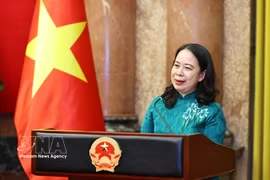
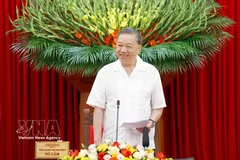
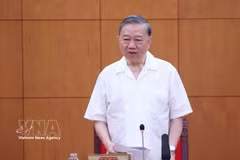
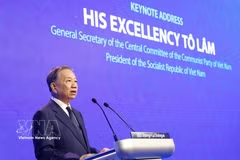
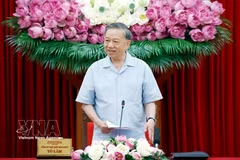
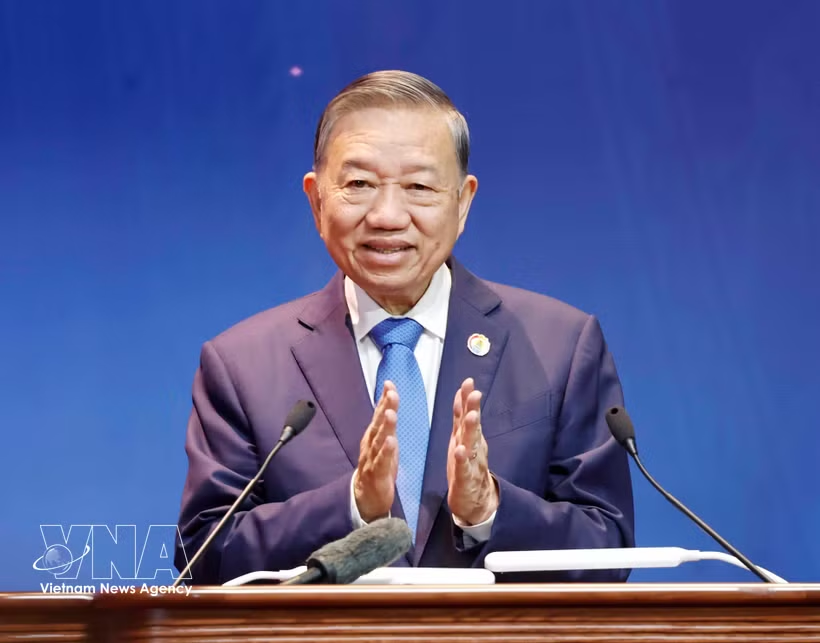
Party General Secretary and State President To Lam speaks at the 14th Vietnam Trade Union Congress on June 4. (Photo: VNA)

Hanoi (VNA) – Party General Secretary and State President To Lam has urged the Vietnam Trade Union to build a modern and robust working class, befitting its role as a pioneer in the nation’s industrialisation and modernisation process.

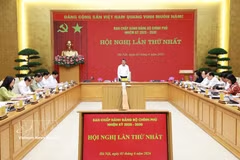
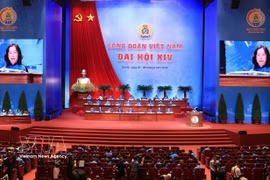
He made the call at the plenary session of the 14th Vietnam Trade Union Congress for the 2026 – 2031 term in Hanoi on June 4, which drew 789 distinguished officials representing the will, aspirations, and collective wisdom of nearly 10 million union members nationwide.

With the country pursuing its 2030–2045 goals, the working class and labour force play an especially critical role and require comprehensive training and genuine listening to secure sustainable development, he said. The congress, he added, must answer a central question: how should the union reform to truly become a trusted support for workers, a strong bridge between the Party, State and the working class, and a key force for national development in the new era.

Basically endorsing the political report, orientations, goals and tasks set out by the congress, the top Vietnamese leader commended and congratulated the working class, civil servants, employees and trade unions on their significant achievements in the previous term.

While flagging existing limitations, he urged the Vietnam Trade Union to reform more rapidly, deeply and substantively. It must work together with the State, enterprises and training facilities to improve workers’ professional qualifications, digital skills and adaptability.

Union activities must place members and workers at the centre. Every agenda, plan and movement must answer key questions: what do workers gain, what rights are protected, what difficulties are resolved, and whose voices are being heard. The effectiveness of trade unions should not be measured by the number of meetings, documents or campaigns, but by the trust of members, the satisfaction of workers, the quality of collective bargaining agreements, the number of successfully resolved cases, and the improvement of living conditions at the grassroots.

In his view, enterprises should be encouraged to operate efficiently, innovate and integrate deeply into global value chains, while strictly complying with labour laws, ensuring occupational safety and hygiene, fully contributing to social insurance, and improving workers’ welfare. Investment in workers, he noted, is also an investment in productivity, brand value and long-term business growth.

He underscored the need to build a modern, professional, digitalised, transparent Vietnam Trade Union capable of effectively representing workers in the new context, enabling them to easily submit feedback, access legal advice, check their rights, register for support, and join surveys and evaluations of union activities. This would also help trade unions better understand labour conditions, anticipate disputes, and provide timely and targeted support.

Trade union officials, he said, must be professionally trained in labour law, collective dispute settlement, social welfare, digital communications, data management, organisational governance and crisis response. They must also have dedication to workers, resilience under pressure, skills in working with enterprises, persuasive ability and credibility among workers.

Trade unions must also play a more active role in Party building and strengthening the political system, contributing to consolidating the Party’s social foundation within the working class. More outstanding workers should be identified, nurtured and introduced for Party membership, so that industrial zones, factories and enterprises increasingly have Party members who are frontline workers with strong professional competence and peer credibility.

The Party, State, National Assembly, Government and the entire political system must always accompany and share responsibility with the VGCL, the Vietnam Fatherland Front and workers, he said.

Trade unions must also play a more active role in Party building and strengthening the political system, contributing to consolidating the Party’s social foundation within the working class. More outstanding workers should be identified, nurtured, and introduced for Party membership, so that industrial zones, factories, and enterprises increasingly have Party members who are frontline workers with strong professional competence and peer credibility.

The Party, State, National Assembly, Government, and the entire political system must always accompany and share responsibility with trade unions, the Vietnam Fatherland Front (VFF), and workers, he said.

To ensure the success of the Vietnam Trade Union’s tasks, he called on Party committees at all level, authorities, the VFF, socio-political organisations, and the business community to continue creating supportive conditions for trade unions to operate more effectively.

Local Party committees and authorities must consider caring for the working class a key political task, regularly engage in dialogue, listen to workers, and promptly address their legitimate concerns. Policies on wages, housing, insurance, vocational training, occupational safety, and cultural facilities for workers must be endorsed substantively, with clear supervision and measurable outcomes.

Immediately after the Congress, the Vietnam General Confederation of Labour (VGCL) was tasked with translating its resolution into concrete action with clear responsibilities, tasks, deadlines, and outcomes, ensuring that the Congress’s spirit reaches every trade union level, industrial zone, enterprise, production unit, and worker.

Delegates discussed issues directly related to trade union members, workers, and activities in the new period, including representing, caring for, and protecting the legitimate rights and interests of union members and workers; developing grassroots trade unions; improving the quality of trade union officials; renewing outreach and launching patriotic emulation movements, among others./.
VNA

See more

Vietnamese Ambassador to Algeria Tran Quoc Khanh poses for a group photo with the university leadership and staff of the University of Skikda. (Photo: VNA)

Vietnam, Algeria strengthen agricultural trade connectivity

Vietnam’s main exports to Algeria include coffee, cashew nuts, pepper, textiles and garments, steel and selected industrial products, while the North African country sells animal feed, chemicals, dates and other agricultural products to Vietnam.

Vietnamese Deputy Minister of Foreign Affairs Le Thi Thu Hang speaks at the forum. (Photo: VNA)

Vietnam, Switzerland eye stronger economic connectivity

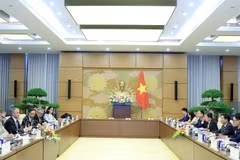
Vietnamese Deputy Minister of Foreign Affairs Le Thi Thu Hang expressed Vietnam’s desire to see Swiss enterprises expand their long-term presence and investment in the country, particularly in high technology, innovation, renewable energy, pharmaceuticals, healthcare and digital transformation. She also emphasised cooperation in talent development, high-end tourism and international financial centre development.

Chairman of the People’s Committee of Hue city Nguyen Khac Toan (right) presents a souvenir to Karl Wilfing, President of the State Parliament of Lower Austria. (Photo: People’s Committee of Hue city)

Hue city moves to deepen multifaceted cooperation with Austrian partners

Toan proposed Lower Austria consider establishing an official cooperation mechanism with Hue to facilitate investment collaboration in tourism, education and training, healthcare, information technology, green and smart urban development, heritage conservation, hi-tech agriculture and sustainable development.

Prime Minister Le Minh Hung chairs the working session with the Standing Board of the Hanoi Party Committee on June 11. (Photo: VNA)

Prime Minister urges Hanoi to target higher growth, become leading innovation hub

The PM emphasised that Hanoi must achieve its 11% growth target for 2026 through comprehensive solutions and regular reviews of growth scenarios. He called on the city to unlock growth potential in processing, manufacturing, trade, services, finance, banking, insurance, transport, logistics, construction and real estate, while controlling inflation and market stability.

Party General Secretary and State President To Lam addresses the conference. (Photo: VNA)

Top leader calls for better quality of institutional development

Party General Secretary and State President Lam underscored the need for a new mindset that places judicial reforms within a unified rule-of-law framework: good law-making, strict law enforcement, an honest judiciary, safeguarded justice, controlled power, protected human and citizens’ rights, and national development supported by a transparent, effective and coherent institutional system.

A damaged road is seen following the earthquake near General Santos City, the Philippines, on June 9, 2026. (Photo: Xinhua/VNA)

Messages of sympathy sent to Philippines over losses caused by earthquake

General Secretary of the Communist Party of Vietnam Central Committee and State President To Lam, and Prime Minister Le Minh Hung on June 11 sent messages of sympathy to Philippine President Ferdinand Romualdez Marcos over great losses of life and property caused by a recent earthquake in the southern Philippines.

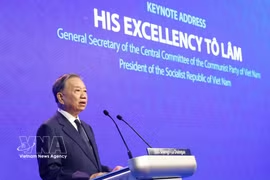
Vietnamese Deputy Prime Minister Le Tien Chau delivers a speech at the 31st Future of Asia Conference in Tokyo on June 11 (Photo: VNA)

Vietnam proposes three Asian cooperation orientations

Drawing on Asia’s development journey, Vietnamese Deputy Prime Minister Le Tien Chau distilled three lessons: resilience as the bedrock of sustainable development, cooperation as the engine of a stable and open future, and reform and innovation as essential catalysts for economies adapting to a fast-changing era.

☕ Afternoon briefing on June 11

☕ Afternoon briefing on June 11

A national conference disseminating and implementing Politburo Resolution No. 06-NQ/TW, the launch of the 14th national red journey blood donation campaign, and the 2026 national high school graduation examination are among news highlights on June 11.

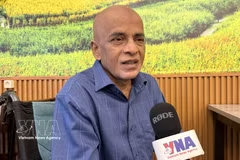
Dr. Gnel Rattha, President of the Cambodia – Russia Business Association and an expert in geopolitics and international economics, grants an interview to the Vietnam News Agency. (Photo: VNA)

Cambodian expert hails AFF 2026 as milestone in multilateral party diplomacy

AFF 2026 is a testament to Vietnam’s ability to pursue a foreign policy of independence, self-reliance, and deeper international integration. The forum’s agenda also demonstrated the host country’s organisational capacity in broadening dialogue beyond the government level, bringing together representatives of major ASEAN cities, youth groups, and the private sector, said Dr. Gnel Rattha, President of the Cambodia–Russia Business Association.

Flag-raising ceremony marking the 57th anniversary of the founding of the Association of Southeast Asian Nations (ASEAN), organised by the Vietnamese Ministry of Foreign Affairs in Hanoi on August 8, 2024. (Photo: VNA)

AFF 2026 potential to become an incubator of ideas for ASEAN’s future agenda: expert

Collins Chong Yew Keat, a strategic, security and foreign affairs analyst at the Universiti Malaya, said that Vietnam’s decision to organise the forum was highly timely, as the bloc is currently facing a range of interconnected challenges, from major-power competition, maritime tensions and supply chain disruptions to non-traditional issues such as climate change and technological transformation.