Independent survey portal launched to assess 50 public services in Hanoi

The portal will provide technological solutions and data infrastructure, while the service centre will facilitate system integration.

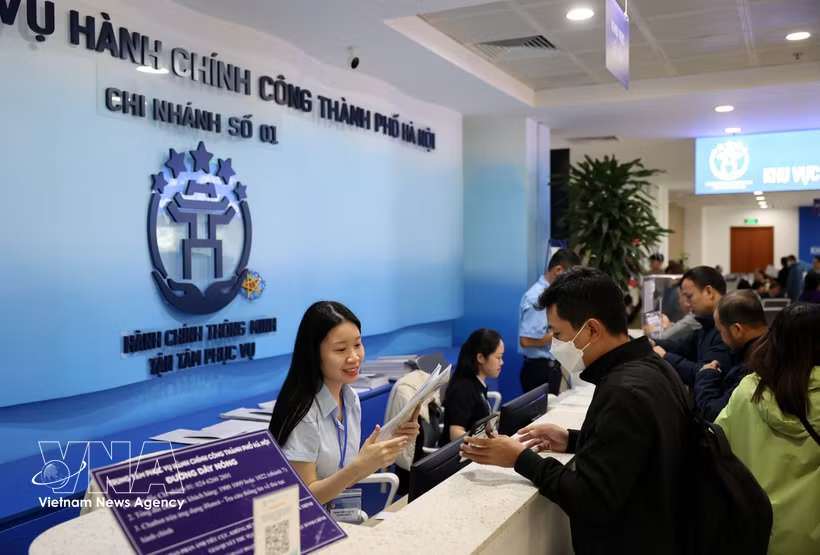
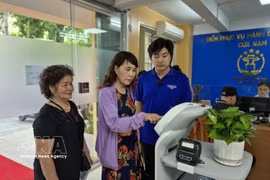
Civil servants at the Hanoi Public Administrative Service Centre assist residents with administrative procedures. (Photo: VNA)

Hanoi (VNA) – The independent survey portal HIHUB, designed to collect public feedback on 50 groups of public services across the capital, was officially launched on June 4.

The launch took place during a ceremony that also saw the signing of a cooperation memorandum (MoU) between Hanoi Innovation Hub (HIHUB), the Hanoi Public Administration Service Centre, the Institute for Vietnam Initiatives (IVI), PVcomBank, and ShopeeFood Vietnam.

Under the MoU, HIHUB will provide technological solutions and data infrastructure, while the service centre will facilitate system integration. The institute and PVcomBank will contribute resources and methodological support. The bank and ShopeeFood Vietnam, meanwhile, are partnering in the implementation of the survey campaign.

According to organisers, the initiative is based on a memorandum signed on May 12 between the Party Central Committee's Office and HIHUB, with the aim of conducting an independent assessment of citizens’ real-life experiences when accessing public services.

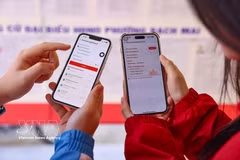
The campaign is scheduled to begin citywide in early June, focusing on 50 essential public services. Through the HIHUB portal, residents are able to share their experiences directly, evaluate service quality and report difficulties encountered during administrative procedures.

A notable feature of the new model is its shift from simply measuring satisfaction levels to evaluating the entire user experience. The survey covers all stages of the process, from obtaining information and submitting applications to processing procedures and receiving final results.

In addition to surveys conducted through the public service portal and at public administration centres, the system employs independent survey technology with encrypted and secure data handling. Survey links will be automatically sent approximately two hours after a citizen completes an administrative procedure via official Zalo accounts, SMS messages, email or the iHanoi application.

By allowing users to provide feedback after leaving the service centre, the system is expected to encourage more candid and objective responses.
cong-khao-sat-040626.jpg
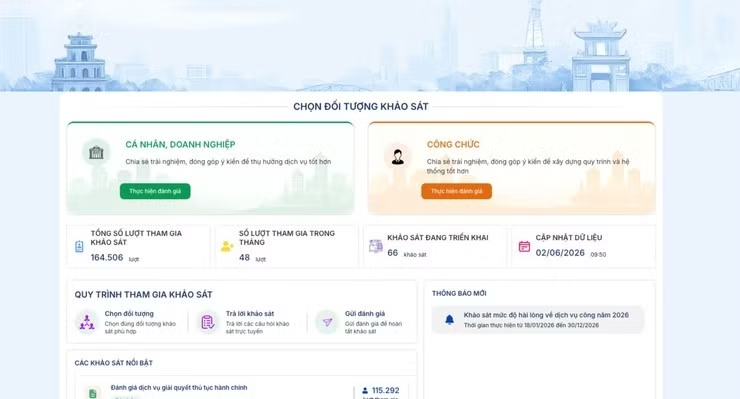
The interface of the HIHUB independent survey portal. (Photo: ttpvhcc.hanoi.gov.vn)

Another innovation is the incorporation of feedback not only from citizens and businesses but also from frontline civil servants who directly process applications. The survey data will be supplemented by digital administrative data, including error rates at different stages of processing, system interaction times and other operational indicators.

Speaking at the event, representatives of the project steering committee stressed that listening to citizens should go beyond one-off surveys and become a continuous feedback mechanism. Such a system, they said, would help authorities identify practical bottlenecks more effectively and support ongoing administrative reform efforts./.
VNA

See more

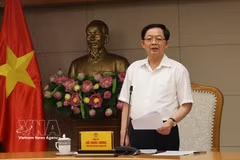
Deputy Prime Minister Ho Quoc Dung speaks at the meeting of the Government task force on strategic technology development on June 4. (Photo; VNA)

Deputy PM demands tangible results in strategic tech development

Deputy PM Ho Quoc Dung pressed ministries and agencies to rapidly convert their assigned tasks into concrete action plans with clearly defined responsibilities, and effectively launch projects that create strategic technology products capable of sharpening national competitiveness.

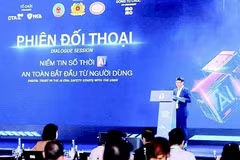
A panel discussion on “Digital trust in the AI era: Security starts with the users” at the Digital Trust in Finance 2026 forum (Photo: nhandan.vn)

Protecting users crucial in building digital trust: Experts

In Vietnam, digital transformation in the finance and banking sector is accelerating cashless payments, expanding access to financial services, improving market transparency and supporting economic growth and macroeconomic management.

Illustrative image

Proactive cybersecurity essential in age of AI-powered crime: experts

According to Dr. Le Minh Nghia, Chairman of the Vietnam Financial Consulting Association (VFCA), AI has become a key driver reshaping the global financial industry. In Vietnam, the technology is already widely used in banking and finance for credit analysis, electronic customer identification (eKYC), risk management, service personalisation and real-time transaction processing.

Dr Nguyen Huu Ha, Deputy Director of the Gia Lai Department of Science and Technology, speaks at the scientific workshop on recent advances in the study of strongly correlated electron systems opened in the central province on June 1, 2026. (Photo: VNA)

Global physicists discuss strongly correlated electron materials advances

The workshop aims to achieve three key objectives providing a platform for academic exchange and strengthening collaboration between leading international scientists and young researchers, including doctoral students; promoting multidimensional scientific dialogue on major open questions in the field; and initiating new directions for international research cooperation with the active participation of Vietnam's physics community.

Tra Vinh University attracts a growing number of students and interns from Vietnam and abroad for study and research programmes. (Photo: VNA)

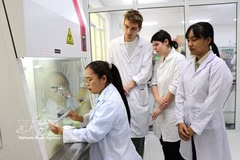
Fostering skilled workforce for innovation era: experts

Experts said close coordination among State management agencies, research institutes, universities, and businesses will improve training quality and serve the dual goals of quality education and practical research application.

Manufacturing cameras at the Sunny Opotech Vietnam Co., Ltd. in the Yen Binh Industrial Park, Thai Nguyen province. (Illustrative photo: VNA)

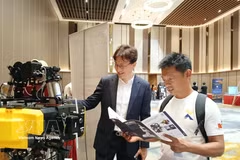
OV intellectuals pin hopes on stronger Vietnam – Singapore technology ties

OVs hope the two countries can establish an interconnected cooperation mechanism in the technology supply chain, from sharing research, testing, and development infrastructure to training human resources, thereby forming a technology alliance able to compete with others in the ASEAN region and the world.

Deputy Prime Minister Nguyen Van Thang talks with technology enterprises on the sidelines of the event. (Photo: VNA)

Vietnam launches first national AI-native hackathon

Part of the Vietnam Innovation Challenge 2026, the programme goes beyond conventional coding competitions by requiring participants to develop AI-driven solutions to business challenges in real time.

Ho Chi Minh City: Rising hub for science, technology, innovation

Ho Chi Minh City: Rising hub for science, technology, innovation

Ho Chi Minh City currently hosts 143 science and technology enterprises, accounting for around 20% of the national total. Total factor productivity (TFP) contributes 59% to the city’s GRDP growth, with science and technology responsible for 74% of TFP growth.

A view of the talks in Bangkok on May 28. (Photo: VNA)

Vietnam, Thailand step up cooperation in science, technology, innovation

Over recent years, NSTDA has built strong partnerships with Vietnamese research institutes and organisations in agriculture, biotechnology, energy and sustainable development. Notable examples include joint projects on cassava value chains, salt-tolerant rice, biotechnology products and an initiative on green energy cooperation and development in the Mekong basin.

Targeting full integration of all individual and organisational documents on VNeID by 2028 in accordance with regulations on electronic identification and authentication. (Photo: VNA)

VNeID set to become Vietnam’s all-in-one digital super app

The project aims to transform VNeID into a modern, secure and highly scalable national digital platform capable of effectively serving citizens, businesses, agencies and organisations in handling administrative procedures, accessing online public services, conducting electronic transactions and using digital utilities.