Deputy PM demands tangible results in strategic tech development

Deputy PM Ho Quoc Dung pressed ministries and agencies to rapidly convert their assigned tasks into concrete action plans with clearly defined responsibilities, and effectively launch projects that create strategic technology products capable of sharpening national competitiveness.

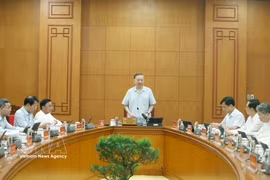
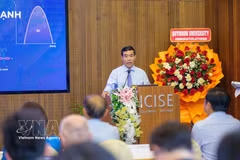
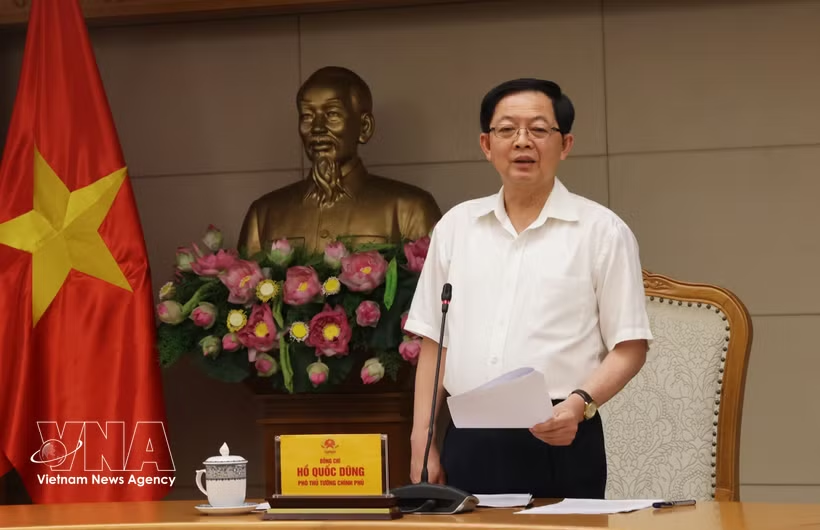
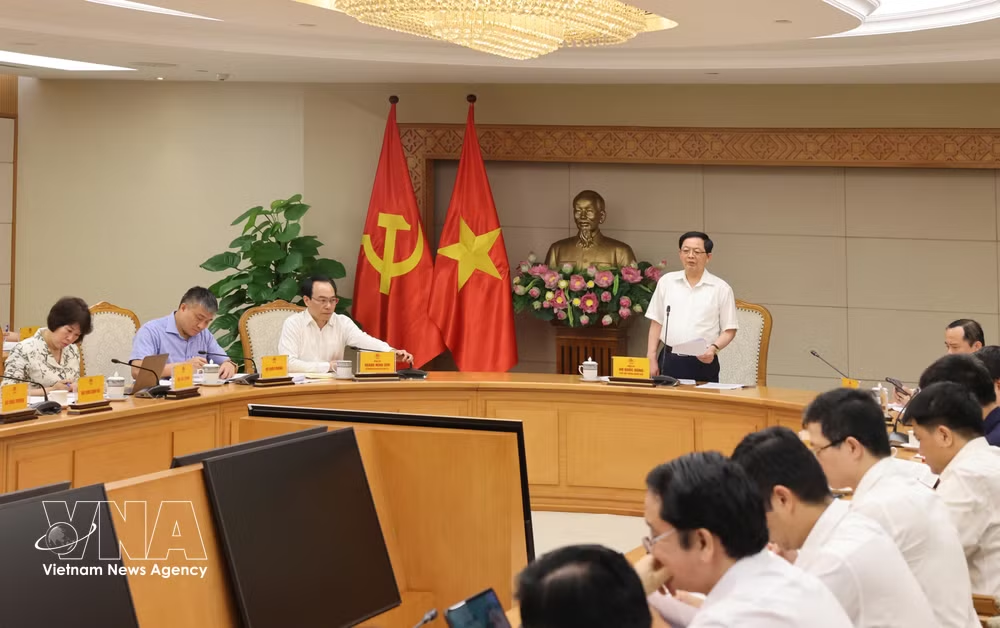
Deputy Prime Minister Ho Quoc Dung speaks at the meeting of the Government task force on strategic technology development on June 4. (Photo; VNA)

Hanoi (VNA) – Deputy Prime Minister Ho Quoc Dung on June 4 underscored the need for drastic and coordinated action, and measurable outcomes as he chaired the first meeting of the Government task force on strategic technology development, a move meant to realise under the Prime Minister’s recent Decision 808/QD-TTg.

Targeting concrete products in 2026

Deputy PM Dung noted that the Government has identified 20 strategic technology sectors and assigned specific tasks to 10 ministries and agencies. The order is to move aggressively beyond the preparatory phase and deliver specific products, technologies, and enterprises that generate visible, quantifiable, and substantive results.

A decree guiding the enforcement of the Law on High Technology must be finalised this month, with a sharp focus on those related to strategic technologies. He also called for research and proposals on mechanisms to identify, certify, and label strategic technology products.

To realise the PM’s decision, Dung assigned the Ministry of Science and Technology (MoST) to evaluate and provide guidance on tasks proposed by other ministries and agencies. They were instructed to proactively allocate personnel and resources, set clear goals, expected outcomes and timelines, and strive to deliver concrete products this year. Any bottlenecks exceeding their authority must be promptly reported to the Government for consideration.

The MoST was also told to fast-track a scheme to develop key national research centres, testing facilities, and labs serving strategic technology research and development. Other ministries and agencies were ordered to review the need for technical standards and regulations governing strategic technology products within their respective domains.

On workforce training, the MoST will continue to lead a support scheme for outstanding graduates through 2030. The Ministry of Education and Training was directed to review and propose high-quality manpower training courses for strategic technology fields.
vnanet-t.jpg
The first meeting of the Government task force on strategic technology development on June 4 (Photo: VNA)

The Deputy PM pressed ministries and agencies to rapidly convert their assigned tasks into concrete action plans with clearly defined responsibilities, and effectively launch projects that create strategic technology products capable of sharpening national competitiveness.

48 strategic technology tasks proposed

A MoST representative said the ministry immediately partnered with relevant stakeholders to provide guidance and monitor rollout after the PM’s decision was issued. In parallel, it reviewed and reinforced the necessary conditions, including legal frameworks, policies, mechanisms, technical standards and regulations, research and testing infrastructure, human capital, and oversight tools.

Assigned ministries and agencies have since identified focal points, reviewed tasks, built proposals, defined expected outputs, assessed resource requirements, and prepared conditions for execution.

The MoST noted that ministries and agencies have swiftly set up task forces, reviewed existing projects, and drawn enterprises, research institutes, universities, and experts to shape assignments despite the short implementation period. Many tasks already have identified expected outputs, participating enterprises, resource needs, and roadmaps stretching to 2030.

In total, ministries and agencies have put forward 48 strategic technology development tasks.

They also recommended the early completion of supporting mechanisms and policies to ensure the strategic technology agenda goes forward./.​

VNA

See more

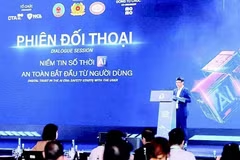
A panel discussion on “Digital trust in the AI era: Security starts with the users” at the Digital Trust in Finance 2026 forum (Photo: nhandan.vn)

Protecting users crucial in building digital trust: Experts

In Vietnam, digital transformation in the finance and banking sector is accelerating cashless payments, expanding access to financial services, improving market transparency and supporting economic growth and macroeconomic management.

Illustrative image

Proactive cybersecurity essential in age of AI-powered crime: experts

According to Dr. Le Minh Nghia, Chairman of the Vietnam Financial Consulting Association (VFCA), AI has become a key driver reshaping the global financial industry. In Vietnam, the technology is already widely used in banking and finance for credit analysis, electronic customer identification (eKYC), risk management, service personalisation and real-time transaction processing.

Dr Nguyen Huu Ha, Deputy Director of the Gia Lai Department of Science and Technology, speaks at the scientific workshop on recent advances in the study of strongly correlated electron systems opened in the central province on June 1, 2026. (Photo: VNA)

Global physicists discuss strongly correlated electron materials advances

The workshop aims to achieve three key objectives providing a platform for academic exchange and strengthening collaboration between leading international scientists and young researchers, including doctoral students; promoting multidimensional scientific dialogue on major open questions in the field; and initiating new directions for international research cooperation with the active participation of Vietnam's physics community.

Tra Vinh University attracts a growing number of students and interns from Vietnam and abroad for study and research programmes. (Photo: VNA)

Fostering skilled workforce for innovation era: experts

Experts said close coordination among State management agencies, research institutes, universities, and businesses will improve training quality and serve the dual goals of quality education and practical research application.

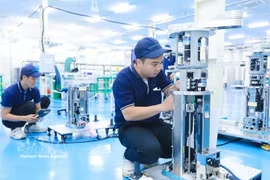
Manufacturing cameras at the Sunny Opotech Vietnam Co., Ltd. in the Yen Binh Industrial Park, Thai Nguyen province. (Illustrative photo: VNA)

OV intellectuals pin hopes on stronger Vietnam – Singapore technology ties

OVs hope the two countries can establish an interconnected cooperation mechanism in the technology supply chain, from sharing research, testing, and development infrastructure to training human resources, thereby forming a technology alliance able to compete with others in the ASEAN region and the world.

Deputy Prime Minister Nguyen Van Thang talks with technology enterprises on the sidelines of the event. (Photo: VNA)

Vietnam launches first national AI-native hackathon

Part of the Vietnam Innovation Challenge 2026, the programme goes beyond conventional coding competitions by requiring participants to develop AI-driven solutions to business challenges in real time.

Ho Chi Minh City: Rising hub for science, technology, innovation

Ho Chi Minh City: Rising hub for science, technology, innovation

Ho Chi Minh City currently hosts 143 science and technology enterprises, accounting for around 20% of the national total. Total factor productivity (TFP) contributes 59% to the city’s GRDP growth, with science and technology responsible for 74% of TFP growth.

A view of the talks in Bangkok on May 28. (Photo: VNA)

Vietnam, Thailand step up cooperation in science, technology, innovation

Over recent years, NSTDA has built strong partnerships with Vietnamese research institutes and organisations in agriculture, biotechnology, energy and sustainable development. Notable examples include joint projects on cassava value chains, salt-tolerant rice, biotechnology products and an initiative on green energy cooperation and development in the Mekong basin.

Targeting full integration of all individual and organisational documents on VNeID by 2028 in accordance with regulations on electronic identification and authentication. (Photo: VNA)

VNeID set to become Vietnam’s all-in-one digital super app

The project aims to transform VNeID into a modern, secure and highly scalable national digital platform capable of effectively serving citizens, businesses, agencies and organisations in handling administrative procedures, accessing online public services, conducting electronic transactions and using digital utilities.