Japanese scholar highlights global significance of Ho Chi Minh’s journey abroad

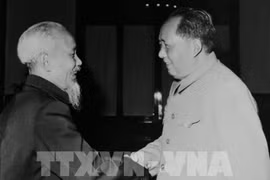
President Ho Chi Minh's observations of Western societies, colonised territories and international labour movements helped shape a global vision that was rare among Asian figures of that period, Professor Shimizu Masaaki said.

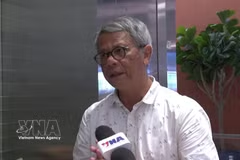
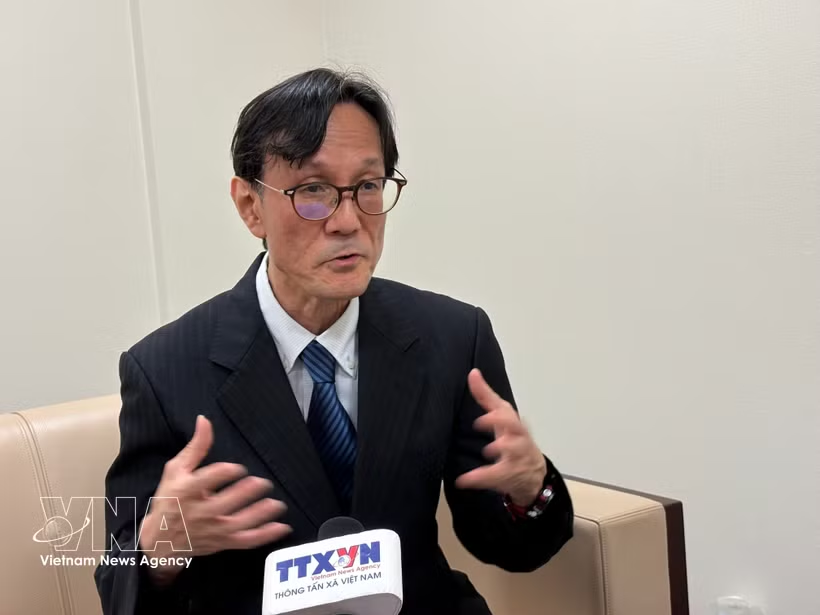
Professor Shimizu Masaaki of the University of Osaka talks to the Vietnam News Agency. (Photo: VNA)

Tokyo (VNA) – President Ho Chi Minh’s journey to seek a path for national salvation starting on June 5, 1911 was not only a turning point in Vietnam’s modern history but also a symbol of global interaction and exchange in Asia in the early 20th century, according to Professor Shimizu Masaaki of the University of Osaka.

On June 5, 1911, the young Nguyen Tat Thanh, who later became President Ho Chi Minh, boarded the vessel Latouche-Treville at Nha Rong Wharf and departed Vietnam in search of a path to liberate the nation. During his 30-year odyssey across continents, he identified a road to national liberation, ultimately leading Vietnam to independence, freedom, national reunification and the path towards socialism.

Speaking to the Vietnam News Agency (VNA) correspondent in Japan on the occasion of the 115th anniversary of the late leader’s departure, Shimizu highlighted the broader historical significance of the event.

According to the professor, one remarkable aspect of President Ho Chi Minh’s journey was that under the name Nguyen Tat Thanh at the time, he engaged with the world not simply as a citizen of a colonised nation, but through direct transnational experiences.

His observations of Western societies, colonised territories and international labour movements helped shape a global vision that was rare among Asian figures of that period, Shimizu said.

From the perspective of ideological history and international exchanges, he noted that the deeper significance of the 1911 departure lies in the recognition that modernisation and national liberation are inseparable from learning from the world through practical experience and international dialogue.

Discussing the relevance of Ho Chi Minh’s journey to today’s younger generations in Vietnam and Japan, the scholar underscored the enduring lesson of “going out into the world to better understand one’s own country.”

In the context of globalisation, studying abroad and participating in international exchanges should not be limited to acquiring foreign languages or technical knowledge, he said. More importantly, such experiences enable people to engage in dialogue with other cultures and reflect more deeply on their own societies.

The professor expressed his hope that young people from Vietnam and Japan will promote new forms of cooperation not only in economic fields but also in education, multilingualism, migration and models of social coexistence.

Regarding perceptions of President Ho Chi Minh in Japan, Shimizu said that within the academic circle, the Vietnamese leader is increasingly viewed not only as a revolutionary and political leader but also as an intellectual of international stature closely associated with East – West exchanges.

Many scholars, he noted, are interested in Ho Chi Minh’s ability to absorb diverse cultural influences, his linguistic skills and his international outlook. As a result, perceptions of the late Vietnamese leader in Japan have become more multidimensional than in the past.

However, the scholar pointed out that public understanding of Vietnamese history in Japan remains relatively limited. He therefore stressed the importance of further strengthening academic exchanges and educational cooperation between the two countries./.
VNA

See more

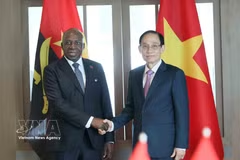
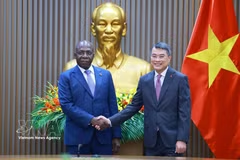
Minister of Foreign Affairs Le Hoai Trung (R) welcomes visiting Angolan Minister of External Relations Téte António in Hanoi on June 4 (Photo: VNA)

Vietnamese, Angolan foreign ministers hold talks in Hanoi

The Vietnamese FM proposed that the two sides strengthen political trust through high-level exchanges, while maintaining existing cooperation mechanisms, particularly the Vietnam–Angola Intergovernmental Committee and Political Consultations between the two foreign ministries.

Party General Secretary and State President To Lam chairs a working session with the Party Central Committee’s Commission for Policies and Strategies and relevant agencies on a project to renew the country’s development model based on science, technology, innovation and digital transformation on June 4, 2026. (Photo: VNA)

Party chief calls for building national capacity for innovation, adaptation

The new development model must place people at the centre as the objective, driving force and key actor of development. All development policies should aim to improve people’s material and spiritual well-being, creative capacity, dignity, opportunities for advancement and equitable access to development benefits, said top leader To Lam.

Nguyen Hong Thanh (R), Permanent Vice Chairman of the Tay Ninh provincial People's Committee, and Vipra Pandey, Consul General of India in Ho Chi Minh City, discuss cooperation opportunities during a working session in Tay Ninh province on June 4. (Photo: VNA)

Tay Ninh seeks stronger cooperation with Indian partners

Tay Ninh is home to 14 Indian-invested projects with total registered capital of about 108 million USD. These projects are mainly engaged in industrial production and processing, including garment manufacturing, rice bran oil production, sugar production, seed processing and agricultural product processing.

Party General Secretary and State President To Lam speaks at the 14th Vietnam Trade Union Congress on June 4. (Photo: VNA)

Vietnam needs more modern, creative working class: Top leader

Party General Secretary and State President To Lam urged the Vietnam Trade Union to reform more rapidly, deeply and substantively. It must work together with the State, enterprises and training facilities to improve workers’ professional qualifications, digital skills and adaptability.

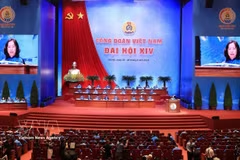
A view of the 14th Vietnam Trade Union Congress for the 2026–2031 term (Photo: VNA)

Grand opening of 14th Vietnam Trade Union Congress for 2026–2031 term

VGCL President Nguyen Anh Tuan said achievements obtained over the past ternure reflect the close guidance of the Party, effective coordination among State agencies, local authorities, the Vietnam Fatherland Front and socio-political organisations, support from employers and, above all, the dedication and innovation demonstrated by trade union officials, members and workers across the country.

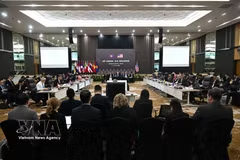
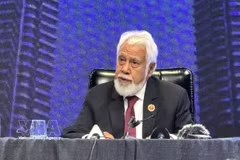
At the 38th ASEAN–US Dialogue (Photo: VNA)

ASEAN, US foster bonds, look towards 50th anniversary of ties

On the East Sea issue, Giang reaffirmed Vietnam’s and ASEAN’s consistent stance on maintaining peace, stability, security, safety, and freedom of navigation and overflight, settling disputes by peaceful means in accordance with international law, particularly the 1982 United Nations Convention on the Law of the Sea (UNCLOS), and stressed the need for the early finalisation of an effective, substantive, and legally binding Code of Conduct (COC) in the East Sea.

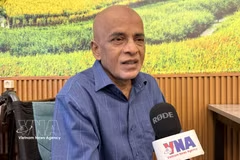
Veeramalla Anjaiah, Senior Research Fellow at the Centre for Southeast Asian Studies in Indonesia. (Photo: VNA)

Vietnam affirms growing stature in global, regional affairs: Indonesian scholar

Veeramalla Anjaiah, Senior Research Fellow at the Centre for Southeast Asian Studies in Indonesia, said the keynote address by General Secretary of the Communist Party of Vietnam Central Committee and State President To Lam at the 23rd Shangri-La Dialogue came at a highly opportune moment and at a forum of particular significance to global and regional security.