President Ho Chi Minh’s diplomatic thought remains lodestar: scholars

Peace, independence, national unity and territorial integrity are the immutable principles at the heart of President Ho Chi Minh’s diplomatic thought. These are sacred values that cannot be compromised under any circumstance.

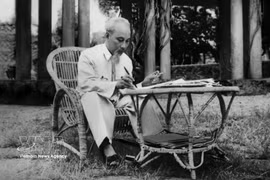
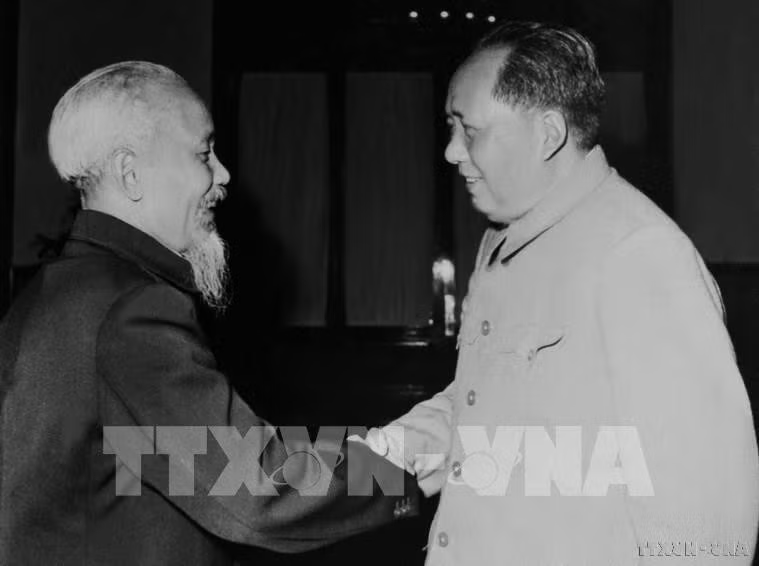
President Ho Chi Minh meets with Chairman Mao Zedong on November 2, 1960 in Beijing during his visit to China from November 2 - 4, 1960. (Photo: VNA)

Hanoi (VNA) – Scholars have highlighted the enduring value of President Ho Chi Minh's diplomatic thought, describing it as a guiding principle for Vietnam’s foreign policy of independence, self-reliance, peace, cooperation and development.

According to Dr. Le Trung Kien from the Ho Chi Minh National Academy of Politics, one of the core legacies of President Ho Chi Minh is the principle of "staying firm in policy, yet flexible in its execution".

The ideals of “Independence – Freedom – Happiness” represent the immutable values that Vietnam must consistently uphold in today’s context of intensifying strategic competition, he said on the occasion of the President's 136th birth anniversary (May 19, 1890–2026).

“Vietnam’s foreign policy is not about choosing sides, but about choosing justice and righteousness,” Kien stressed.

Drawing from President Ho Chi Minh’s philosophy of “befriending all democratic countries without earning enmity towards any,” Vietnam has maintained a foreign policy of non-alignment, refraining from military alliances or siding with one country against another, while remaining committed to independence, peace, stability and the interests of its people.

Kien emphasised that national independence today extends beyond territorial sovereignty to include independence in policymaking and development orientation. Political independence, he noted, must be underpinned by economic self-reliance.

To strengthen its strategic autonomy, Vietnam needs breakthroughs in defence industry, core technologies and energy security, he said, adding that a strong and independent economy would enhance the country’s voice and position in international negotiations.

At the same time, Vietnam should continue pursuing international cooperation based on mutual support and shared interests while preserving its political identity and socialist orientation.

Rather than relying on a single strategic partner, Vietnam is building a network of intertwined interests with major powers. When partners’ interests are closely linked to Vietnam’s stability and development, that itself becomes an effective shield for national sovereignty, Kien said.

He also noted that President Ho Chi Minh’s concept of “people-to-people diplomacy” has evolved into a broader diplomatic approach serving sustainable development.

Amid deep integration in the digital era, diplomacy must protect the legitimate rights and interests of millions of Vietnamese citizens living, working and studying abroad through international law, while also helping Vietnam improve governance capacity and legal institutions by learning from advanced international models.

Kien stressed that President Ho Chi Minh’s ideology on combining national strength with the strength of the times remains highly relevant in the current era.

Today, the “strength of the times” includes international law, global trade frameworks and multilateral institutions such as the World Trade Organisation, the Comprehensive and Progressive Agreement for Trans-Pacific Partnership and the European Union–Vietnam Free Trade Agreement.

Vietnam’s legal reforms, therefore, should proactively internalise international standards while remaining rooted in the country’s political, cultural and social realities, he said.

Professor and Dr. Mach Quang Thang, former senior lecturer at the Ho Chi Minh National Academy of Politics, said President Ho Chi Minh was the architect of modern Vietnamese diplomacy.

Thang said Vietnam has never enjoyed such international stature as it does today, thanks in large part to President Ho Chi Minh’s profound diplomatic thinking.

From the early days of the Democratic Republic of Vietnam, President Ho Chi Minh advocated a broad and open foreign policy centred on friendship and cooperation with all nations.

Vietnam today continues to expand and deepen comprehensive strategic partnerships, strengthen cooperation in economy, defence, security, and other fields, and actively contribute to peace, stability and development in the region and the world, he said.

Thang stressed that regardless of how broad Vietnam’s international relations become, the country must always remain steadfast in safeguarding its fundamental national interests while respecting the legitimate rights of other nations.

According to him, peace, independence, national unity and territorial integrity are the immutable principles at the heart of President Ho Chi Minh’s diplomatic thought.

“These are sacred values that cannot be compromised under any circumstances,” he said./.
source

See more

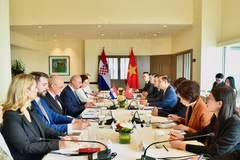
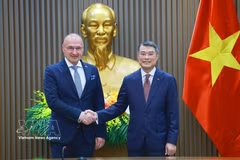
Vietnamese Minister of Foreign Affairs Le Hoai Trung and Croatian Minister of Foreign and European Affairs Gordan Grlić Radman hold talks in Hanoi on May 19, 2026. (Photo: Ministry of Foreign Affairs)

Vietnam always treasures bilateral relations with Croatia: FM

Welcoming the first-ever visit to Vietnam by a Croatian foreign minister since the establishment of diplomatic ties in 1994, Trung described the trip as a strong signal of Croatia’s commitment to expanding multifaceted cooperation with Vietnam. He affirmed that Vietnam always treasures relations with traditional friends, with Croatia regarded as one of its priority partners in the Balkan region.

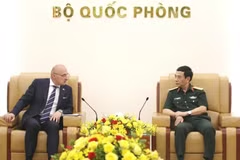
Deputy Prime Minister and Minister of National Defence General Phan Van Giang (R) receives Croatian Minister of Foreign and European Affairs Gordan Grlić Radman. (Photo: VGP)

Vietnam, Croatia seek to enhance defence cooperation

Affirming that Vietnam always values its traditional friendship with countries in the Balkan region, with Croatia regarded as one of its priority partners, Giang spoke highly of bilateral collaboration achievements in politics-diplomacy, economy, culture, tourism and people-to-people exchanges.

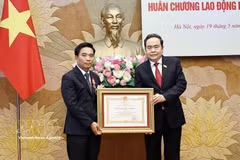
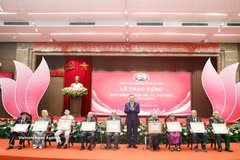
NA Chairman Tran Thanh Man (R) presents the first-class Labour Order to NA Vice Chairman Nguyen Doan Anh on May 19. (Photo: VNA)

NA Vice Chairman Nguyen Doan Anh awarded first-class Labour Order

On behalf of Party and State leaders, NA Chairman Tran Thanh Man presented the noble reward to Anh, describing him as a well-trained official who has matured through practical experience and held many important leadership positions within the Party, State, military and local administrations.

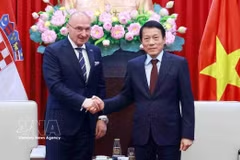
Minister of Public Security Luong Tam Quang (right) and Croatian Minister of Foreign and European Affairs Gordan Grlić Radman at their meeting in Hanoi on May 19 (Photo: VNA)

Vietnam, Croatia seek stronger law enforcement cooperation

In recent years, the Vietnamese Ministry of Public Security (MoPS) and Croatian partners have carried out various practical cooperation activities, including the signing of a cooperation agreement on fire prevention, firefighting, search and rescue as well as coordination in verifying criminal information at the request of the Croatian INTERPOL Office.

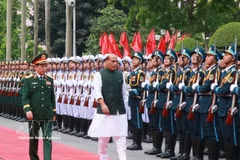
Deputy Prime Minister and Minister of National Defence General Phan Van Giang and Indian Defence Minister Rajnath Singh review the guard of honour of the Vietnam People's Army at the welcome ceremony for the latter in Hanoi on May 19, 2026. (Photo: VNA)

Indian Defence Minister pays official visit to Vietnam

Following the ceremony, the two sides held talks during which the Vietnamese minister emphasised the significance of the visit as the two countries celebrate the 10th anniversary of their Comprehensive Strategic Partnership and recently upgraded ties to an Enhanced Comprehensive Strategic Partnership under the spirit of “Shared Vision, Strategic Convergence and Substantive Cooperation,” during the state visit to India by Party General Secretary and State President To Lam from May 5-8.

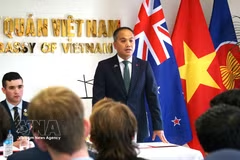
Vietnamese Ambassador to New Zealand Phan Minh Giang congratulates NZMAM 2026 on its great success. (Photo: VNA)

Vietnam supports first Model ASEAN Meeting in New Zealand

As the coordinator for ASEAN-New Zealand relations for the 2024-2027 period, Vietnam remains committed to closely coordinating with New Zealand and ASEAN member states to further deepen the newly established Comprehensive Strategic Partnership, bringing more practical benefits to people and contributing more effectively to peace, stability, prosperity and sustainable development for both sides and the wider region.

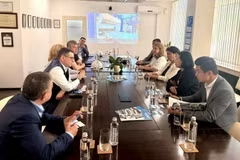
The meeting between Vietnamese Ambassador to Bulgaria Nguyen Thi Minh Nguyet and leader of the Alcomet factory. (Photo courtesy of the Vietnamese Embassy in Bulgaria)

Vietnam, Bulgaria expand cooperation between key localities

Ambassador Nguyen Thi Minh Nguyet noted that the Vietnam – Bulgaria Strategic Partnership has opened up fresh opportunities for cooperation in logistics, maritime transport, port operations, information technology, education and coastal tourism.

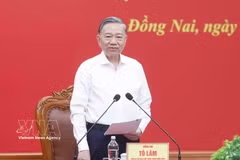
Party General Secretary and State President To Lam (first, right) presents the National Assembly’s resolution on the establishment of Dong Nai city to local officials at the ceremony on May 18, 2026. (Photo: VNA)

City status marks great turning point for Dong Nai: top leader

Party General Secretary and State President To Lam noted that the new status requires a new development vision; a larger development space demands stronger governance capacity; and greater pride must be transformed into a greater sense of responsibility toward the people and the nation.

Prime Minister Le Minh Hung receives Croatian Minister of Foreign and European Affairs Gordan Grlić Radman in Hanoi on May 18. Photo: VNA

Vietnam treasures ties with Croatia: PM

Vietnam and Croatia should strive to double bilateral trade turnover from the current level of 161 million USD; study the establishment of a Joint Committee on Economic Cooperation to create a long-term, stable, and effective framework for collaboration, said Prime Minister Le Minh Hung.