Paris archives preserve traces of President Ho Chi Minh’s journey for national liberation

The survival of documents relating to Nguyen Ai Quoc’s years in France is due in large part to the often-unseen efforts of librarians, archivists and museum professionals. Today, these records provide scholars with valuable insights into a pivotal stage in the intellectual and political development of the man, who later became President Ho Chi Minh.

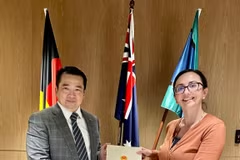
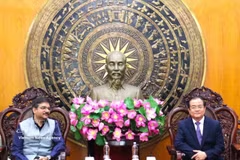
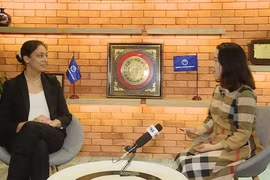
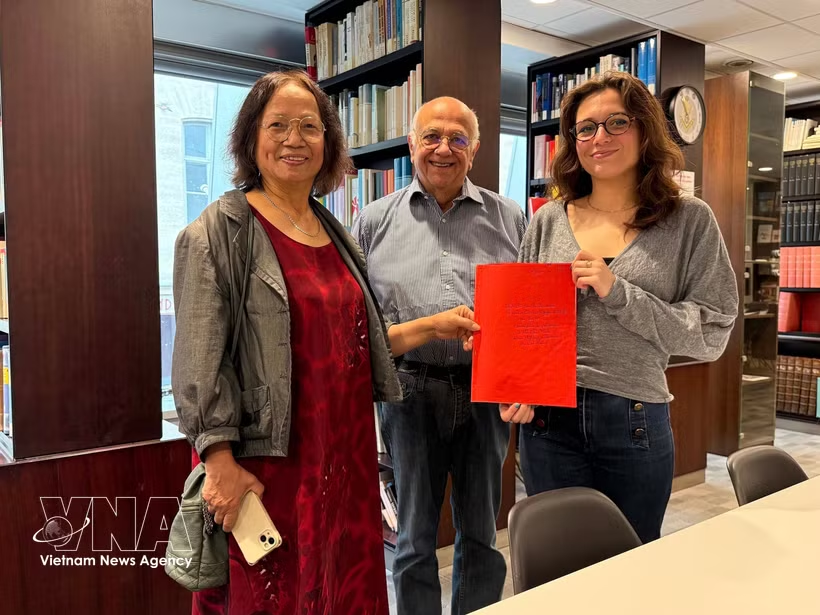
Cultural researcher Tran Thu Dung (left), Yonnel Ghernaouti, a member of the Executive Board of the French Institute for Masonic Studies, and Emma Lallemand, a librarian at the Grand Orient de France, pose with archival documents relating to Nguyen Ai Quoc. (Photo: VNA)

Paris (VNA) – More than a century after Nguyen Ai Quoc, later President Ho Chi Minh, arrived in France in search of a path to national liberation, a collection of rare documents preserved in Paris continues to shed light on the formative years that shaped one of Vietnam’s most influential leaders

The records are housed at the headquarters of the Grand Orient de France (GODF), France’s largest Masonic organisation, which also serves as a major centre for historical preservation through its library, archives and the French Museum of Freemasonry. Over generations, the institution has safeguarded valuable materials documenting French history, the development of Freemasonry and the activities of Nguyen Ai Quoc during his time in France.

Emma Lallemand, a librarian at the GODF, told Vietnam News Agency correspondents that most of the collection have been acquired through donations from members and their families. Many letters, manuscripts, personal papers and historical artefacts were carefully preserved for decades before being transferred to the institution.

For archivists, she said, such materials are not simply ageing documents but irreplaceable pieces of history that help preserve collective memory.

The GODF library currently holds around 40,000 items, ranging from books and specialised journals to dissertations, research publications, administrative records and rare historical collections. Particularly valuable documents are kept under tightly controlled environmental conditions, while ongoing digitisation efforts are helping ensure their preservation for future generations.

Lallemand noted that many historically significant documents have been lost over time because their value was not recognised by surviving relatives. Preserving archives, she said, means protecting not only records but also stories, memories and lessons that might otherwise disappear.

Denis Sisco, who is responsible for welcoming visitors and research delegations at the French Museum of Freemasonry, said the institution has been officially recognised as a “Museum of France” since 2003.

Dedicated to history and civilisation, the museum houses thousands of artefacts reflecting more than three centuries of Freemasonry’s evolution in France and Europe. Among them are items linked to notable figures in French history, each offering a glimpse into a particular chapter of the nation’s past and collective memory.

The survival of documents relating to Nguyen Ai Quoc’s years in France is due in large part to the often-unseen efforts of librarians, archivists and museum professionals. Today, these records provide scholars with valuable insights into a pivotal stage in the intellectual and political development of the man, who later became President Ho Chi Minh.

In the heart of Paris, timeworn documents and carefully preserved artefacts continue to tell stories that extend beyond Freemasonry and early 20th-century France. They also recount the journey of a young Vietnamese patriot whose determination to secure national liberation led him across continents and ideas before he ultimately found the path that would guide Vietnam towards independence and freedom./.
VNA

See more

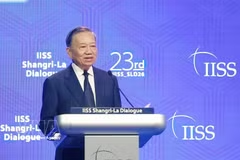
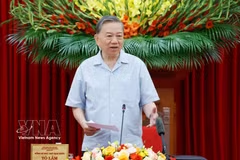
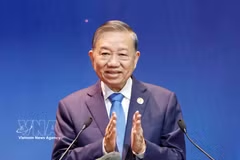
General Secretary of the Communist Party of Vietnam Central Committee and State President To Lam speaks at the 23rd Shangri-La Dialogue on May 29, 2026. (Photo: VNA)

Vietnam contributes to shaping regional agenda at 23rd Shangri-La Dialogue: Indian expert

Speaking to Vietnam News Agency correspondents in New Delhi, Pradhan noted that, drawing on his extensive experience in national security and international relations, as well as his deep knowledge of international law, the top Vietnamese leader identified three closely interrelated crises facing the world today: a crisis of the international order, a crisis of the development model, and a crisis of strategic trust.

Administrative procedures cut and simplified will be publishedNational Public Service Portal (Photo: VNA)

Administrative procedures cut, simplified to be published online

The dispatch states that in implementing Conclusion No. 18-KL/TW dated April 2, 2026 of the 14th Party Central Committee on the 2026–2030 socio-economic development plan, national finance, public debt management and medium-term public investment, linked to the goal of achieving double-digit economic growth, the Government on April 29 issued 11 resolutions on cutting, decentralising and simplifying administrative procedures, business conditions, and conditional business lines. The Prime Minister subsequently directed ministries, agencies and localities to implement these resolutions.

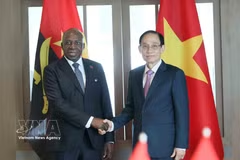
Minister of Foreign Affairs Le Hoai Trung (R) welcomes visiting Angolan Minister of External Relations Téte António in Hanoi on June 4 (Photo: VNA)

Vietnamese, Angolan foreign ministers hold talks in Hanoi

The Vietnamese FM proposed that the two sides strengthen political trust through high-level exchanges, while maintaining existing cooperation mechanisms, particularly the Vietnam–Angola Intergovernmental Committee and Political Consultations between the two foreign ministries.

Party General Secretary and State President To Lam chairs a working session with the Party Central Committee’s Commission for Policies and Strategies and relevant agencies on a project to renew the country’s development model based on science, technology, innovation and digital transformation on June 4, 2026. (Photo: VNA)

Top leader calls for building national capacity for innovation, adaptation

The new development model must place people at the centre as the objective, driving force and key actor of development. All development policies should aim to improve people’s material and spiritual well-being, creative capacity, dignity, opportunities for advancement and equitable access to development benefits, said top leader To Lam.

Nguyen Hong Thanh (R), Permanent Vice Chairman of the Tay Ninh provincial People's Committee, and Vipra Pandey, Consul General of India in Ho Chi Minh City, discuss cooperation opportunities during a working session in Tay Ninh province on June 4. (Photo: VNA)

Tay Ninh seeks stronger cooperation with Indian partners

Tay Ninh is home to 14 Indian-invested projects with total registered capital of about 108 million USD. These projects are mainly engaged in industrial production and processing, including garment manufacturing, rice bran oil production, sugar production, seed processing and agricultural product processing.

Party General Secretary and State President To Lam speaks at the 14th Vietnam Trade Union Congress on June 4. (Photo: VNA)

Vietnam needs more modern, creative working class: Top leader

Party General Secretary and State President To Lam urged the Vietnam Trade Union to reform more rapidly, deeply and substantively. It must work together with the State, enterprises and training facilities to improve workers’ professional qualifications, digital skills and adaptability.

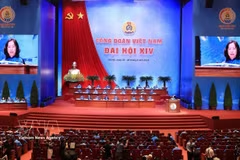
A view of the 14th Vietnam Trade Union Congress for the 2026–2031 term (Photo: VNA)

Grand opening of 14th Vietnam Trade Union Congress for 2026–2031 term

VGCL President Nguyen Anh Tuan said achievements obtained over the past ternure reflect the close guidance of the Party, effective coordination among State agencies, local authorities, the Vietnam Fatherland Front and socio-political organisations, support from employers and, above all, the dedication and innovation demonstrated by trade union officials, members and workers across the country.