Hanoi (VNA) – On June 5, 1911, 21-year-old Nguyen Tat Thanh stepped aboard the Amiral Latouche-Tréville at Nha Rong Wharf in Ho Chi Minh City with little more than determination and a vision: to learn from the world and return to help his people. One hundred and fifteen years later, that journey remains a defining chapter in Vietnam’s history.
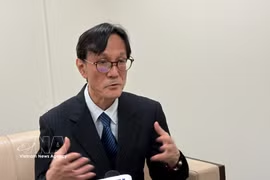
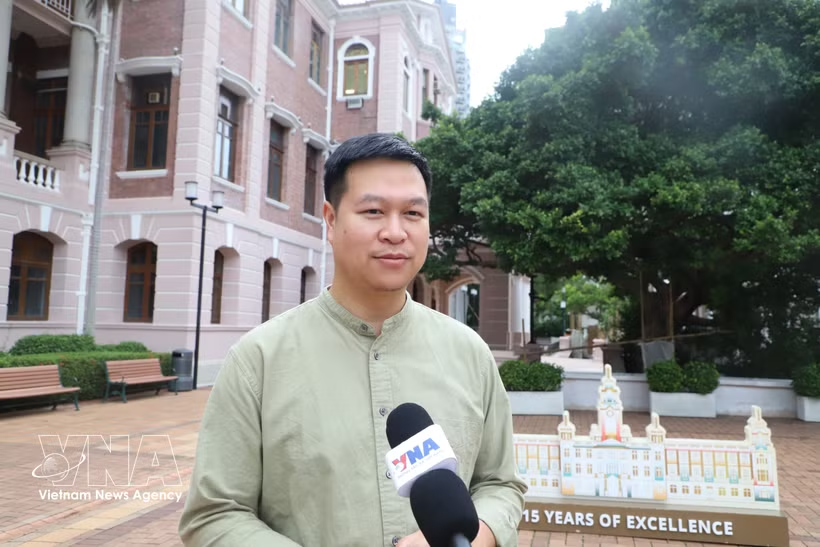
For Vu Hai Truong, a Vietnamese scholar living and working in Hong Kong (China), a place closely associated with President Ho Chi Minh’s revolutionary activities, the anniversary carries particular significance.
Truong, who works at the University of Hong Kong, said he feels fortunate to study and work in a city once chosen by Ho Chi Minh as a base for organising and advancing the Vietnamese revolutionary movement.
Reflecting on the late leader’s time in Hong Kong, he said it is inspiring to think that President Ho Chi Minh worked in modest surroundings more than a century ago, drafting documents that helped shape the nation’s destiny. Under his leadership, the conference that unified three communist organisations and led to the founding of the Communist Party of Vietnam was held not in a grand hall, but in small rooms in Kowloon Walled City, concealed amid the bustle of Lunar New Year celebrations.
Although little remains of the old Kowloon Walled City today, Truong believed that its historical significance endures. As long as people continue to remember and share its stories, history remains alive.
He said President Ho Chi Minh might have chosen the location because of its ordinariness, which provided the perfect cover for a revolution in the making. He also found it remarkable that a place once linked to Vietnam’s revolutionary beginnings has evolved into a global city attracting talent from around the world.
From the perspective of a young intellectual, Truong said that Vietnamese youth must do more than admire previous generations. They should embrace Ho Chi Minh’s courage by asking difficult questions, taking on challenges and engaging with the wider world while remaining true to their identity and values.
As someone helping Vietnamese students pursue education and research opportunities in Hong Kong, Truong believed that overseas Vietnamese have a responsibility for honouring the place that once sheltered the nation’s revolutionary movement while maintaining a strong connection to their roots and contributing to national development.
He said hopes to continue building meaningful links between Vietnamese schools and the international academic community.
After more than two years in Hong Kong, Truong said the most valuable lesson he has gained is perspective. While Vietnam may be small on the world map, it possesses immense potential. The gap between Vietnam and more developed nations, he argued, lies not in intellect but in opportunities to experiment, learn and succeed.
According to the scholar, young people serving as bridges between Vietnam and Hong Kong should first act as honest ambassadors for Vietnam in a city that brings together academics, journalists and financial professionals from around the world. Their voices can help shape international perceptions of the country.
Second, they should learn selectively from global experiences. The ability to absorb new ideas without losing one’s identity, he noted, was a principle President Ho Chi Minh practised throughout his decades-long journey abroad.
Finally, he called for a stronger Vietnamese community in Hong Kong. While students at institutions such as HKU, HKUST, CUHK and CityU are individually talented, greater cooperation and mutual support would strengthen their collective impact.
Truong said Vietnamese students in Hong Kong today are heirs to a legacy of courage, determination and intellectual curiosity. They embody a passion for learning and a desire to acquire knowledge in order to contribute to a stronger and more prosperous Vietnam./.