Da Nang explores ‘sponge city’ model to tackle urban flooding

The central city of Da Nang is exploring the “sponge city” model and other nature-based solutions to strengthen its resilience against urban flooding as climate change and rapid urbanisation place increasing pressure on existing drainage infrastructure.

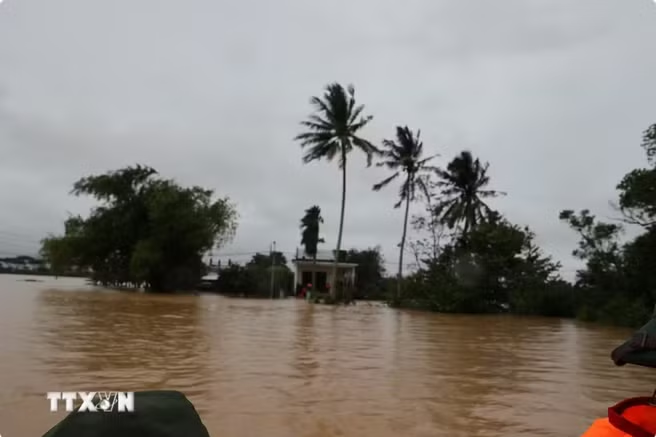
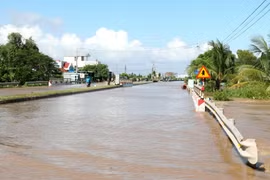
Floodwaters inundate parts of Da Nang in October 2025. (Photo: VNA)

Da Nang (VNA) – The central city of Da Nang is exploring the “sponge city” model and other nature-based solutions to strengthen its resilience against urban flooding as climate change and rapid urbanisation place increasing pressure on existing drainage infrastructure.

Recent extreme rainfall events have exposed the limitations of traditional flood-control systems. During the historic floods in late October 2025, more than 100,000 houses were inundated, dozens of communes and wards were isolated, and economic losses exceeded 3.1 trillion VND (124 million USD).

Experts said Da Nang’s steep terrain, short river systems and extensive urban development have reduced the city’s natural flood-retention capacity. Urban expansion, land filling and transport infrastructure projects have altered natural water flows, contributing to more prolonged flooding.

According to Dr. Architect Hoang Duc Anh Vu of the Da Nang University of Architecture, Da Nang is a typical central coastal city characterised by significant elevation changes, ranging from 1,450 meters at Ba Na Mountain in the west to around 50 metres in the eastern coastal areas. This steep topography causes rainwater to flow rapidly toward low-lying coastal zones during the rainy season. Da Nang’s river systems are short and steep, discharging directly into the sea, which means that water from upstream areas quickly converges on urban districts during heavy rainfall.

In addition, tidal surges and sea-level rise have reduced the ability of rivers to drain into the sea. High construction density, limited water-retention spaces, and weak integration between green spaces, water bodies, and natural drainage corridors have further diminished the city’s resilience, making Da Nang increasingly vulnerable to heavy rainfall and high tides, he added.

Research by Dr. Le Hung and Associate Professor Dr. To Thuy Nga from the University of Science and Technology – The University of Da Nang, said that flooding patterns in Da Nang have shifted from “rapid rise–rapid recession” to “prolonged inundation,” a trend that became particularly evident during the extreme flood events of 2025. Urban expansion and transportation infrastructure development have significantly affected the city’s natural flood-drainage capacity.

Researchers have recommended that the city move from a flood-control approach to adaptive planning based on river basins, while expanding water-retention spaces and protecting natural drainage corridors. Green infrastructure measures, including rain gardens, green roofs and urban water-storage systems, have also been proposed.

Under the “sponge city” model, urban areas are designed to absorb, store, filter and reuse rainwater through integrated green and blue infrastructure. Experts believe the approach could help transform water from a source of risk into a key element of sustainable urban development and climate adaptation.

Vice Chairman of the municipal People’s Committee Le Quang Nam said the unprecedented flooding in 2025 highlighted the growing threat of extreme weather events. He affirmed that the city would incorporate scientific recommendations into urban planning, architectural management and infrastructure investment to enhance long-term resilience./.
VNA

See more

Maj. Gen Nguyen Quoc Toan, spokesman of the Ministry of Public Security and Chief of its Office, speaks to reporters. (Photo: VNA)

Ministry details early gains in IP violation crackdown

Police across the country have initiated criminal proceedings in 56 cases, involving 98 suspects, for violations of copyright and related rights, industrial property offences, and the production and sale of counterfeit goods. Administrative fines were also stepped up, with 216 individuals fined more than 850 million VND (32,600 USD) in the first month.

Vietnamese guest workers are bound for Japan, RoK (Photo: VNA)

Vietnam sends over 53,100 workers abroad in five months

Japan remained the top destination, taking in 24,030 workers, including 10,750 women. Taiwan (China) followed with 21,104 workers, 6,752 of them women. The Republic of Korea (RoK) received 3,217, China 1,498, Singapore 704, Greece 441 and Russia 344.

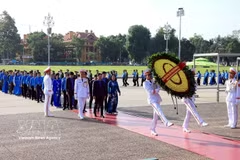
Delegates to the 14th Vietnam Trade Union Congress pay tribute to President Ho Chi Minh at his mausoleum on June 3 morning. (Photo: VNA)

14th Vietnam Trade Union Congress convened

The three-day congress is regarded as an important political event for Vietnam’s working class and trade union organisations, marking a new development stage of the organisation as the country advances its integration and development agenda.

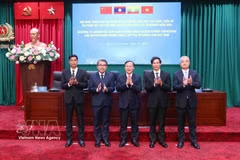
Senior Lieutenant General Nguyen Van Long, Vietnam's Deputy Minister of Public Security (centre) and heads of the delegations of Vietnam, China, Laos and Myanmar at the conference. (Photo: VNA)

Vietnam, China, Laos, Myanmar launch joint anti-drug crime crackdown

The Vietnamese Ministry of Public Security (MPS) proposed that the public security ministries of China and Laos and the Ministry of Home Affairs of Myanmar jointly implement an anti-drug campaign from June to September 2026. The initiative reflects not only operational cooperation but also a strong political commitment to addressing global drug crime and drug abuse.

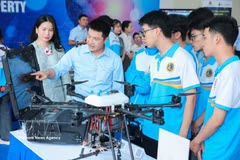
Students visit a science and technology product exhibition booth at the seminar between the Director-General of the World Intellectual Property Organisation (WIPO) and Vietnamese youngsters in September 2025. (Photo: VNA)

Vietnam steps up efforts to strengthen intellectual property protection and enforcement

Tran Le Hong, Deputy Director of the Intellectual Property Office of Vietnam under the Ministry of Science and Technology, said Vietnam has consistently pursued a policy of comprehensive and effective IP protection while balancing the interests of rights holders with the public interest. The approach aims to foster innovation, support international integration and contribute to socio-economic development.

An officer of the market surveillance unit No. 2 inspects a retail outlet on Hang Dao street, Hanoi, in 2025. (Photo: VNA)

Deputy PM calls for stronger action against intellectual property violations

Deputy Prime Minister Ho Quoc Dung has directed ministries and agencies to conduct a comprehensive review of laws and regulations governing the enforcement of intellectual property (IP) rights, aiming to promptly address legal bottlenecks, improve enforcement effectiveness and help foster a culture of respect for IP rights in Vietnam.

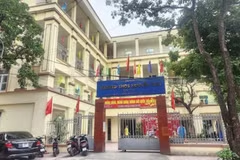
The former headquarters of the Vietnam Fatherland Front Committee of Ha Dong district in Hanoi has been converted into a school following the administrative restructuring. (File photo - Source: thoibaotaichinhvietnam.vn)

Development resources unlocked via two-tier local administration model

According to the Ministry of Finance's one-year review report on the restructuring of administrative units and the operation of the two-tier local administration model, the first phase of handling 25,885 state-owned land and property facilities has been completed nationwide.

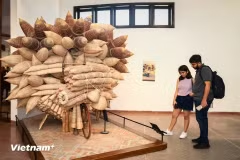
Each exhibition area, featuring distinctive designs and modern technology, offers immersive experiences that help visitors gain deeper insights into the history, customs, traditions and rich cultural life of Vietnam’s ethnic communities. (Photo: VNA)

Vietnam Museum of Ethnology embraces AI to shape digital future

In recent years, the museum has stepped up the application of technology to transform traditional exhibition spaces into interactive and immersive experiences. The process began in 2021 with the launch of an exploration room for children featuring interactive screens.

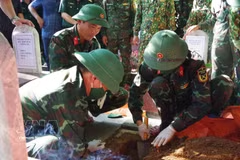
Working groups collect DNA samples from remains of martyrs at Truong Son National Martyrs’ Cemetery. (Photo: VNA)

Communication drive promoted for 500-day campaign to locate, identify fallen soldiers’ remains

Under the plan, all central and local media outlets are required to launch columns on the campaign, maintain regular coverage, and produce at least five to seven in-depth reports each month in key search areas. Media agencies will also be encouraged to gather and verify valuable information and develop high-quality products in both Vietnamese and foreign languages, including feature articles, documentaries, reports and short videos.

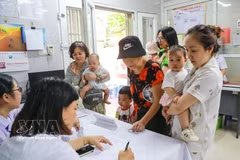
Ngo Phuong Ly, spouse of General Secretary of the Communist Party of Vietnam Central Committee and State President To Lam, visits the Asilo de San Vicente de Paul Centre in Manila, the Philippines, on June 1. (Photo: VNA)

Vietnam's First Lady visits disadvantaged children in Philippines

Ngo Phuong Ly, spouse of Party General Secretary and State President To Lam, expressed her emotion at seeing the children’s optimism despite difficult circumstances, noting that both Vietnam and the Philippines place children at the centre of their development policies, from education, health care to child protection.

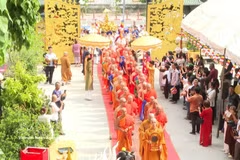
The Buddha procession around Phat Tich Pagoda in Vientiane, Laos. (Photo: VNA)

Buddhist activities help strengthen Vietnam–Laos special relationship

Addressing the event, Venerable Thich Minh Quang, abbot of Phat Tich Pagoda, said Vesak not only meets the spiritual needs of the Vietnamese community in Laos but also contributes to promoting people-to-people exchanges and deepening the special friendship between the two neighbouring countries.

At the press centre for the 14th National Party Congress. (Photo: VNA)

📝 OP-ED: Vietnam’s media landscape challenges narrow assessments of press freedom

As digital transformation and global integration reshape the information landscape, Vietnam’s press sector continues to solidify its role as a key channel connecting the Party, State and people while providing comprehensive coverage of social life. The sector’s evolution reflects the country’s efforts to advance press freedom in line with its development goals and national circumstances.