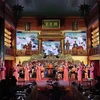
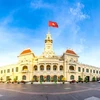
A wide range of activities were held in Hanoi on October 2 to mark the 1,000th anniversary of Thang Long-Hanoi.
A ten-day exhibition showcasing vestiges on the Thang Long Imperial Citadel unearthed at 18 Hoang Dieu Street opened in the presence of General Director of the UN Educational, Scientific and Cultural Organisation (UNESCO) Irina Bokova.
This is the first time relics from the archaeological site have been displayed to domestic and foreign visitors.
The Thang Long Royal Citadel was recognised by UNESCO as a World Cultural Heritage on August 1, 2010 for its long-lasting cultural history, the continuity of the citadel as a power centre and the variety of relics it contains.
The Vietnam Stamp Exhibition 2010 (Vietstampex 2010) jointly held by the Ministry of Information and Communication, the Ministry of Culture and the Hanoi People’s Committee also kicked off on the day.
On display at the largest-ever exhibition are 500 stamps under the themes of praising the Party, President Ho Chi Minh, the land and people of Vietnam and the 1,000 th anniversary of Thang Long-Hanoi.
Vietstamex will run until October 5.
An international seminar on Hanoi’s architecture also took place in the capital city, drawing famous architects from Vietnam and foreign countries, including France , Japan , Italy , Germany and Australia .
As part of the chain of activities celebrating the capital city’s 1,000 th birthday, the Hanoi Publishing House and the National Library of Vietnam launched a book series entitled “Thang Long – 1,000-year civilisation”.
The book series was built in order to systemise and summarise the value of Thang Long-Hanoi civilisation over its 1,000-year history in all fields, covering geography, economics, history, literature and art, and socio-culture. It will help readers understand more about the capital not only systematically and completely, but also generally and deeply.
A photo exhibition entitled “1,000 views of Hanoi ” also opened at the Hanoi Library, showcasing 150 big-sized photos on Hanoi and the largest photo on Ho Guom ( Sword Lake ) made of 1,000 small photos.
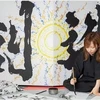
At the Ly Thai To Flower Garden, the Hanoi Calligraphy Club, the Vietnam Craft Villages’ Association and the Bank for Foreign Trade of Vietnam (Vietcombank) presented the largest gilded and wood-framed calligraphic work of “Chieu doi do” (the Royal Edict on the Transfer of the Capital) to Hanoi city.
The 458cm x 385cm, 5-tonne work, was made from seven tonnes of block wood. It was taken from the ancient capital of Hoa Lu in the northern province of Ninh Binh to Van Mieu-Quoc Tu Giam (the Temple of Literature) in Hanoi to be displayed at a calligraphic exhibition from October 4-10.
The Dong Xuan Joint Stock Company launched five tours discovering Hanoi's Old Quarter by electric cars in order to diversify its tourism products and meet the demand of domestic and foreign tourists during the grand celebrations.
Also the same day, the Hanoi People’s Committee organised ceremonies to inaugurate and name works celebrating the 1,000th anniversary of Thang Long-Hanoi for the Workers’ Theatre and the An Khanh Eco-tourism Area in Hoai Duc district./.
A ten-day exhibition showcasing vestiges on the Thang Long Imperial Citadel unearthed at 18 Hoang Dieu Street opened in the presence of General Director of the UN Educational, Scientific and Cultural Organisation (UNESCO) Irina Bokova.
This is the first time relics from the archaeological site have been displayed to domestic and foreign visitors.
The Thang Long Royal Citadel was recognised by UNESCO as a World Cultural Heritage on August 1, 2010 for its long-lasting cultural history, the continuity of the citadel as a power centre and the variety of relics it contains.
The Vietnam Stamp Exhibition 2010 (Vietstampex 2010) jointly held by the Ministry of Information and Communication, the Ministry of Culture and the Hanoi People’s Committee also kicked off on the day.
On display at the largest-ever exhibition are 500 stamps under the themes of praising the Party, President Ho Chi Minh, the land and people of Vietnam and the 1,000 th anniversary of Thang Long-Hanoi.
Vietstamex will run until October 5.
An international seminar on Hanoi’s architecture also took place in the capital city, drawing famous architects from Vietnam and foreign countries, including France , Japan , Italy , Germany and Australia .
As part of the chain of activities celebrating the capital city’s 1,000 th birthday, the Hanoi Publishing House and the National Library of Vietnam launched a book series entitled “Thang Long – 1,000-year civilisation”.
The book series was built in order to systemise and summarise the value of Thang Long-Hanoi civilisation over its 1,000-year history in all fields, covering geography, economics, history, literature and art, and socio-culture. It will help readers understand more about the capital not only systematically and completely, but also generally and deeply.
A photo exhibition entitled “1,000 views of Hanoi ” also opened at the Hanoi Library, showcasing 150 big-sized photos on Hanoi and the largest photo on Ho Guom ( Sword Lake ) made of 1,000 small photos.
At the Ly Thai To Flower Garden, the Hanoi Calligraphy Club, the Vietnam Craft Villages’ Association and the Bank for Foreign Trade of Vietnam (Vietcombank) presented the largest gilded and wood-framed calligraphic work of “Chieu doi do” (the Royal Edict on the Transfer of the Capital) to Hanoi city.
The 458cm x 385cm, 5-tonne work, was made from seven tonnes of block wood. It was taken from the ancient capital of Hoa Lu in the northern province of Ninh Binh to Van Mieu-Quoc Tu Giam (the Temple of Literature) in Hanoi to be displayed at a calligraphic exhibition from October 4-10.
The Dong Xuan Joint Stock Company launched five tours discovering Hanoi's Old Quarter by electric cars in order to diversify its tourism products and meet the demand of domestic and foreign tourists during the grand celebrations.
Also the same day, the Hanoi People’s Committee organised ceremonies to inaugurate and name works celebrating the 1,000th anniversary of Thang Long-Hanoi for the Workers’ Theatre and the An Khanh Eco-tourism Area in Hoai Duc district./.