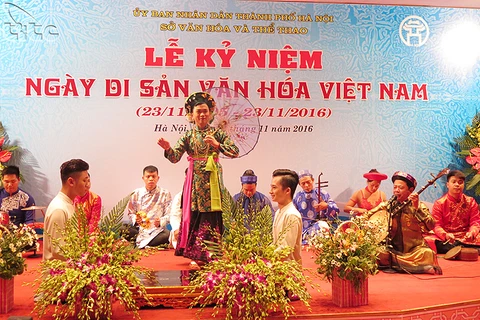
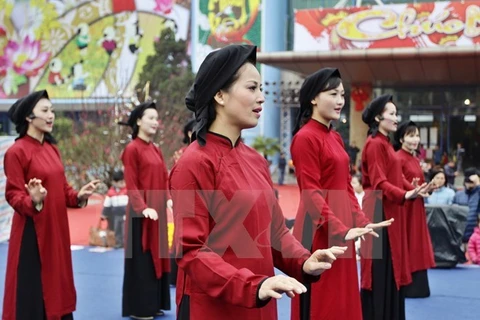
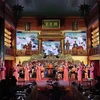
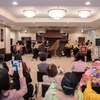
Artisan Ta Thi Bich Loc performs chầu văn during a festival at Cua Dong Temple in the northern mountainous province of Lang Son. (Photo baolangson.vn)
 Lang Son (VNS/VNA) - The beautiful melody of traditional instruments and the charming lyrics of chau van (trance ritual singing) have enchanted Ta Thi Bich Loc since she was a small child.
Loc, now 80, works at Cua Dong Temple in Lang Son city in the northern province of Lang Son. She has vowed to devote her life to the preservation of this traditional ritual, and she has been a ’chau van’ singer for more than 40 years.
The artisan said she first heard ’chau van’ when she was six years old when her mother took her to a local festival.
“When I was a little girl, I enjoyed going with my mother to temples and pagodas and watching hau dong (also known len dong) trance shows. The charming folk music of ’chau van’ was part of the performances and affected me so much I vowed to become a singer,” Loc said.
“Every time I listened to the chanting, I wondered how the singers could remember the lyrics and melodies. They are beautiful but very hard to sing,” according to Loc.
‘Chau van’ or ‘hat van’, also known as ‘hat bong’, is a popular singing ritual in Vietnamese spiritual culture, and started in the north of the country.
It appears in the Vietnamese beliefs of the Mother Goddesses of Three – Four Realms, which often accompanies ‘hau dong’ or spiritual rituals in pagodas and temples to honour the Mother Goddesses and form a connection between people and the Gods.
‘Hau dong’ involves singing and dancing by psychics to express the will and instructions of supernatural beings.
The ancient lyrics of ’chau van’ songs were designed to sound poetic and invite Gods or divinities to descend to Earth.
‘Chau van’ singers are often elderly artisans who can play instruments and take turns singing for up to eight hours.
The dan nguyet (moon-shaped lute) is normally the main instrument used for a ’chau van’ performance, along with phach (a piece of wood or bamboo to mark the rhythm), senh (clappers), trong ban (drums), chieng (small gongs), dan tranh (16-stringed zither) and sao (flute).
Experts said instruments play a very important role in ’chau van’ as they could both emphasise important passages and create contrasting effects to the lyrics.
Loc was first taught ’chau van’ in 1978 by Nguyen Thi Tỵ, who also worked at Ky Cung Temple in Vinh Trai ward, Long Son city. Ty, who is also a ’chau van’ singer taught the art in Chi Lang ward.
After successfully mastering the principles, techniques and content of the songs, Loc has regularly participated in rituals dedicated to the Mother Goddesses since 1990.
In 1995, with the permission of local authorities, Loc and her family launched a programme to call for donations to invest in restoring and preserving Cua Dong Temple.
Thanks to the successful programme, the temple received a certification recognising it as a provincial relic in 2002, and it was recognised as a national relic in 2015.
Loc has performed at temples throughout Lang Son and other provinces and cities.
She has also participated in festivals overseas, including the Vietnam–Republic of Korea Culture Exchange Festival in Seoul.
With her passion for singing and deep love for folk music, Loc is always thinking about how to pass on her skills and love for ’chau van’ to future generations.
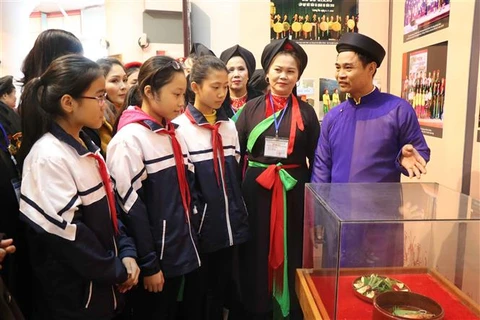
Loc has helped 116 people learn about ’chau van’ performances.
”I want to transfer everything I know about ’chau van’ to the students so I always encourage them to try and preserve the art. I tell them that to study and sing ’chau van’, they should be passionate and determined,” Loc said.
Nguyen Hai Thanh, an incense lighter at Co Be Thuong Ngan (Little Girl Goddess of the Forest) Temple in Lang Son city, is one those students, and has been praised by Loc as a pioneer in preserving and promoting the folk art.
“I was really lucky to become one of her followers. She taught me from the most simple sentences and tried to refine my work to the upper levels of ancient rituals,” Thanh said.
Chairman of the Lang Son Cultural Heritage Association Hoang Van Pao said ’chau van’ was an indispensable activity of Mother Goddesses in Lang Son, and Loc was one of the most experienced singers who had grasped the ancient and precious skills and rules of the ritual.
“Loc has an open heart and is dedicated to ’chau van’, which is a precious traditional ritual,” Pao said./.
VNA