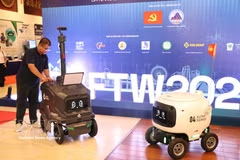
ASEAN-China smart industry conference held in HCM City

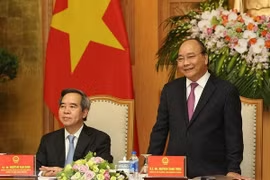
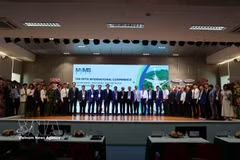
Research and development (R&D) is the cornerstone of innovation and the driving force of economic growth in the digital age, experts said at the ASEAN – China smart industry conference in Ho Chi Minh City on July 25.
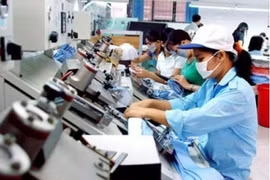
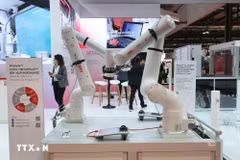
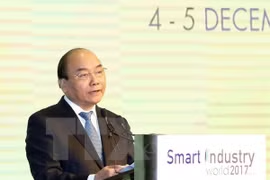
ASEAN-China smart industry conference held in HCM City ảnh 1Illustrative image (Photo: Internet)
HCMCity (VNA) – Research and development (R&D) is the cornerstone of innovationand the driving force of economic growth in the digital age, experts said atthe ASEAN – China smart industry conference in Ho Chi Minh City on July 25.

Speakingat the event, Director of the Vietnam Chamber of Commerce and Industry – Ho ChiMinh City branch Vo Tan Thanh said the fourth industrial revolution affordsVietnam a chance to use new technologies to step up industrialisation andmodernisation.

In2018, Vietnam was one of the five countries globally posting the fastestinformation technology growth with over 72 percent of population using smartphones and more than 68 percent exploiting the Internet. The country’sinnovation was up 12 places from 2016.

TheVietnamese government pays attention to information and digital technology, industry,tourism, smart urban development, start-up ecological system, and workforcetraining.

Accordingto Thanh, Vietnam faces challenges regarding the shortage of high-quality humanresources, incomplete technical infrastructure and policies, and outdatedtechnology. If fully tapping opportunities from global integration and Industry4.0, Vietnam’s economic growth will be higher, generating 8 – 18 billion USDeach year.

SecretaryGeneral of ASEAN – China Centre Chen Dehai said China is strong in telecomtechnology, automation and artificial intelligence while ASEAN has huge demandfor new technologies used in manufacturing, artificial intelligence, big dataand smart urban development.

MatasukaFujida, Secretary General of ASEAN – Japan Centre urged ASEAN member states topromptly fine-tune mechanisms and policies for R&D.

InASEAN, Singapore and Malaysia spend most on R&D while Thailand and Malaysiarecord the highest number of workforce in the field.-VNA
VNA
See more

Illustrative image (Photo: SGGP)

Ericsson establishes R&D capability in Vietnam

This initiative builds on Ericsson’s growing software engineering and testing capabilities in the country, and will further strengthen Vietnam’s contribution to Ericsson’s global technology development.

An AI-powered robot at the 2026 Seoul AI Conference. (Photo: VNA)

RoK’s AI robotics drive opens cooperation opportunities with Vietnam

Dao Tuan Hung, President of the Business Association of Vietnamese in Korea (BAVIK), said Vietnam should adopt a practical approach by prioritising specialised robots, including autonomous mobile robots (AMR/AGV), collaborative robots and machine vision systems, in sectors such as agro-fishery processing, textiles and garments, electronics and logistics.

Russian survey vessel Akademik M.A. Lavrentyev (Photo: VNA)

Russian survey vessel docks in Hai Phong

This is the third joint marine scientific survey in Vietnamese waters, running from November 4 - December 12, and one of the opening field activities under the Vietnam–Russia roadmap for marine scientific research cooperation for 2026-2035.

Smart products, chips and semiconductor materials are displayed at the launch ceremony of the national semiconductor chip prototyping support centre in Hanoi on June 26, 2026. (Photo: VNA)

Vietnam-Japan semiconductor cooperation paves the way for high-tech investment

The two countries are implementing five semiconductor research projects involving leading universities, with funding agreements signed in July. The projects cover three-dimensional integrated circuits, advanced semiconductor materials, secure artificial intelligence (AI) chips and power electronic components.

An exhibition space at the “Da Nang Semiconductors and High-Tech 2026” conference, organised by the Da Nang People’s Committee. (Illustrative photo: VNA)

Mobilising international resources to drive Vietnam’s technology development

Vietnam previously focused mainly on attracting overseas experts and intellectuals to work in the country over the long term, but this approach encountered certain difficulties. Cooperation methods are now shifting towards greater flexibility, allowing experts to take part in conferences and scientific seminars, contribute to addressing major national challenges, or participate in short-term training and research programmes.

Assoc. Prof. Dr. Dinh Ngoc Thach, lecturer and researcher in automatic control theory and robotics at the French National Conservatory of Arts and Crafts (Cnam) (Photo: VNA)

Core technologies key to sustainable robotics development in Vietnam: expert

Vietnam should select suitable robotic platforms and gradually build capacity in core technologies, including sensing, environmental perception, positioning, state estimation, AI, control and system integration. This will help develop technologies applicable across multiple sectors while avoiding fragmented investment and dependence on a single product category.

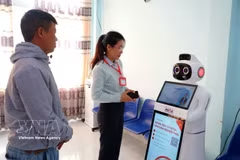
AI robots have become effective assistants in providing administrative services and reducing the workload of officials in Lam Dong province (Photo: VNA)

AI robots help streamline administrative procedures

Operating around the clock, AI robots provide information on administrative procedures, required documents, processing times, fees and relevant regulations, complementing assistance from civil servants.

High prospects for Vietnam-Italy cooperation in robotics industry

High prospects for Vietnam-Italy cooperation in robotics industry

Vietnam and Italy have highly complementary strengths in this robotics field. Italy has experience in machinery manufacturing, industrial robotics applications and an established business network, while Vietnam has a dynamic market, strong demand for production modernisation and a promising young engineering workforce.

General Secretary of the Communist Party of Vietnam (CPV) Central Committee and President To Lam and the foreign ambassadors at the meeting (Photo: VNA)

Top leader receives new foreign ambassadors

Vietnam wishes to step up cooperation with the countries in such areas as economy, trade and investment; cutting-edge science and technology applications, semiconductors, artificial intelligence, new materials, digital transformation, sustainable agriculture, the environment, energy and renewable energy, the marine economy and maritime transport.

Delegates at the event (Photo: VNA)

Over 400 scientists attend international material conference

Discussions focus on six key areas, including advanced materials and their applications for sustainable development; environmentally friendly material processing technologies; product lifecycle engineering; sustainable machine design; low-carbon industries and the circular economy; and artificial intelligence and digital transformation in material and mechanical engineering.

Deputy Prime Minister Ho Quoc Dung (R) and Pierre Barnabé, Chief Operating Officer of French technology group Dassault Systèmes. (Photo: VNA)

Vietnam, France step up cooperation in AI, digital twin technology

At the meeting, the Deputy PM praised the group's contributions to promoting technology cooperation between Vietnam and France, particularly its collaboration with the Ministry of Finance and the National Innovation Centre (NIC) to establish a Centre of Excellence (CoE) for digital twins and artificial intelligence (AI) in Hanoi.

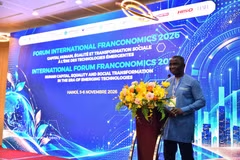
Rigobert Pinga Pinga, Acting Representative of OIF for Asia-Pacific speaks at the event. (Photo: VNA)

Franconomics 2026 explores human-centred technological transformation

Addressing the opening ceremony, Nguyen Anh Tuan, Rector of VNU-IS, said Franconomics was launched in 2019 as a multidisciplinary platform connecting scientists, policymakers, businesses and international organisations to discuss socio-economic issues relevant to Vietnam and the Francophone community.

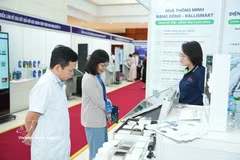
A new technology exhibition area arranged within the framework of the International Research and Innovation Funders Forum in Hanoi (Photo: VNA)

Vietnam promotes int'l cooperation in science, technology and innovation

Science is opening up new opportunities in artificial intelligence, healthcare, semiconductors and clean energy, while challenges such as climate change, energy security and epidemics require international cooperation. Science, technology, innovation and digital transformation are central to Vietnam’s new growth model.