ASEAN senior economic officials meet in Hanoi

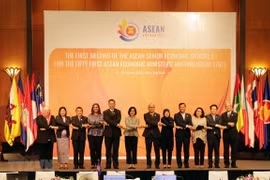
The first meeting of the ASEAN senior economic officials for the fifty first ASEAN Economic Ministers’ Meeting (SEOM 1/51) was held in Hanoi from January 12 to 14.
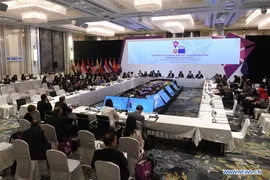
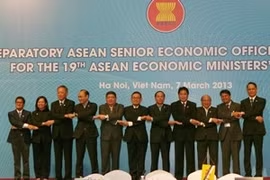
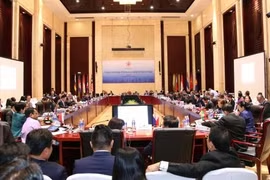
ASEAN senior economic officials meet in Hanoi ảnh 1Delegates at the event (Photo: VNA)

Hanoi (VNA) -
The first meeting ofthe ASEAN senior economic officials for the fifty first ASEAN EconomicMinisters’ Meeting (SEOM 1/51) was held in Hanoi from January 12 to 14.

The Vietnamese Ministry of Industry and Tradechaired the event which saw the participation of representatives from otherministries such as foreign affairs, finance, transport, science-technology,information and communications, agriculture and rural development, planning andinvestment, and the State Bank of Vietnam.

Senior economic officials of the Association ofSoutheast Asian Nations (ASEAN) members, and representatives from the ASEANSecretariat were also present at the event.

Based on the theme of the ASEAN Year 2020“Cohesive and Responsive”, Vietnam put forth three priority orientations under theASEAN economic pillar: promoting intra-bloc economic integration andconnectivity, intensifying partnerships for peace and sustainable development,and enhancing the bloc’s adaptive capacity and operational efficiency.

In order to implement the theme and prioritiesof ASEAN in 2020, Vietnam built 14 specific initiatives, priorities andspecific cooperation plans for discussion, consultation and agreement with the ASEANmember states at the first meeting.

Vietnam’s initiatives were highly appreciated byother ASEAN countries as they help ensure that ASEAN will continue cooperationin 2020 and the following years to accelerate the process of establishing theASEAN Economic Community as scheduled by ASEAN leaders, thus strengthening thebloc’s central position in the regional and global economic cooperationframeworks.

During SEOM 1/51, participants discussed reportsof specialised working groups on portfolio of goods, services, investment,trade facilitation, quality standards, small-and medium-sized enterprises, andrules of origin.

They also proposed solutions to addressingrestrictions while implementing the ASEAN Trade in Goods Agreement (ATIGA) betweenASEAN member nations, as well as ASEAN’s cooperation priorities with partners,directions to speed up the signing of the Regional Cooperation EconomicPartnership (RCEP) agreement, and the accession of Timor Leste.

Founded in 1967, the Association of SoutheastAsian Nations (ASEAN) groups 10 member countries, namely Brunei, Cambodia,Indonesia, Laos, Malaysia, Myanmar, the Philippines, Singapore, Thailand andVietnam./.
VNA
See more

Minister Counsellor Nguyen Hai Luu, Deputy Permanent Representative of Vietnam to the UN, speaks at the discussion on November 12, 2026. (Photo: VNA)

Vietnam supports peace, reconstruction efforts in Gaza: diplomat

Minister Counsellor Nguyen Hai Luu, Deputy Permanent Representative of Vietnam to the UN, expressed deep concern over the dire humanitarian situation in Gaza, particularly as recent heavy rains and flooding have worsened living conditions for residents.

Thailand diversifies oil sources to ensure energy security

Thailand diversifies oil sources to ensure energy security

Although the diversification of oil import sources has helped reduce the risk of domestic oil shortage, it has not immediately reduced energy costs because import prices depend on market mechanisms, transportation costs, foreign exchange rates and the terms of oil contracts.

ST Telemedia Global Data Centres (Thailand), an affiliate of Singapore Telecom, is developing three data cehtres in Thailand including this facility on Rama IX Road in Bangkok. (Photo: bangkokpost)

Thailand tightens regulations on data centres

The new rules focus on controlling investment scale, electricity and water consumption, environmental impacts, and preventing investors from reserving resource quotas beyond their actual needs.

A road is under construction in Dong Nai city, Vietnam. (Photo: VNA)

ADB: Southeast Asia needs 7.1 trillion USD in infrastructure investment by 2040

ADB estimates that the region will need an average of 476 billion USD in infrastructure investment annually during 2026–2040, equivalent to 8.7% of GDP. However, at current investment levels, government budget resources would cover only around 45% of this demand, leaving an annual financing gap of 264 billion USD.

Kyodo News publishes an article titled “Sculptures by Japanese, Vietnamese artists on display in Yokohama,” (Screenshot photo)

Japanese media widely cover top Vietnamese leader ’s visit

Japanese media have continued extensive coverage of General Secretary of the Communist Party of Vietnam (CPV) Central Committee and President To Lam’s activities in Japan, highlighting his meetings with representatives of leading financial institutions at the Tokyo Stock Exchange, witnessing of cooperation agreement signing and participation in cultural exchanges.

Thailand pushes for establishment of ASEAN emergency public health centre

Thailand pushes for establishment of ASEAN emergency public health centre

The draft agreement stipulates that ACPHEED will comprise three specialised centres based in three ASEAN member states. Vietnam will oversee the centre for prevention and preparedness; Indonesia will host the centre for detection and risk assessment; and Thailand will be responsible for the centre for response and risk communication.

Indonesia designates 31 mln ha of waters as conservation areas

Indonesia designates 31 mln ha of waters as conservation areas

Head of the Convention and Marine Resource Balance working team at the ministry’s Directorate of Ecosystem Conservation Ahmad Sofiullah said this week that it is a strategic effort to ensure the sustainability of Indonesia’s marine ecosystems.

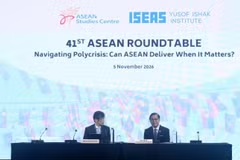
Thai Deputy Prime Minister and Minister of Foreign Affairs Sihasak Phuangketkeow (R) takes part in the Q&A session at the 41st ASEAN Roundtable. (Photo: VNA)

Thailand calls on ASEAN to proactively address polycrisis

Thai Deputy Prime Minister and Minister of Foreign Affairs Sihasak Phuangketkeow noted that no single member state could tackle challenges ranging from major-power competition and economic fragmentation to climate change and energy and food security on its own. Regional cooperation is therefore a strategic imperative, enabling ASEAN not only to overcome crises but also to sustain its development momentum.