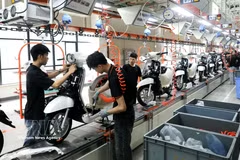
A corner of Ho Chi Minh City (Photo: VNA)
Released on January 23 in London, the Asia House Annual Outlook 2024 examineshow eight key economies in Asia will power ahead in 2024, delivering growth ofcirca 5% overall despite external global pressures including geopoliticaltensions, conflict and a challenging inflation and interest rate environment.The report forecasts Vietnam and the Philippines will be the standoutperformers.
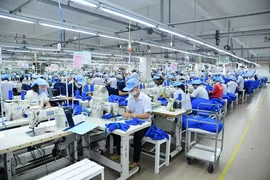
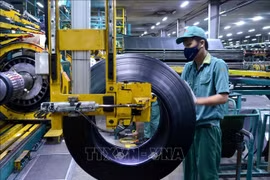
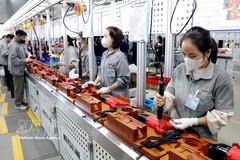
According to the report, in the first ten months of 2023, FDI in manufacturingprojects was roughly 18 billion USD, or 73% of total FDI inflows registered inthe same period. Additionally, foreign investors will increasingly turn toVietnam to diversify their supply chains away from China.
Vietnam’s digital transformation programme aims to situate its domestic techfirms as global players. Vietnam has a thriving tech start-up environment andthere has been significant public investment in AI. The National InnovationCentre supports tech breakthroughs in multiple sectors, while the bankingsector is very active in AI testing and application. VPBank has applied Al incurrency transactions, personal credit and digital banking, while Vietcombankhas cooperated with FTP Smart Cloud to develop a customer chatbot platform,called VCB Digibot.
Vietnam is a leader in crypto-currency adoption and in blockchain projects. Itis estimated to have more than 200 active blockchain projects and has beendeploying blockchain technology for a number of functions, including for creditguarantees in trade and supply-chain finance.
Vietnam will continue to leverage blockchain technology to boost efficiency inthe logistics industry with a particular focus on firms in Ho Chi Minh City.
The Make in Vietnam programme, in which homegrown businesses manufactureglobally competitive products, will scale growth in multiple sectors. A stronglabour market (69% of the population are of working age) will aid this growth.
In 2024, AI will reshape multiple sectors in Vietnam's economy and boost inwardproductive investment. By collaborating with educational institutions andactively participating in the development of AI infrastructure, inwardinvestment can catalyse positive economic spill overs - both horizontally andvertically.
According to the report, as a major agricultural producer, Vietnam will benefitfrom inward investment in precision agriculture, AI monitoring and analysis tooptimise yields and fertiliser use. AI can also be used to collect data on soilconditions, weather, crop growth and water usage, while sensors and drones can alsoprovide key data. This can influence decisions on seed planting, fertilisation,pest management and other agronomic procedures.
The reports says that economic dynamism, resilient fundamentals and theopenness of Vietnam's economy augur well for its green finance ecosystem.Regulatory incentives to encourage a shift to financing the green economy willbe key in 2024 and beyond. The continued promotion and scaling of incentives toattract and channel green finance - with the engagement of domestic financial institutions- will spur Vietnam's energy transition and help build resilience againstclimate shocks.
The Bank for Investment and Development of Vietnam became the first bank toissue green bonds with the proceeds used to finance green, energy-saving, emission-reducingand environmental protection projects.
This was the first domestic green bond issuance in the Vietnamese capitalmarket scored by Moody's. Additional efforts to scale green bond issuance willcreate pathways for more issuance and deliver more depth and breadth in thegreen ecosystem.
According to the report, Vietnam's blended green finance initiatives - such asthe Asian Development Bank blended finance loan supporting wind energy (ADB,2022b) - is particularly effective in supporting Vietnam's adaptation toclimate risks and supporting renewable energy. As is the case in neighbouringSouth East Asian economies, climate finance mechanisms need to be calibrated tomitigate risk and to promote risk-sharing, particularly when channelling sustainablefinance to Vietnam's smallholder farmers and SMEs.
With regard to Asian economies, the report forecasts in a world marked bygeopolitical uncertainty, conflict and climate change, Asian economies will bethe global growth engine in 2024, buoyed by regional trade and advances indigital technology and green finance.
The report, which includes detailed outlooks for China, India, Japan,Indonesia, Vietnam, Malaysia, Thailand and the Philippines, also points tomultiple risks facing Asia, from possible disruptions caused by the number ofelections in this “super-election” year, to escalating political tensions,volatile energy markets and restrictive monetary conditions./.
VNA