Banh gio, softest rice dough dumpling

Banh gio (rice dough dumpling with minced pork and wood ear mushrooms inside) is favoured as a breakfast dish and as an after-school supper dish for children.
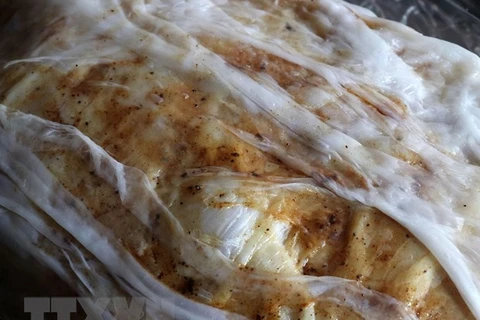
Banh gio is a popular dish in Hanoi (Photo: VNA)

Hanoi (VNA) - Banh gio (rice dough dumpling with minced pork and wood ear mushrooms inside) is favoured as a breakfast dish and as an after-school supper dish for children.  

Among the myriad Vietnamese dishes made with rice, be it main courses, side-dishes or snacks that are meals in themselves, the softest gluey texture belongs to banh gio.

A banh gio served hot stands alongside a bowl of steaming hot, aromatic pho as dishes of choice on a misty, chilly morning in the capital city.

At just 15,000 to 30,000 VND (70 USD cents to 1.4 USD) each, a banh gio offers great value for money.

The pyramid-shaped rice dough dumpling is wrapped in layers of banana leaves. Once the leaves have been removed to reveal the translucent dumpling, expert eaters just bite into it cupping the leaves in their hands, but spreading the leaves out and using a teaspoon is a far “safer” option in terms of avoiding a mess.

Once the teaspoon cuts into the cake, the filling of minced pork, wood ear mushrooms and shallots is uncovered and it can be eaten with the covering-filling proportion best left to individual preferences.

Inside the mouth, it seems to melt on the tongue, with the soft exterior and well-cooked filling making the whole cake tender and aromatic.

Eating the good rice dough, one feels like it melts in their tip of the tongue. The filling which features both fat and lean minced pork and wood ear, is often over cooked, therefore, it is very tender, soft and aromatic.

Banh gio is sometimes served with cha, gio (Vietnamese sausage), grilled pork, chilli sauce and cucumber. In some places, banh gio is dipped in soya sauce before it is eaten.  

While the cake is a popular dish in Hanoi, it is particularly favoured by students, for whom it is a tasty, affordable snack. As a result, many food stalls near schools sell this delicacy. It is also sold in most markets, and on many streets in Hanoi. As it is served as breakfast or supper, some eateries offering this dish only open in the morning or late afternoon./.
VNA

See more

At the event “Vietnamese Language in the heart of Kyushu, Japan” (Photo: VNA)

Vietnamese in Japan revive mother tongue among young generations

While the number of Vietnamese-origin children in Japan is surging, opportunities to actually speak Vietnamese in daily life are vanishing fast. Many children can understand the language but default to Japanese in response, gradually relegating their mother tongue to a secondary role, sometimes even treating it as a “second foreign language” inside their own houses.

A tribute to Hung Kings in Ho Chi Minh City (Photo: VNA)

Hung Kings’ Commemoration Day 2026 to spread sacred values, foster national unity

Following the merger of Phu Tho, Vinh Phuc, and Hoa Binh provinces into the new Phu Tho province last year, the Hung Kings Temple Festival has taken on heightened significance. It now serves not only as a tribute to the ancestral homeland but also a unified cultural platform that extends sacred ancestral values to Vietnamese communities at home and abroad.

A traditional art performance at Bach Ma temple in Hanoi (Photo: VNA)

Traditional arts hold untapped economic power

Traditional arts embody deep aesthetic values, worldviews, and national identity, shaping the country’s distinctive “aesthetic identity” and foundational cultural tastes

A performance at the opening ceremony of the Hung Kings Temple Festival and the 2026 Ancestral Land Culture and Tourism Week on late April 17 (Photo: VNA)

Hung Kings Temple Festival, associated tourism week kick off

The annual festival serves as a major national cultural event, offering an opportunity for people across Vietnam and overseas Vietnamese communities to pay tribute to their ancestors, express gratitude, and strengthen the great national solidarity.

A ritual at Hue Nam Temple Festival (Photo: VNA)

Hue Nam Temple Festival: From imperial relic to distinctive cultural celebration in Hue

Historically known as Ngoc Tran Son Tu, the temple was renamed Hue Nam during the reign of King Dong Khanh in the late 19th century, symbolising royal gratitude to the Mother Goddess. It is also the only temple in Hue that harmoniously combines royal ceremonial elements with folk religious practices, creating a distinctive blend of court ritual and popular belief.

Participants in the 20th Cong hien (Devotion) Awards presentation ceremony in Hanoi on April 15 (Photo: VNA)

Devotion Awards mark two decades of honouring excellence in music, sports

Nguyen Thien Thuat, Editor-in-Chief of the The Thao & Van Hoa newspaper and Head of the organising board of the awards, said, noting that their achievements reflect the spirit of the Politburo’s Resolution No. 80, which emphasises preserving national cultural values while selectively absorbing the essence of world culture.

Artisans and students take part in cultural activities and exchanges in the Xoan singing performance space at Hung Lo ancient communal house in Phu Tho province (Photo: VNA)

Ancestral legends revived through contemporary performance

Beyond cultural value, well-organised festival programmes linked with tourism and media can contribute to the development of cultural industries and enhance Vietnam’s cultural soft power, positioning heritage-based events as distinctive national cultural brands in the international arena.

Khue Van Cac (Khue Van Pavilion) stands as a defining cultural symbol of Hanoi, closely associated with Vietnam’s long-standing tradition of valuing education and honouring knowledge. (Photo: VNA)

Greater efforts needed for heritage to shape Hanoi’s identity

As suggested by UNESCO experts, heritage should be approached as an integrated system encompassing space, people and everyday life. This perspective can inform urban planning, cultural tourism development and the creation of clear economic drivers.