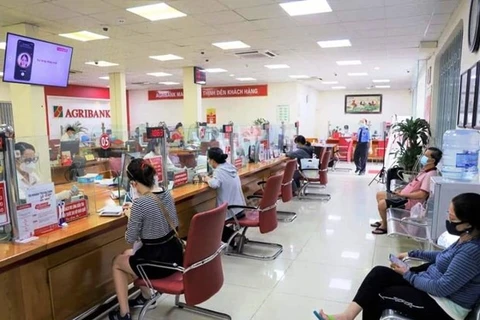
Illustrative image (Photo: VNA)
 Hanoi (VNA) - The COVID-19 pandemic has caused many difficulties for economic activities around the world, including banking activities. Vietnamese banks’ application of strict procedures on liquidity safety will increase their resilience to market shocks.
Increasing suitability of banking system
The State Bank of Vietnam (SBV) said that most credit institutions have to date complied with the capital requirements according to Basel II standards, with many banks having completed all three of the pillars of Basel II, while others are preparing to meet Basel III requirements. Some banks have even fulfilled all the requirements of Basel III.
Basel III is the third Basel Accord, a framework that sets international standards for bank capital adequacy, stress testing, and liquidity requirements. The focus of Basel III is to promote greater resilience, reducing the risk of shocks across the financial market system and averting future economic crises.
Market surveys show that many Vietnamese banks, after meeting Basel II requirements, have prepared for applying higher standards in Basel III, including Tien Phong Commercial Joint Stock Bank (TPBank), Vietnam International Commercial Joint Stock Bank (VIB), Maritime Commercial Joint Stock Bank (MSB), and Ho Chi Minh City Housing Development Commercial Joint Stock Bank (HDBank).
In early October 2021, TPBank was the first bank to announce the fulfilment of all the requirements of Basel III and international financial reporting standards 9 (IFRS 9), and the comprehensive implementation of these important international standards from the fourth quarter of this year.
“TPBank aims to become the leading private bank in Vietnam, not only in business activities but also in pioneering in compliance with international standards. The application of Basel III and IFRS, as well as other international standards, will strengthen the bank’s governance capacity and increase transparency, thereby enhancing TPBank's reputation and position in the international and domestic markets,” said Nguyen Hung, General Director of TPBank.
After applying Basel II standards, VIB has continued to put Basel III standards on trial in Vietnam. Meanwhile, MSB has applied Basel III in the management of liquidity, market and operation risks.
According to Nguyen Hoang Linh, General Director of MSB, the implementation of advanced Basel II standards and the preparation for Basel III application are the driving force as well as a solid foundation for the bank to ensure a balance between growth, sustainability, and quality in operation, thus preventing and minimising losses.
The Military Commercial Joint Stock Bank (MB) is a typical example of upgrading risk management in line with Basel standards. MB completed all three pillars of Basel II early, in compliance with Circular 41 and Circular 13 of the SBV. It has focused on building a scientific internal control and smart risk management system associated with models, tools and data for rapid growth and risk control.
“Basel II has helped us achieve the targets of credit growth of over 20 percent, bad debt ratio of less than 1 percent, bad debt coverage ratio of 300 percent, and capital adequacy ratio of about 11 percent,” MB General Director Luu Trung Thai said.
Thai added that MB has applied a capital allocation model based on risk-weighted assets (RWA), following Circular 41 to ensure efficiency in the context of limited credit room. In addition, this bank has also developed and applied credit scoring models for individual customers, small and medium enterprises, as well as credit rating models for businesses and financial institutions. All show high reliability, enhancing automation of the entire process of granting credits to customers.
“Currently, about 30 percent of loans of MB flagship products are automatically approved through the system, reducing the approval time by about 42 percent," said Thai.
Increasing banks’ resilience to shocks
An SBV representative said that the application of Basel III standards built on the foundation of Basel I and Basel II helps improve the capacity of the banking sector in dealing with financial and economic risks and enhances transparency in business activities.
Moving towards this standard is the goal of the Vietnamese banking system, to go in line with international practices as well as to ensure safe and smooth operations in the context of many unpredictable impacts. The banks themselves are well aware of this issue.
Han Ngoc Vu, VIB General Director, said that the bank has reaped many benefits from the early and full application of international standards.
According to Vu, the application of IFRS 9, or Basel II and III, helps the bank to set standards for the re-evaluation of the value of financial assets, making loans be assessed more thoroughly while improving operational efficiency and transparency in governance.
"For VIB, applying IFRS standards also help the bank increase benefits for shareholders when our equity is projected to increase by over 1 trillion VND (43.1 million USD) compared to accounting standards. International standards help banks in particular and the banking system in general develop more sustainably, bringing more practical values to shareholders," Vu added.
ABBANK also implemented the perfection of Basel II standards and is moving towards upgrading Basel III requirements in liquidity and market risk management frameworks according to international standards.
ABBANK General Director Le Hai emphasised that compliance with Basel II and III standards is an important factor in creating a solid risk management foundation, ensuring a healthy, safe and effective development of banks.
"At present, ABBANK is accelerating in fully meeting this standard, thereby improving its credit rating and enhancing its reputation and competitiveness in the international market," said Hai.
Leaders of some banks also believe that the early implementation and application of international standards will help banks take one step ahead in improving governance efficiency and competing with rivals.
In addition, banks can also quickly increase their access to international capital markets to attract competitive and sustainable capital sources, ensuring resources for their operations.
According to Dr Vo Tri Thanh, a member of the National Financial and Monetary Policy Advisory Council, this is an important step for banks towards increasing transparency and more comprehensive risk management.
“Over the past time, many banks have actively implemented strict processes on risk and liquidity management in their operations as per international standards. This is also one of the prerequisites for Vietnamese banks to list in international markets such as Singapore, the US, the UK or Hong Kong," Thanh said./.