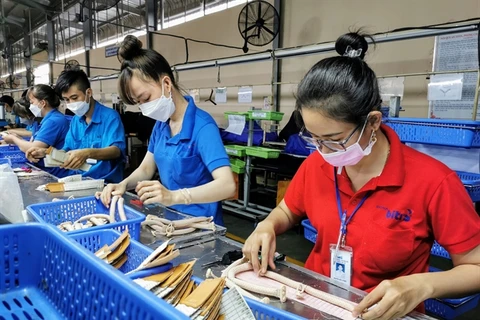
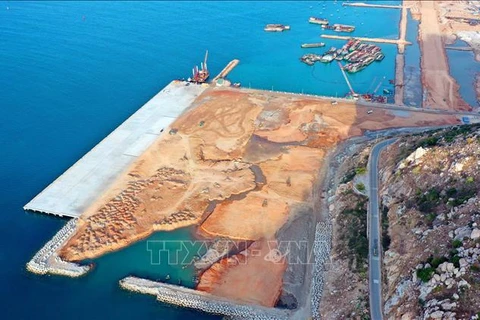
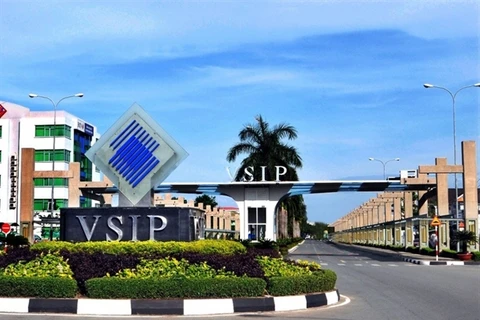
Illustrative image (Photo: VNA)
 Hanoi (VNA) – With the concerted implementation of policies on supporting socio-economic recovery and development under the Government’s Resolution No. 11/NQ-CP, the socio-economic situation in the first quarter is expected to be positive with fast recovery, creating momentum for economic growth this year, an official has said.
Recovery and growth trend
Do Thi Ngoc, Director of the Department for Integral Statistics and Statistical Information Dissemination at the General Statistics Office, told VietnamPlus that much improvement has been recorded in the socio-economic situation in the first two months of 2022. Most sectors and localities have been recovering and regaining growth thanks to safe and flexible adaptation to the COVID-19 pandemic.
Inflation is under control with the two-month consumer price index (CPI) up 1.68% and core inflation up 0.67% from a year earlier.
The February index of industrial production bounced back, rising by over 8% from the same period last year. The two-month index increased 5%, including the processing - manufacturing sector up 6%.
Total trade turnover rose 13% year on year to 108 billion USD in two months. While exports expanded 10% to 54 billion USD, imports (mainly materials for production) grew 16% to 55 billion USD.
The number of businesses newly established or resuming operations was approximately 43,000 during the period, up 46% year on year.
This is an encouraging sign for enterprise development, Ngoc said.
The Government’s solutions and policies have enhanced the business community’s trust in economic recovery and development capacity in the time ahead, she noted.
Foreign direct investment (FDI) has also continued rebounding, with the capital added to existing projects shooting up 124%. This means foreign investors are expanding production and business activities and maintaining their trust in Vietnam’s investment environment, she said.
Pressure from input expenses
Ngoc also pointed out that prices of animal feed, fertiliser and input materials are still high. In particular, fuel prices have continually escalated, putting pressure on production and business activities.
As a result, production and business activities haven’t been able to return to pre-pandemic levels. In some localities, the two-month index of industrial production grew at a slow space or even decreased from a year earlier. Ho Chi Minh City is up 2.1%, Long An up 1.1%, Bac Ninh up 0.1%, Tien Giang down 0.1%, Ba Ria - Vung Tau down 2.6%, and Ha Tinh down 11.5%.
Ngoc provided recommendations to help deal with difficulties and tap into chances to achieve the best possible socio-economic development results for the coming months. She said localities should focus on concertedly and effectively implementing the COVID-19 prevention programme so as to effectively control the pandemic.
Apart from promoting the domestic production of COVID-19 vaccines, the policies on drug import and manufacturing must be transparent to prevent speculation and negative phenomena.
To fuel industrial production recovery and development, Ngoc held that authorities should keep a close watch on the global fuel market to take measures for ensuring domestic supply and curbing price hikes. They need to guarantee the supply of essential goods since traditional supply sources may decline, she said.
The Ministry of Industry and Trade should carry out policies to expand the domestic market, diversifying export markets and improving the capitalisation of preferential tariffs under free trade agreements (FTAs).
The official underlined the necessity for quickly facilitating business access to capital to shore up their operations, adding that it is also important to reactivate tourism soon.
A stable business climate will encourage investors to boost production and business activities. Therefore, monetary tools should be closely coordinated with fiscal policies in order to control inflation. This will help stabilise the macro-economy and ensure balance in the economy, thus helping drive socio-economic recovery and development, Ngoc said./.