Chairman of the Vietnam Chamber of Commerce and Industry (VCCI) Vu Tien Loc speaks at the launching workshop of the “Report on Business Environment Improvement Programme: Assessment by businesses” on April 20. (Photo: VietnamPlus)
Hanoi (VNA) – Vietnam’s business environment has become safer and fairer for all economic sectors, with improved public administrative service delivery and declining informal fees, Chairman of the Vietnam Chamber of Commerce and Industry (VCCI) Vu Tien Loc told a workshop in Hanoi on April 20.
It will be more challenging to improve business climate over the next five years as the COVID-19 pandemic is slowing down efforts to enforce measures for business climate enhancement and to support enterprises, Loc said at the launching workshop of the “Report on Business Environment Improvement Programme: Assessment by businesses”.
The report was produced by the VCCI within the framework of “Enhancing businesses’ participation in monitoring and implementing economic restructuring” under the Australian programme for supporting Vietnam’s economic restructuring – Aus4Reform, funded by the Australian Department of Foreign Affairs and Trade (DFAT).
The report reflected and analysed measures applied by ministries, branches and local authorities to implement Resolution No.2/NQ-CP in 2019 and 2020 on improving the business environment and enhancing national competitiveness and Resolution No.35/NQ-CP on enterprise supporting and developing enterprises by 2020, and their impact on economic activities and the business environment in Vietnam. It attempted to sketch out an overall picture from the business community's perspective of the achievements and shortcomings that need to be solved in Vietnam’s business environment over the past year.
According to the report, Business Registration and Access to Electricity remained the two highest-scoring indices, with respectively 72.5 percent and 65.9 percent of the surveyed companies rating them as having good or very good progress. Business insolvency ranked the lowest, with only 44.4 percent of the respondents rating it as good or very good.
 A view of the workshop held in Hanoi on April 20. (Photo: VietnamPlus)
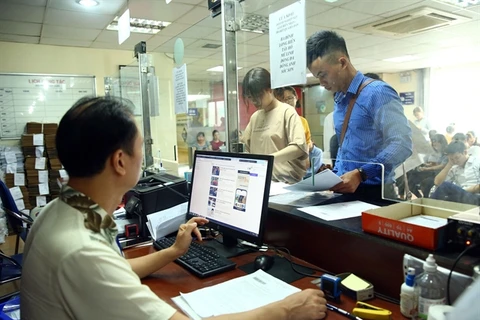
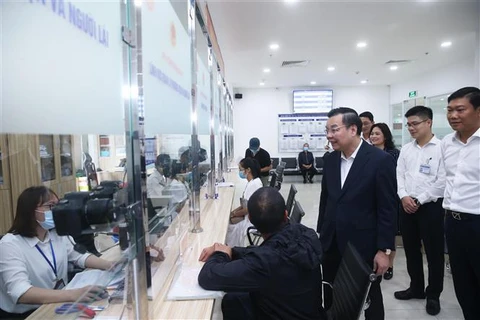
The median time for registering new enterprises and starting a business has constantly reduced since 2014 and this trend is expected to continue in the coming time thanks to the issuance of some legal documents designated to improve linkage between procedures in 2020. However, Vietnam’s IT infrastructure failed to meet the increasing demand for conducting public administrative procedures by electronic means last year.
Additionally, tax service delivery has seen significant progress but there was little improvement in transparency. Social insurance procedures have also experienced improvement for years on the back of increased use of information technology, however the trend slowed down last year.
In her remarks, Tran Thi Hong Minh, President of the Central Institute for Economic Management (CIEM) and Director of the Aus4Reform Programme, emphasised that improvement has been seen in two key areas – business conditions and specialised management and inspection. But there are still many obstacles for businesses, such as complex regulation system, overlapping and unnecessary business conditions which deeply interfered with corporate self-determination of businesses, she said.
Specialised inspection activities, however, still moved slowly; and the one-door customs mechanism had failed to prove effective as businesses still had to submit paper copies to authorities, she noted, adding that there was also a lack of connection between ministries, and the information technology system got clogged regularly.
The target of one million enterprises by 2020 has not been accomplished, with only about 81.2 percent of the goal, or over 811,500 businesses in operation as of the end of last year. Several provinces has witnessed a strong increase in the number of enterprises, namely Vinh Phuc, Bac Ninh, Hung Yen, Bac Giang, Binh Phuoc, Binh Duong and Dong Nai.
Many enterprises highly regarded Vietnam’s efforts to organise dialogues and solve problems for enterprises which have proved effective for years.
Andrew Barnes, Australian Deputy Head of Mission to Vietnam, said the report will provide a chance for policy makers to listen to the business community’s point of view.
“The business community has a critical role to play in informing government authorities of improvements to policy settings to reduce unnecessary regulation and support the business environment and economic growth,” Barnes noted./.