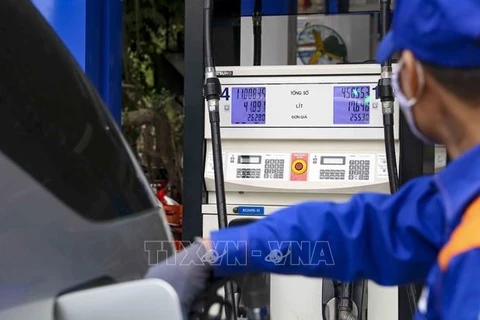
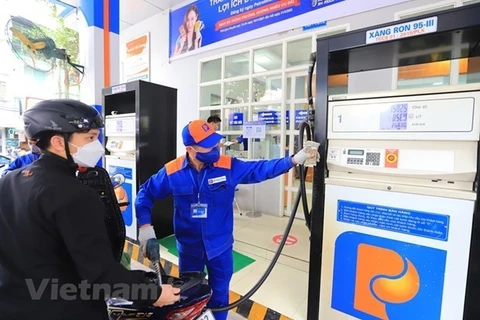
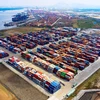
The lowered petrol prices since April 1 have not been enough. (Photo nhandan.vn)
 Retail petrol prices fell by more than 1,000 VND per litre following the latest adjustment by the Ministry of Industry and Trade and the Ministry of Finance. Accordingly, the retail price of RON95 bio-fuel dropped by 1,039 VND to a maximum of 28,153 VND (1.23 USD) per litre, while E5RON92 was adjusted down by 1,021 VND to no more than 27,309 VND per litre.
Meanwhile, diesel 0.05S went up from 1,447 VND per litre to 25,080 VND, and kerosene increased by 1,519 VND per litre.
According to the ministry, this was the second decline following seven consecutive hikes in petrol prices in 2022 that caused price increases of over 6,500 VND per litre.
“If the environmental protection tax stayed the same, the domestic gasoline price in this operating period would have increase,” a ministry representative said.
Vu Tuyet Hanh, a representative of Cuong Thang Transport Company, specialising in transporting goods on the North-South route, said: “Transport enterprises expect gasoline prices to drop more as the adjustment in petrol and oil prices does not help reduce the burden on enterprises. The transport business continues to face difficulties. Many vehicles have had to stop working.”
Nguyen Ngoc Thanh, director of Kim Phat Transport Company, said: “Fuel for container trucks usually accounts for about 40 percent of the cost of transportation. But from mid-2021, the oil price has increased by about 50 percent, and businesses cannot increase freight rates by that level.”
Other transport enterprises said if freight rates increased sharply, they would undoubtedly lose customers, but if they didn’t they would continue to lose money.
Nguyen Hong Dong, a driver on the Hanoi - Noi Bai route, said that “Currently, the price of gasoline is high, and my income is less. I will lose customers if I raise the price. Some of my colleagues have had to give up driving their cars and stay at home because their income is not enough to cover expenses.”
Bui Danh Lien, an expert at the Hanoi Transport Association, said the association’s businesses were worried gasoline prices were still too high.
“More cars are in the parking lot, and companies are forced to reduce routes and trips. If gasoline prices continue to stay high, transport enterprises will not be able to hold out,” he said.
“The impact from the COVID-19 pandemic has brought businesses to a standstill, with no revenue, while the cost of driving tests and petrol increased sharply recently, leaving them struggling to survive.”
Lien said many businesses would be forced to sell cars or even go bankrupt.
The aviation industry is also in a bind because of soaring fuel prices. Vietnam Airlines calculates that if the price of jet fuel remains at 130 USD per barrel for the whole of 2022, the airline’s cost could increase by 5.7 trillion VND. If a barrel goes up to 160 USD as forecast, costs will rise to 9.12 trillion VND, exacerbating the expected loss in 2022.
Experts said sea freight rates to the US and European routes, which increased again from the beginning of the year, were expected to go up again, causing Vietnamese import-export businesses to struggle.
Duong Ngoc Trung, deputy general director of SDS - MP Logistics, said the price of petrol had increased by 30 percent from last year, raising transportation charges another 5-10 percent.
Economists said petroleum products were currently subject to many taxes simultaneously. While petrol is not a luxury good, it still has to bear excise tax.
Economist Ngo Tri Long said it was advisable to reduce the special consumption tax on petrol again to ease inflationary pressure and avoid impacting people and businesses further.
Expert Dinh Trong Thinh said the special consumption tax should be levied on harmful goods and services and luxury goods, not on petrol, an essential commodity. Moreover, petrol was already subject to an environmental protection tax.
Director of the MoIT’s Domestic Market Department Tran Duy Dong said that if petrol prices continued to rise, it would consider reducing the special consumption tax.
“We still need to calculate longer and have more scenarios,” Dong said. “The ministry will propose a scenario to continue to reduce taxes on petrol, such as the environmental tax, special consumption, VAT and diversification of supply./.
VNA