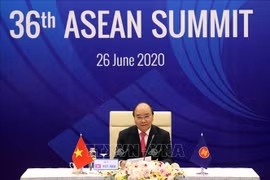
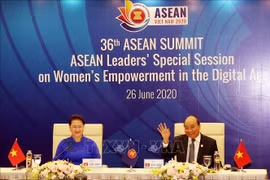
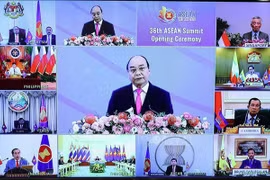
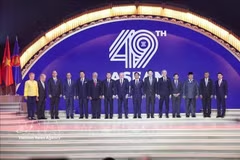
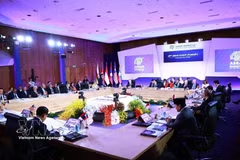
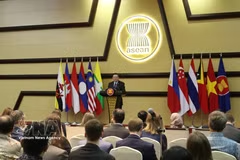
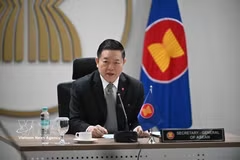
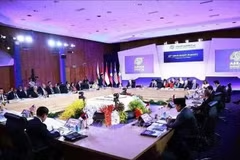
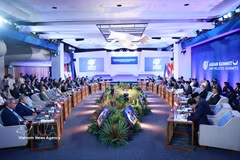
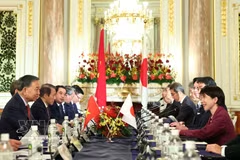
An overview of the ASEAN Leaders’ Special Session at the 36th ASEAN Summit on Women’s Empowerment in the Digital Age on June 26 (Photo: VNA)
Hanoi (VNA) - The ASEAN Leaders’ Special Session atthe 36th ASEAN Summit on Women’s Empowerment in the Digital Age, heldon June 26 via videoconferencing, has adopted a Chairman’s Press Statement.
The following is the full text of the statement:
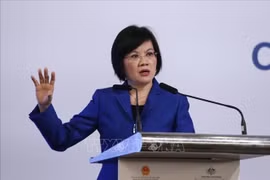
The ASEAN Leaders’ Special Session at the 36th ASEAN Summit on Women’s Empowerment in the Digital Age was held on 26 June 2020 via videoconferencing. The Special Session was chaired by H.E. Nguyen Xuan Phuc, Prime Minister of Viet Nam, in his capacity as the Chairman of ASEAN and was attended by Leaders of ASEAN Member States. H.E. Mme. Nguyen Thi Kim Ngan, Chairwoman of the National Assembly of Viet Nam; the Right Honourable Jacinda Arden, Prime Minister of New Zealand, Dr. Armida Salsiah Alisjahbana, Executive Secretary of the United Nations Economic and Social Commission for Asia and the Pacific (ESCAP), and H.E Dato’ Lim Jock Hoi, Secretary-General of ASEAN were keynote speakers at the Special Session.
The ASEAN Leaders reiterated ASEAN’s steadfast commitment and staunch efforts to promoting gender equality and empowerment of all women, towards realizing an inclusive, people-oriented, people-centred ASEAN Community, as reflected in the ASEAN Charter, the ASEAN Community Vision 2025 and the ASEAN Socio-Cultural Community Blueprint 2025.
The Leaders welcomed valuable opinions shared by the keynote speakers on the importance of and the way forward to facilitate women’s active participation and contribution to ASEAN Community building efforts, as well as enhancing the crucial role of women in peace, stability and sustainable development in the digital age.
The Leaders emphasized ASEAN’s continued commitment to implement the Beijing Declaration and Platform for Action and the United Nations Security Council Resolution 1325 on Women, Peace and Security. The Leaders took this opportunity to join the world in commemorating the 25th and 20th anniversary of the adoption of these milestone documents on gender equality and women’s empowerment.
The Leaders recalled the Joint Statement on Promoting Women Peace and Security in ASEAN and the ASEAN Declaration on the Gender-Responsive Implementation of the ASEAN Community Vision 2025 and Sustainable Development Goals adopted at the 31st ASEAN Summit in 2017 and further reaffirmed their support for the women peace and security agenda to be prioritized in ASEAN’s cooperation policies and programmes, as well as encouraged the enhanced roles of women in peace processes such as conflict prevention and resolution, post-conflict reconstruction and rehabilitation.
The Leaders committed to providing support to cooperation initiatives on women empowerment, gender equality, promotion and protection of the rights of women and girls through, among others, the active works of the ASEAN Ministerial Meeting on Women (AMMW), the ASEAN Commission on the Promotion and Protection of the Rights of Women and Children (ACWC), ASEAN Committee on Women (ACW), the ASEAN Women Entrepreneurs Network (AWEN), and ASEAN Women for Peace Registry (AWPR).
The Leaders reaffirmed their need to leverage ASEAN-led mechanisms and cooperation with development partners to support the implementation of regional commitments in advancing the women, peace and security agenda; to continue addressing issues that hinder greater women empowerment such as poverty, discrimination, gender inequality, social injustice, armed conflicts, economic, and social exclusion of persons and communities vulnerable to and at risk of radicalisation, violent extremism, and terrorism; and to contribute to achieving economic progress, and enabling social development and longstanding peace and prosperity in the region.
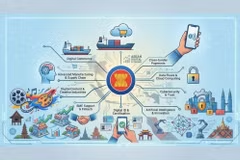
The Leaders underscored the importance of enhancing welfare and development of all women and children in ASEAN, improving their access to opportunities and responding to emerging challenges as a result of the rapid development of science and technology, in particular, the 4th Industrial Revolution and the digital transformation.
The Leaders further dedicated to promote human resource development and capacity building to further strengthen opportunities for women in frontier technologies and innovation, especially in relation to smart factories, digital value chains, digital inclusion and digital literacy, including by creating greater opportunity for women’s access to digital education, skills and tools, women’s financial inclusion and up-skilling and re-skilling of the women workforce, promoting STEM education for women and girls, and enabling environment for women micro, small, medium enterprises (MSMEs). The Leaders committed to enabling conducive conditions for inclusive and sustained economic growth, decent work for all, taking into account different levels of national development and capacities.
The Leaders agreed that, during the challenging time of COVID-19, addressing gender inequality and upholding women’s rights as well as preventing and combating violence against women and domestic violence are essential to responding effectively to the pandemic’s multi-sectoral impacts, to recovering faster and building a better future. In this regard, they urged governments and all relevant stakeholders to consciously mainstream the need of womens and girls’ concerns in their efforts and place women’s leadership and contributions at the heart of the COVID-19 response, resilience, and post-pandemic recovery efforts.
The Leaders agreed to enhance regional platforms in order to promote equitable opportunities, participation and effective engagement of women in the development and implementation of ASEAN policies and programmes;
The Leaders also agreed to strengthen existing mechanisms and technical capacity of ASEAN Member States’ relevant agencies to promote gender equality, women’s empowerment, gender mainstreaming and child-centred approach in planning, programming, implementation, monitoring and evaluation processes at all levels in the region.
The Leaders underlined that ensuring achieving gender equality and the empowerment of all women and girls will significantly contribute to the effective realisation of the Sustainable Development Goals (SDG), where no one will be left behind. In this connection, they reaffirmed their commitment to the ASEAN Declaration on the Gener Responsive Implementation of the ASEAN Community Vision 2025 and Sustainable Development Goals for realizing full potential and sustainable development, to ensure women and girls enjoy equal access to quality education and health care, economic resources and political participation as well as equal opportunities with men and boys for employment, leadership and decision-making at all levels.
The Leaders stated their strong dedication to gender mainstreaming and women’s empowerment in the post-2025 vision of the ASEAN Community and its associated Blueprints in all pillars.
The Leaders expressed their appreciation the specialguests and keynote speakers for their valued contribution to the SpecialSession, and stated ASEAN’s commitment and readiness to further strengthencollaboration with the United Nations, ASEAN’s external partners, regional andinternational organisations in advancing the roles of women and girls andempowering them to fully and effectively respond to opportunities andchallenges of the digital age./.
VNA