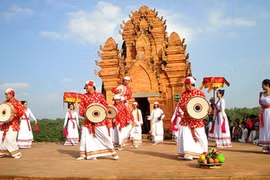
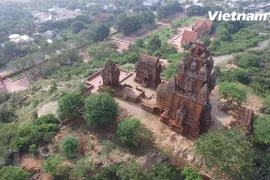
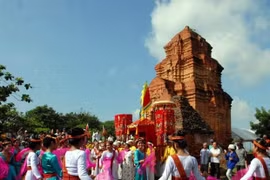
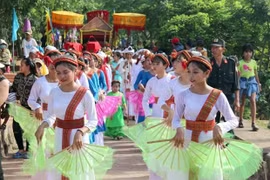
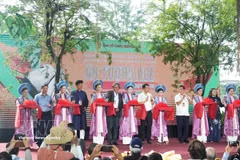
Cham women dance to celebrate the Kate Festival 2019 at Po Klong Giarai Tower in Phan Rang city, Ninh Thuan province. (Photo: VNA)
Hanoi (VNA) – Kate, the largest and most important traditional festival of Cham ethnic minority people in Vietnam, is celebrated on the first day of the seventh lunar month to revere Gods, heroes, ancestors, and kings.
Cham people in the central province of Ninh Thuan, the biggest Cham population in the country, celebrate the festival at three towers named after kings and queens – Po Rome and Po Inu Nugar in Ninh Phuoc district and Po Klong Giarai in Phan Rang city, which is also the most popular venue.
On the last 10 days of the sixth lunar month, the Cham make offerings to their ancestors to ask for their help in organising Kate and thank them beforehand. They wear traditional clothes to join in rituals and cultural activities, folk dances, musical performances with traditional instruments, and folk games.
In the first festive day, hundreds of people gather early in the morning at the Y trang Ngai shrine (Costume of the Genie) in Phuoc Dong hamlet, Phuoc Hau district, for a ceremony to bring the King Po Klong Giarai’s costumes to the eponymous tower.
At 5am, Kamunay, the old man who takes care of the shrine, offers liquor, eggs, fruits, betel, and areca to seek the deity’s permission to take the costumes to Po Klong Giarai Tower.
When he finishes his task, seven Cham girls in ‘ao dai Cham’ (the traditional long dress with a red belt) perform the traditional Patri dance accompanied by Gi Nang and Branung drums and Saranai trumpets. The Raglai dance with their ‘cong’ and ‘chieng’ (Gong).
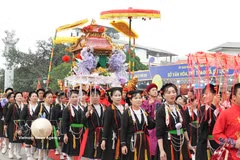
A palanquin comes in a procession to Po Klong Giarai Tower, which is around 4km away. The procession is packed with revellers and accompanied by the ubiquitous Raglai music. As it passes, residents in Cham villages join in.
Before the procession arrives at the tower, thousands of Cham in colourful traditional costumes flock to the Po Klong Giarai Tower to celebrate Kate. Women wearing festive clothes balance trays or baskets of gifts on their heads.
"Po Klong Giarai was the king who brought peace to his people. He reigned in the 12th-13th centuries and made great contributions to the development of agriculture," Dan Dieu, a priest, said.
According to legend, a Cham couple once saw a small bag drifting along a river and fished it out. Inside the bag was a baby girl whom they took home to bring up.
When the child grew up into a young woman, one day she went to the forest with her parents to cut wood. Feeling thirsty, she drank water from a brook and became pregnant.
In due course, she delivered a baby boy named Po Ong. He was said to be the son of Po Sah Ino who had leprosy as a child and was cured by the Snake God before becoming deified.
People made Po Ong king but some refused to accept this saying he was a mere cowherd and betel seller. Po Ong relinquished the throne and became a monk. Soon, there was an invasion by the Khmer and people beseeched him to take over the throne again. Po Klong Giarai thus means "the king who returned."
"He built the Chaklin (Nha Trinh) reservoir and two channels (Male and Female) to irrigate the main fields in northern Phan Rang, which are in use to this day," Dien said.
Because of the tower’s association with the greatness of the king, the Kate Festival was held here for people to express their respect for him. It lasted three days.
A ceremony to receive the costumes began as soon as the procession arrived at the tower.
Afterwards, the Cham girls and the Raglai danced in front of the tower.
The priests offer wine, betel and areca, and bath water mixed with aloe and seek Lord Siva’s permission to open the tower. One of them then takes a jar of holy water to splash on the Siva idol in the arch above the tower door.
When the priests finish the ritual offering, the sunlight reaches the tower door.
At 2pm, the tower door is closed and people go back to celebrate Kate at home.
In 2017, the Kate Festival was recognised as an intangible cultural heritage by the Ministry of Culture, Sports and Tourism. It is one of the 15 biggest festivals in the country, attracting thousands of domestic and international visitors every year.
Ninh Thuan is preparing an application for the festival to be recognised as UNESCO’s intangible cultural heritage of humanity./.