Collector launches new book on Kim Hoang folk painting

Collector and Director of Hanoi Ceramic Museum, Nguyen Thi Thu Hoa, has launched a new version of her book on Kim Hoang folk painting. While the first edition was published in 2019 and focused on the history, technique and aesthetics of Kim Hoang folk paintings, the latest edition has been updated on the development of painting in modern life.
Collector launches new book on Kim Hoang folk painting ảnh 1Kim Hoang folk painting (Photo: VietnamPlus)

Hanoi (VNA) - Collector and Director of Hanoi Ceramic Museum, Nguyen Thi Thu Hoa, has launched a new version of her book on Kim Hoang folk painting. While the first edition was published in 2019 and focused on the history, technique and aesthetics of Kim Hoang folk paintings, the latest edition has been updated on the development of painting in modern life.

The book project began in 2015 with the participation of many artists, researchers, and collectors of Vietnamese folk paintings as well as artists and photographers.

Released by the The Gioi (World) Publishing House, the 300-page book is arranged in four chapters, introducing readers to the history and materials used in the making of Kim Hoang folk painting as well as the efforts to revive the genre of painting.

According to Dr. Tran Hau Yen The, a lecturer at the Hanoi Fine Arts University, the book "Kim Hoang Folk Paintings" proves an attempt to affirm the position of this painting school in the general flow of Vietnamese folk paintings.

“Regarding Tet (Lunar new year) traditional paintings, people often think of the folk paintings of Dong Ho and Hang Trong. Few people know that Kim Hoang is also a famous line of paintings that used to be displayed during the Lunar New Year celebration. Through many ups and downs over time, Kim Hoang paintings are in danger of falling into oblivion if there is no timely restoration and promotion of this heritage,” The said.

Kim Hoang painting developed in the second half of the 18th century, originating from Kim Hoang Village, Van Canh Commune, Hoai Duc District, Hanoi.

It has themes that are familiar to rural people's lives and have diversified genres such as Tet painting, worship painting and decoration painting. Normally, the paintings are used to hang on the wall to chase away evil spirits and keep the house safe.

The folk paintings became very popular in the early 19th century but interest began to fade after Kim Hoang village suffered a severe flood in 1915. The flood swept away wood blocks of the paintings, which was the beginning of the end of the folk art. By 1945, no one in Kim Hoang village made paintings.

Kim Hoang paintings and their printing wood blocks were then seen only at Vietnam Arts Museum and some collections of local and foreign painting collectors.

According to Hoa, Kim Hoang paintings were in danger of being lost without timely intervention, including restoration and promotion of the value of the paintings. 

“Since 2015, we have been refurbishing the paintings under the project title, Restoring Kim Hoang Folk Paintings. This book came from the project to affirm its position in the annuals of Vietnamese folk paintings. The project has been made with participation of artisans, researchers, collectors, painters and photographers.”

The story of Kim Hoang folk paintings is not only about its history and its printing technique but also about the restoration, she said. The book is a comprehensive look at the origin of Kim Hoang paintings, the traditional way of producing the paintings and the challenges in preserving and developing this traditional form in modern life.

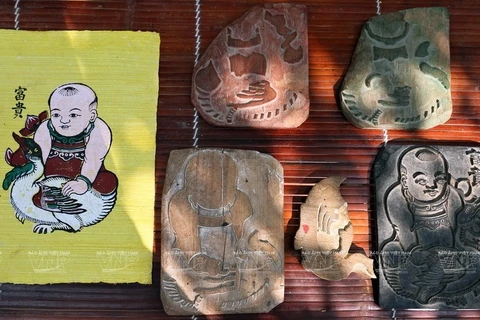
Kim Hoang paintings bear similarities with Dong Ho paintings from Bac Ninh and Hang Trong paintings from Hanoi, the materials used in these paintings are different. Dong Ho paintings are printed on diep paper and Hang Trong paintings use do paper, while Kim Hoang are made on red or pink paper, and it is also called red painting.

Collector launches new book on Kim Hoang folk painting ảnh 2The book details ways to print Kim Hoang paintings. (Photo: VietnamPlus)

Thanks to preservation efforts, Kim Hoang paintings have returned after a 75-year absence.

Hoa said she hoped this book and project would inspire people to keep up the research and develop Kim Hoang paintings. The most important thing is to arouse villagers' pride and sense of ownership over the paintings.

“We want to build a small museum in Kim Hoang Village to preserve and develop Kim Hoang paintings. We want this type of folk painting to develop independently like others.”, she said./.
VNA

See more

The poster of the Vietnam Circus Federation's special performance dedicated to soldiers who devoted and sacrificed their lives in safeguarding the nation's borders. (Photo: Vietnam Circus Federation)

Wide range of artistic programmes to commemorate war invalids and martyrs day

Alongside tribute activities nationwide to mark the 79th anniversary of War Invalids and Martyrs Day (July 27, 1947–2026), arts organisations and local authorities are staging special performances honouring fallen heroes, war invalids, sick veterans and people who rendered meritorious service to the revolution, while promoting the tradition of gratitude, patriotism and national pride.

At the opening of the first-ever Cultures of the World Festival in Hanoi. (Photo: VNA)

Vietnam charts course for regional culture, creativity hub status by 2045

The blueprint seeks to deepen international cultural integration, export Vietnamese values and absorb the essence of world cultures. The end goal is an advanced culture steeped in national identity, deployed as a soft power to fuel rapid, sustainable growth, lift Vietnam’s global standing, and add a distinct thread to the tapestry of human civilisation.

Deputy Minister of Foreign Affairs Ngo Le Van, Chairman of the Vietnam National Commission for UNESCO, speaks at plenary session of the 48th session of the UNESCO World Heritage Committee in Busan on July 20, 2026. (Photo: VNA)

Vietnam proposes priorities to strengthen international cooperation on world heritage conservation

On behalf of Vietnam, the deputy minister proposed three priorities of strengthening international cooperation and capacity-building for member states, particularly developing countries; promoting science-based conservation that strikes a balance between preservation and development while placing local communities at the centre; and enhancing coordination among relevant conventions and programmes, alongside the responsible application of digital technologies and artificial intelligence in heritage conservation.

Claudia Roth, a member of the German Bundestag, visits the Vietnamese booth at the festival. (Photo: VNA)

Vietnam attends multicultural festival in Germany as guest of honour

The Vietnamese booth attracted a large number of visitors with traditional dishes such as "nem cuon" (fresh spring rolls) and "bun cha" (grilled pork with vermicelli), along with displays of ao dai (traditional long dress), conical hats and cultural performances imbued with Vietnamese identity. These activities helped spread Vietnamese culture and foster understanding and closer ties between the Vietnamese community, German residents and international friends.

Representatives of countries and territories participating in the Asian Pencak Silat Championship. Photo: VNA)

10th Asian Pencak Silat Championship opens in Dong Nai

Speaking at the opening ceremony, Director of the municipal Department of Culture, Sports and Tourism Le Thi Ngoc Loan said the championship offers athletes an opportunity to compete in a spirit of fairness and sportsmanship while promoting exchanges, mutual understanding and friendship among participating countries.

A special art performance at the Khanh Hoa Sea Festival 2026 (Photo: VNA)

Khanh Hoa Sea Festival 2026 opens, promoting sustainable marine development

Having been held 10 times, the Khanh Hoa Sea Festival has evolved beyond a local celebration into an event of national significance in culture, economy and external relations. This year's edition continues to honour Vietnam's maritime cultural heritage while promoting tourism, the marine economy and international integration.

The golf course at NovaWorld Phan Thiet will host international tournaments during Sports Festival 2026. (Photo: VNA)

Around 7,000 athletes to compete at Sports Festival 2026

This year's festival will feature 12 sports, introducing several new events such as national youth triathlon and beach tennis championship, while expanding its international scope by bringing together clubs, athletes, and police forces from ASEAN countries for events such as the ASEAN Police Open Golf Tournament 2026.

A performance of Cheo Tau folk singing, a distinctive cultural tradition of O Dien commune in Hanoi. (Photo: VNA)

Beyond preservation: Unlocking the value of Vietnam's heritage

Dr. Nguyen Thu Hanh, Director of the Centre for Research and Development of Vietnam Cultural Industry (SDCI), said Vietnam has traditionally focused on preserving heritage rather than creating new value from it. The key obstacle, she noted, is the weak connection between heritage and science, technology, education, design, communications and the marketplace, limiting its economic, educational and social impact despite the country's abundant cultural resources.

Vietnamese Ambassador to Laos Nguyen Minh Tam speaks at the event. (Photo: VNA)

Film screening in Vientiane highlights Vietnam-Laos strategic cohesion

A screening of the special Vietnamese feature film Mua Do (Red Rain) was held in Vientiane on July 16 to mark the 49th anniversary of the signing of the Vietnam-Laos Treaty of Amity and Cooperation (July 18, 1977–2026), reaffirming the two countries' strategic cohesion through cultural exchange.

Artists from the Vietnam National Puppetry Theatre deliver emotionally compelling performances that recreate the rich historical legacy of Thang Long–Hanoi. (Photo: VNA)

Top leader's directives chart new course for culture-led development: experts

Artists and cultural experts shared the view that the top leader's guidance at the second meeting of the Central Steering Committee for the Development of Vietnamese Culture not only reviewed the initial implementation of the Politburo's Resolution No. 80-NQ/TW but also identified four major gaps requiring urgent action and three strategic shifts to unlock the full potential of culture.