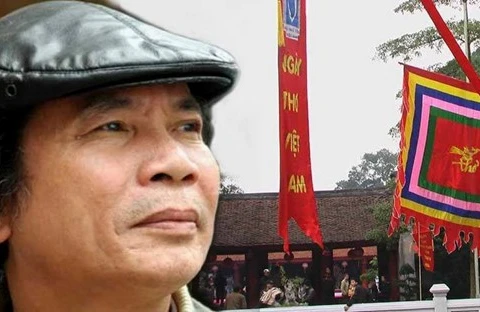
Composer Phan Huynh Dieu (Source: provided by the musician's family)
Hanoi (VNA) - Writing about war, loss or sadness, Phan Huynh Dieu's music depicts optimistism, while and his love songs are always sweet and children's songs are cheerful and clear.
Composer Phan Huynh Dieu was one of the most renowned musicians of Vietnam’s revolutionary music. In over 75 years of his music activities, he wrote more than 100 works, depicting his love of life and the country. One of his famous songs is Doan ve quoc quan (Vietnamese National Army) composed in 1945 after the August Revolution.
In 2000, he was awarded the Ho Chi Minh Prize for Literature and Art for his contributions to the country's music. He became a member of the Vietnam Composers' Association in 1957, and also a member of the Ho Chi Minh City Music Association.
Love music naturally as breath
Composer Phan Huynh Dieu was born on November 11, 1924 in Da Nang to a family of 11 sibblings.
During his childhood, he grew up with smooth folk songs of the Quang Nam-Da Nang region. It was not difficult to understand why his love and attachment to music was so natural.
Phan Huynh Dieu officially began his music activities in Tan nhac (New music) group when he was 16. He wroted his first song - Trau Cau (Betel and areca) after he watched “Tuc luy” drama in Da Nang. Since then, he passionately composed and produced hundreds of musical works with many different topics.
Phan Huynh Dieu was one of musicians writting works linked with the country’s history. He was famous for revolutionary songs.
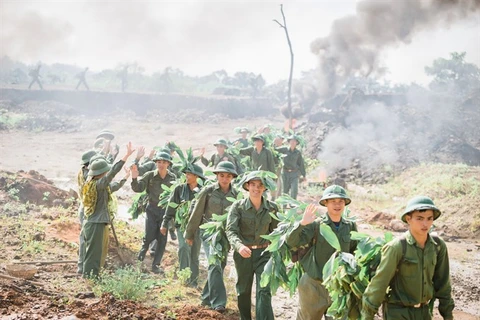
Experiencing the two resistance wars against French and the American troops, being a soldier, and witnessing the patriotism and sacrifice of soldiers, Phan Huynh Dieu wrote songs that have left an impression on many generations of music lovers.
The special thing in Phan Huynh Dieu's revolutionary music was that writting about war, loss or sadness, his works depicts a sense of optimistism.
In addition to revolutionary songs, Phan Huynh Dieu was known as the author of sweet, deep love songs. He said love is his great inspiration, and love is to live and work enthusiastically. Therefore, the music of Phan Huynh Dieu was always full of love.
He was also known for many children’s songs such as ‘Doi ken ti hon’ (Tiny trumpet team) and ‘Nho on Bac’ (Be grateful to Uncle Ho).
His compositions, whose melodies and lyrics embrace Vietnamese folk music, covered many themes: love, comradeship, and love for the homeland. His songs also embraced folk tunes, making them everlasting.
The master of setting music to poems
Musician Phan Huynh Dieu was considered a king of setting music to poems, many of which have been applauded by the public. These include Bong cay Konia (The Shade of Konia tree) by Ngoc Anh, Cuoc doi van dep sao (How beautiful life is) by Duong Huong Ly, Hanh khuc ngay va dem (Day and night marching song) by Bui Cong Minh, and Thuyen va bien (Boat and sea) and Song (Wave) by Xuan Quynh. The imprint in the works is the smooth combination between melody and poetry words.
Phan Huynh Dieu said music and poetry are twin sisters and because of that more than half of his works were poems set to music.
Not only a talented composer, Phan Huynh Dieu was also a senior who has been admired and respected by young Vietnamese artists.
Phan Huynh Dieu passed away on June 29, 2015. Until the last days of his life, Phan Huynh Dieu still devoted to the Vietnamese music as a funny judge at the "Singing forever green" contest. Despite the oldest judge in Vietnam, he still kept the cute and witty features on the "hot seat" with the "life" statements as he gave the title of "green leaf" to a female contestant who turned 40 when she performed the song Chiec la cuoi cung (The last leaf)./.