Con Son-Kiep Bac Spring Festival opens

The Con Son-Kiep Bac 2016 Spring Festival commenced in the northern province of Hai Duong on February 23, or the 16th day of the first lunar month.
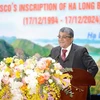
Con Son-Kiep Bac Spring Festival opens ảnh 1Vice President Nguyen Thi Doan offers incense at the festival (Photo: nhandan.com.vn)

Hai Duong (VNA) – The Con Son-Kiep Bac 2016 Spring Festival commenced in the northern province of Hai Duong on February 23, or the 16th day of the first lunar month.

The annual festival commemorates the death anniversary of monk Huyen Quang, who died in 1334 and was the founder of the Truc Lam Zen sect.

Also on the occasion, Vice President Nguyen Thi Doan handed over the Prime Minister’s Decision to recognise Thanh Hu Dong stele (a commemorative standing stone) at Con Son Pagoda as a national treasure.

The Thanh Hu Dong stele dates back to Long Khanh era (1372 – 1377) under the reign of King Tran Due Tong. When Tran Nguyen Dan, a high-ranking mandarin of the Tran dynasty, converted Thanh Hu cave in Con Son Mountain to live in after his retirement, King Tran Due Tong wrote three words: Thanh Hu Dong (Thanh Hu Cave) on a stele erected at the cave’s entrance. The King’s father Nghe Tong also composed a poem which was inscribed on the back of the stele.

Prior to the opening ceremony of the festival, there was a ceremonial water-carrying parade staged by hundreds of people from Con Son Pagoda to Con Son Lake, where monks and nuns offered incense and released birds.

The festival, to run until March 1, will also feature a string of cultural and sporting activities such as incense offerings, worshipping rituals at Ngu Nhac Mountain, a mud banger festival (an ancient game involving tossing a large, shaped peice of clay, approx. 30kg and trying to make the loudest bag from it smashing apart) and a wrestling contest.

Covering a total area of eight hectares in Chi Linh district, the Con Son-Kiep Bac historical site is entwined with the life and cause of general Tran Hung Dao, the Supreme Commander of Vietnam during the Tran Dynasty, and it was where UNESCO’s Great Man of Culture of the World, Nguyen Trai (1380-1442), one of Vietnam’s most famous poets and writers, lived.

The site was a defence line built at the end of the 14 th century to protect the Thang Long Imperial Citadel. It witnessed important battles between the Tran Dynasty army and the Yuan-Mongol invaders in the 14 th and 15 th centuries.

Con Son-Kiep Bac was recognised as a national heritage site in 1962 and a special national heritage site in 2012. The next year, the Ministry of Culture, Sports and Tourism named the Spring Festival a national intangible cultural heritage.-VNA

VNA

See more

Flavours of three regional Tet feasts in contemporary life. (Photo: VNA)

Flavours of three regional Tet feasts in contemporary life

Each dish embodies not only taste but also memories and cultural values nurtured over generations. Sustaining this heritage ensures that Vietnamese cuisine is not eroded by time, but continues to be cherished, renewed and shared with care and respect.

As Lunar New Year approaches, videos guiding viewers on how to prepare a traditional Tet feast attract increasing numbers of likes and comments. (Photo: tienphong.vn)

Gen Z reconnects with their roots, spreads rural Tet spirit

In recent years, Vietnamese social media has witnessed the rise of a content stream that feels old-fashioned yet resonates strongly with young audiences in the digital age: documenting rural life, especially kitchen scenes, Tet preparations, and everyday family routines.

Phan Thi Hong Lien wins the last gold for of Vietnam to help the team place No 1 in the sixth World Kun Khmer Championships' tally. (Photo: VNA)

Vietnam tops medal table at World Kun Khmer Championships

The Vietnamese team claimed 18 gold medals on their debut at the sixth World Kun Khmer Championships in Cambodia, edging hosts Cambodia to finish first overall and strengthening their push for Olympic recognition of the sport.

An exhibition on "do" paper and recycled materials at Dien Hong flower garden. (Photo: nhandan.vn)

Art reawakens Hanoi's public spaces

Last year, Hanoi saw a surge in both quantity and quality of public art endeavours, a leap forward in the art of breathing new life into urban landscapes

The horse image symbolises resilience, endurance, and spirit of “success upon arrival.” (Photo: VNA)

Horse mascot leaves strong impression at spring fair

A major attraction is a unique “Eight galloping horses” (Bat Ma) sculpture displayed at the To Trinh gemstone booth. Carved from a rare monolithic jade block, the artwork features eight spirited horses racing across golden rice fields. The harmonious blend of pure jade veins and natural golden tones enhances both its aesthetic depth and symbolic meaning, evoking prosperity and abundance associated with Vietnam’s rice civilisation.

Delegates cut the ribbon to launch the 46th Spring Flower Festival at Tao Dan Park. (Photo: VNA)

Festive activities herald Lunar New Year of the Horse

A vibrant array of cultural and media events has been launched across Vietnam to welcome the Lunar New Year of the Horse 2026, highlighting both the country’s enduring traditions and its dynamic socio-economic progress.

A calligraphy booth at the festival (Photo: VNA)

Spring Calligraphy Festival 2026 opens in Hanoi

A central attraction remains the traditional New Year calligraphy request activity, featuring 35 booths staffed by calligraphers selected through a rigorous, transparent evaluation process.