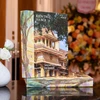
The French School of the Far East (EFEO) in Hanoi. Now the building belongs to the Vietnam National Museum of History. (Photo: vnu.edu.vn)
Hanoi (VNA) – The Institute of Social Sciences Information (ISSI) under the Vietnam Academy of Social Sciences (VASS) on November 25 held an international scientific conference to seek ways to unlock potential of the photo archives of the French School of the Far East (EFEO) at ISSI.
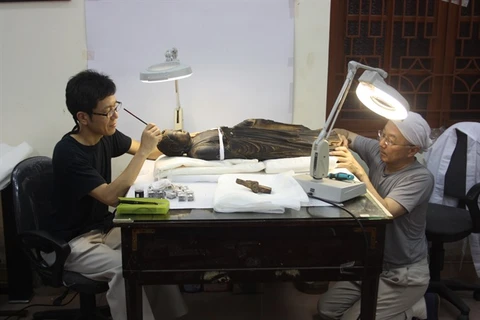
ISSI Deputy Director Assoc. Prof., Dr. Le Hai Dang said the big collection of EFEO photos archived at ISSI has become a valuable heritage for researchers in studying national culture and provided evidence for the restoration of cultural and historic relics damaged by wars or natural disasters.
The social science library operated by ISSI has been preserving a large number of original photos and documents handed over by the EFEO since 1957. They include a collection of 60,000 photographs, one of the rarest and most valuable photo archives in Orientalism in Southeast Asia. However, the archives have not been used to the fullest extent.
Speaking at the event, Isabelle Poujol from the EFEO in Paris shared how technology has been used to preserve and keep records of more than 200,000 old photographs stored for decades at the EFEO headquarters.
These photos are of great interest to the scientific community; in some cases, they are even the only historic evidence, she said. The EFEO in Paris has been digitalizing them in order to not only archive them better but also offer researchers easier access to such a big collection, according to Poujol.
Dr. Nguyen Huu Tam, a former staff from the VASS’s Institute of History, said to protect and promote the values of the photo archives at ISSI , first and foremost, librarians must be provided with comprehensive knowledge on archiving photos and main content of the archived photos.
During the event, attendees discussed social science and humanities issues through the EFEO photo archives and how to preserve and make use of the photo collection.
The French School was established in Vietnam in 1900 in Sai Gon (HCM City today). It was closed in 1959 and re-opened in Hanoi in 1993. It mainly focuses on history, archaeology and philology, as well as the study of modern Asian societies./.